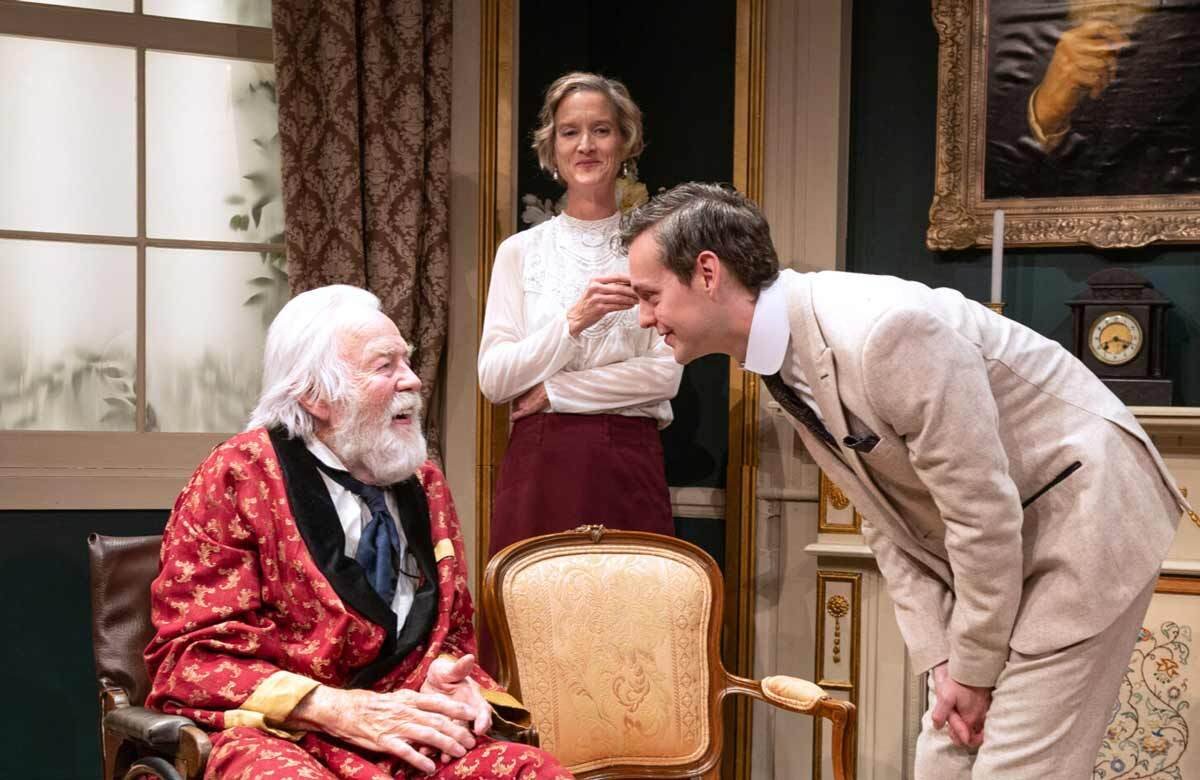
Despite it being written by A. A. Milne, the famous scribe who created Winnie the Pooh, you’ll probably never have heard of The Truth About Blayds. Yet it’s running in London, headed by William Gaunt, who Doctor Who fans will know from Revelation of the Daleks. It’s something really quite special, though, as is the theatre it’s running at: Finsborough Theatre specialises in plays that haven’t been performed in London for at least 25 years, and is situated above a restaurant in Earl’s Court (yes, just up from the Police Box installation typically known as the TARDIS). Blayds is even more extraordinary: it’s not been performed in London for more than 100 years; since, in fact, its first run in December 1921. It toured Australia in 1924 and appeared on Broadway in 1934, and was then adapted for TV in 1948. And that’s it. Quite remarkable given the esteem its author is held in.
Finsborough Theatre has seen some rocky times, the café being shut for a little while for refurbishment, but The Truth About Blayds is a wonderful harkening back, notably as Gaunt previously played there over 20 years ago in Gates of Gold and its subsequent transfer to Trafalgar Studios.
You’d think that, if a play hadn’t been seen in the West End for more than two decades, there’d be a good reason, i.e. it’s a bit naff. But, described by TimeOut as a “fringe theatre”, Finsborough Theatre has a great track record, and The Truth About Blayds continues that blazing trail. Because it’s fantastic.
It seems to be a play about the consequences of having Oliver Blayds (Gaunt), a famed poet in the family, with the first two characters we meet being Blayds’ grandson, Oliver Blayds-Conway (George Rowlands), and sympathetic critic, A. L. Royce (Rupert Wickham) looking to meet the great man. The former is ostensibly derisive, as is his sister, Septima (Lucy Jamieson). They all live in Blayds’ shadow, though that shadow has afforded them, of course, a fantastic standard of living — wealth, if not always happiness. The unhappiest of parties, as it turns out, is Isobel (Catherine Cusack), Oliver Blayds’ daughter who has been graciously caring for her father for some 18 years. She seems happy enough initially, but as a terrible secret is revealed in Act Two, her having given up a significant part of her life for him becomes a sore point, and rightly so. We join this family as Blayds celebrates his 90th birthday, the night he’ll impart a terrible secret to Isobel. This has the potential of shattering all their lives — if they let it.
What that secret is… will remain a secret. It’s not my place to spoil it, though you might guess from some little clues cleverly sprinkled in the first act.
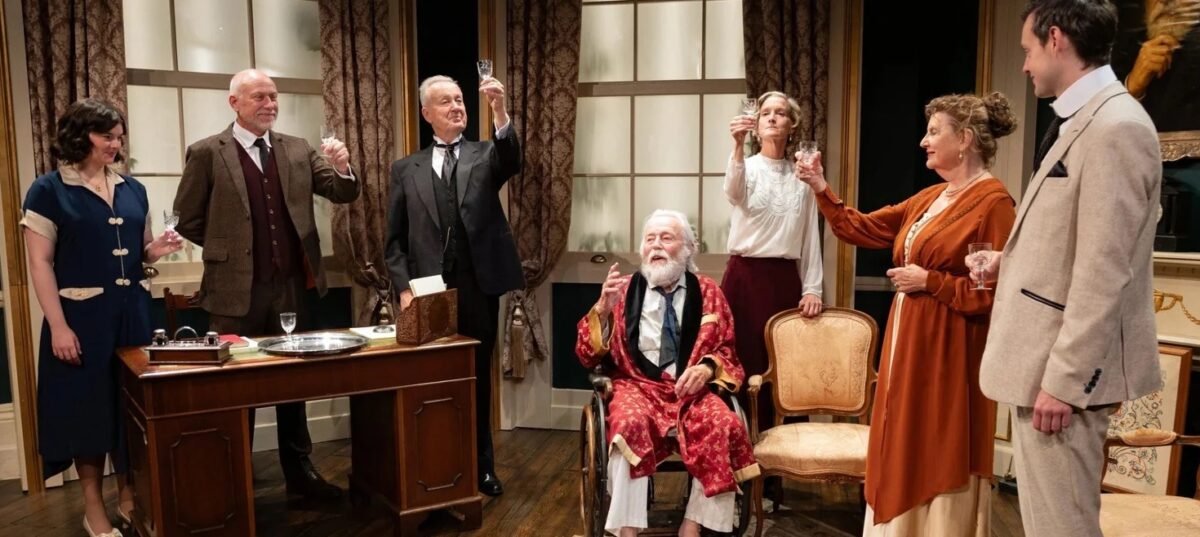
Gaunt admittedly isn’t in the play all that much, but he brings a gravitas and frailty to the role that means he’s a lingering presence. There’s a pain and sadness to him, yet well balanced by the joy he exhibits when his family are all around him. He has a great sorrowful levity when Royce mentions having enjoyed a poetry collection that’s otherwise been scorned. Wickham is a great, commanding but respectful, bringing out the best and the worst in those around him. There’s no weak link among the cast though: all give wonderfully layered performances, so you really connect with them all, despite them not wholly being all that likable.
The second act opens after the interval, and a major event that’s happened off-stage is announced in such a sly and smart way as Blayds-Conway’s smoking reveals a lot more than it may appear. And so begins the to-ing and fro-ing of the family, bitterness coming to a head, panic, anxiety, cut-throat natures — above all else, a selfishness that threatens to quash the truth.
As the title reveals, Milne’s play is all about the truth, and what we’ll do to protect ourselves, even if it means becoming morally corrupt or stabbing someone else in the back. But the play is also an examination of storytelling and of celebrity, meaning it’s a particularly important piece for right now, when celebrity culture is so massive. It’s a fascinating character piece, and the intimate nature of the Finsborough Theatre adds to this. Yes, it’s a shame that its limited availability means fewer people can experience The Truth About Blayds, but as it’s essentially held in a large living room, the audience feels more involved than if this were at the Theatre Royal Drury Lane, for instance; it’s as if you’re in on the secret, becoming embroiled in the lies.
It also means that, afterwards, you can head to the stage and get a closer look at the set (by Alex Marker) and the props, all of which have a fantastic attention to detail. Sadly, the clothing (Carla Joy Evans), while appropriately designed and conjuring up a very particular era and mindset, is getting a little shabby; with such a limited run, however, it’s no great shock that replacements aren’t sourced. It’s a very minor complaint in an otherwise excellent production.
The Truth About Blayds deserves a lot more recognition, as does the Finsborough Theatre, but there’s something very precious about experiencing such a brilliant piece in a setting most people don’t know about. It’s just our little secret.