“(The Doctor) is a Time Lord – it’s all history to him!”
So observed Barry Letts, in his 1993 Myth Makers interview. It was a comment made in relation to how the television series played fast and loose with how the Doctor, as an entity who comes from a higher plane of existence, relates to both Earth’s history, and to his travels in general. Philip Hinchcliffe makes much the same observation when he notes the “Olympian detachment” that Tom Baker helped instil in the part; taken as a whole, what both producers refer to here is the wisdom of the title character – the Doctor sits outside of time and space, stepping in and then out of all of time itself. The 15th Century, the 20th, and right up to the end of time. It’s all history to him. And he is the centre-point.
It’s that sense of an otherworldly alien wisdom and perspective that is extremely well embodied by the Eighth Doctor (Paul McGann) for me. An ethereal figure who flits in and out of time, clad in his frock coat, a man for all seasons, and no season. McGann plays it with a welcome combination of detachment, yes, but also a sprinkling of compassion when the circumstances warrant it. There is a welcome ‘otherness’ about this Doctor, but balanced by a sense of trustworthiness too, as well as an ability to inspire others around him.
And that keenness he has to inspire and teach others plays a key part of this very release from Big Finish. Causeway is set in the early years of this eighth incarnation, when this Doctor was still vibrant and filled with energy… It’s always a pleasure to be able to revisit this Doctor, and on as fabulous a medium as audio drama! We can too often take it for granted…
Lost Amongst the Stars
by Rochana Patel
‘The Doctor wants to find a challenge for Charley and Audacity. All of time and space awaits, with wonders beyond their wildest dreams and darkest nightmares, but are they truly ready to venture further out amongst the stars?’
Despite there being an awkward and unwise splintering of the Eighth Doctor into three ranges now, each being set in different phases of his life, I can honestly say that the overall quality of all three of these is still strong. These are all being buoyed along by being professionally made, with excellent strong casting elevating the material; while it is unsustainable long-term, I have never felt short-changed by the finished quality. These three Paul McGann ranges are all still things that I look forward to in the Big Finish release schedule as they are made with a great deal of love, and by very committed backroom staff and writers.
So this, then, is a new release, set in the early part of this Doctor’s life, and one that works as a fine example of what Barry Letts was alluding to up above – the timeless Doctor in his TARDIS, currently travelling with two companions, both from different eras in Earth history, and like him, all sitting slightly out of time, and stepping in and out of history. It’s a quietly bold and experimental move, and very typical of how Big Finish has been handling the Eighth Doctor since the day they launched him — he stands as unique among all the other Doctors: a bridge of sorts, between the original Doctor Who television format, and modern-day storytelling sensibilities. The original series was ‘television’, whereas the Paul McGann era is more often presented as ‘feature film’. And this release is very much ‘feature film’ in both its style and its visual scale.
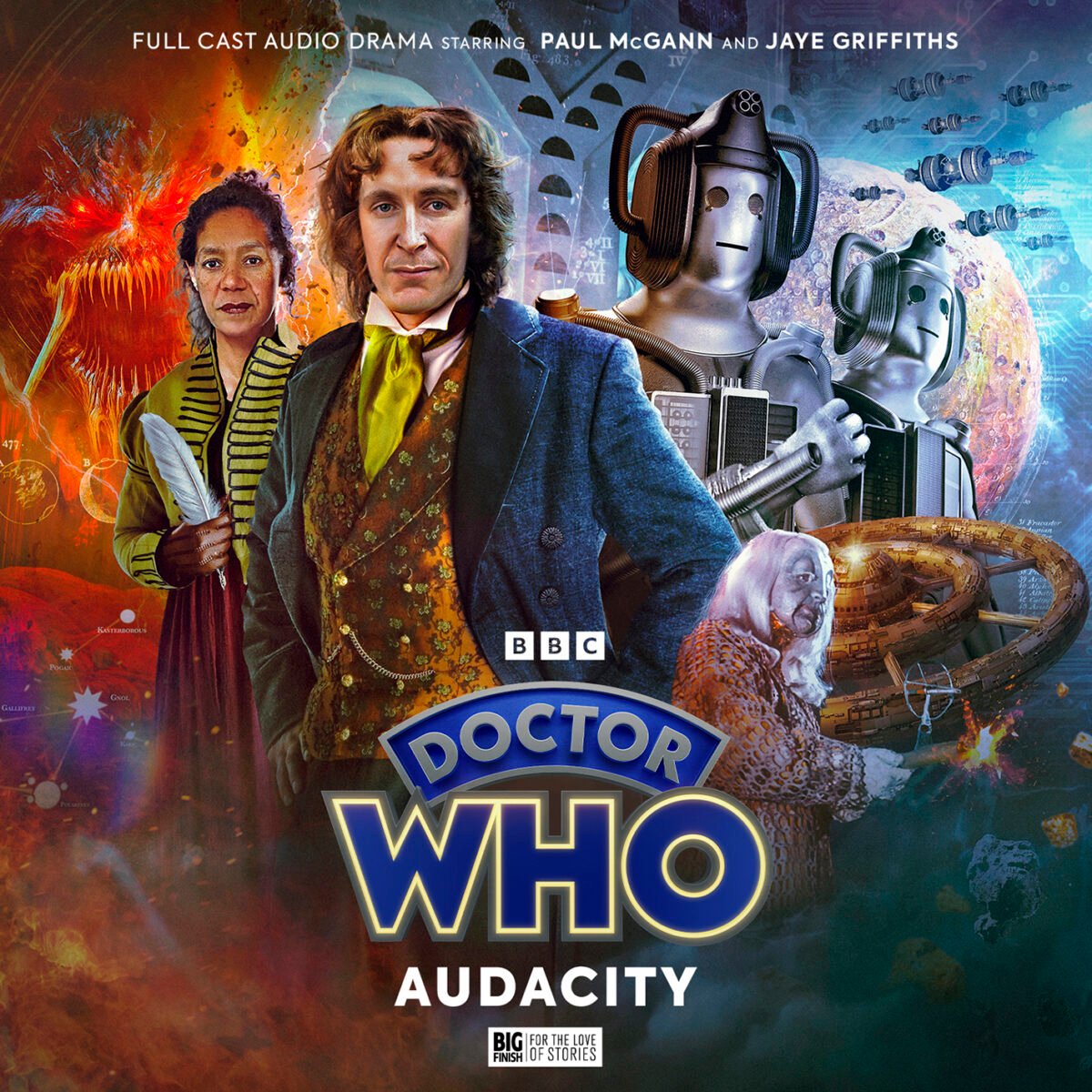
Lady Audacity Montague (Jaye Griffiths) hails from 1812, while Charley Pollard (India Fisher) is native to 1930. Audacity is the older of the two, and highly educated. Far too educated frankly.

But while some writers have tended to struggle with the ‘Mary-Sue’ nature of this woman-of-all-seasons born into the 17th Century, there are others who wisely play down the over-the-top nature of her established characterisation, and as a result Griffiths and Fisher can, quite often, shine — two travellers lost in time and space, but both getting along with the other just fine! The sensibilities are culled from the 1960s era of Doctor Who, when two or more mismatched companions from Earth’s history would be stuck travelling with the Doctor and unable to return home. This is the same sort of dynamic with Charley and Audacity, but, transferred into modern-day Doctor Who, it feels and plays as something truly novel, and, in this day and age, very daring to do! The pity is, this particular story isn’t one that flatters either Audacity or Jaye Griffiths very well…
Rochana Patel is the writer of this opening story, as the Doctor vows to show his two companions something challenging. And so, responding to a sudden distress call, the TARDIS arrives on a desolate frozen world in the 55th Century, where mankind has spread to the stars and religion has been left behind. Atheism, tempered by the faith in science, is now the prevailing wisdom. Yet, despite this intriguing world-building in the first quarter of the script, and a situation developing that seems to have been purposely devised to explore these beliefs, Patel (disappointingly) goes nowhere near it. Exploring the philosophy of atheism versus faith in a higher power, in this imaginative context of being completely isolated on a long-dead world, lost out in the silence of the stars, would have gone a considerable way to lending the story real weight and interest.
Arriving on a planet that is drifting in deepest space, without a sun, the three travellers discover an exploratory ship that has landed here and is in trouble, and a planet that, while dead and in deep freeze, still harbours something unseen, something lethal.
It starts off extremely well as a story. As with previous releases the personalities of the Doctor, Audacity, and Charley are well balanced in the opening quarter and complement the other. These three actors are very professional in their commitment to both the work and with the development of their characters — it’s a release that again demonstrates what a great lead actor Paul McGann is: like Peter Davison, he most definitely leads the people around him in the studio by setting the example, and in turn inspires both their respect and their commitment to follow him in making the very best of the material they are being given.
Set in a distant future enables there to be some nice science-fiction ideas dropped into this script that are mostly left undeveloped. There are things lurking just out of sight. There is a sense of claustrophobia established. And then it all falls into a slop of bad audio drama. Too reliant on poor sound design and over-cooked ‘possession’ acting.
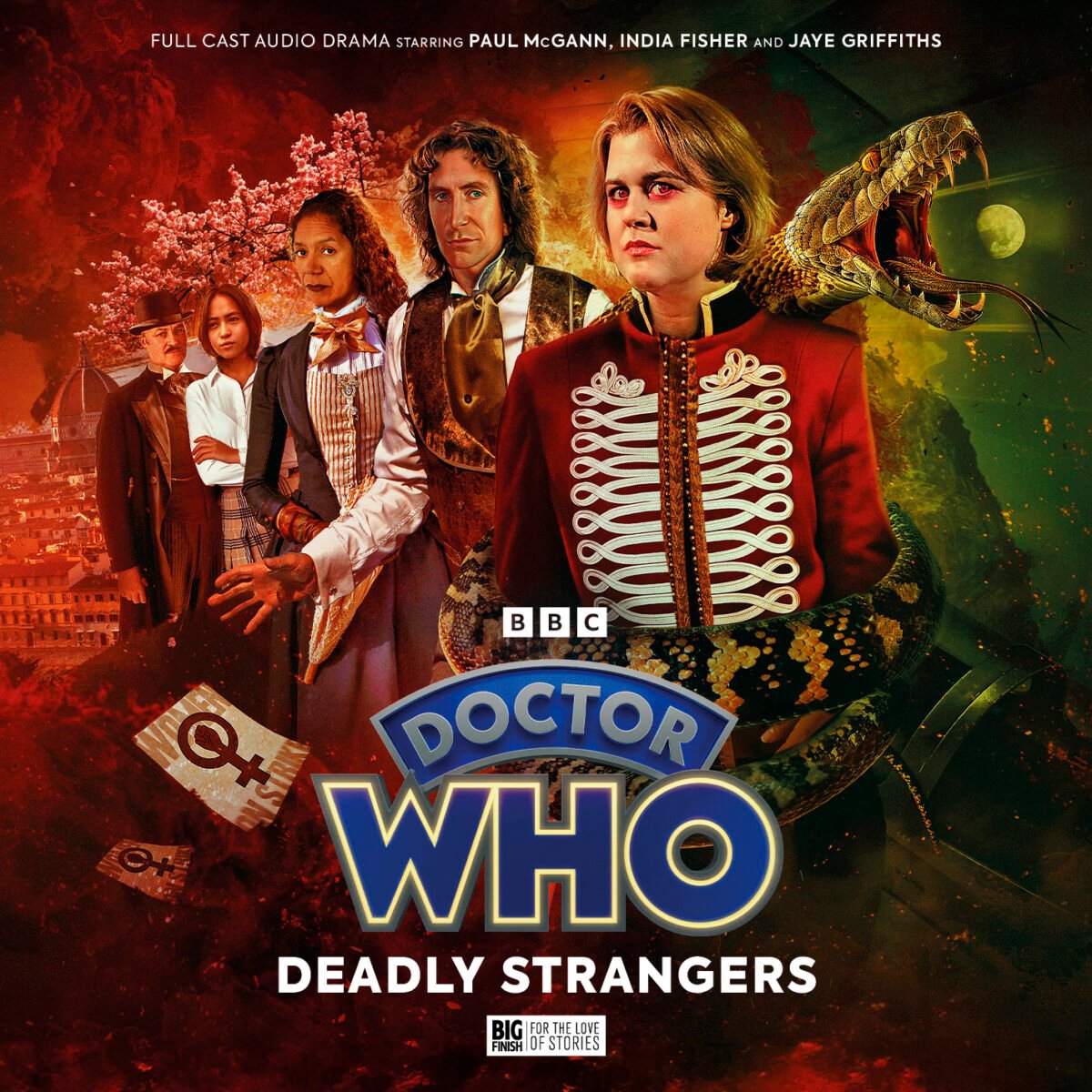
It seems the basic plot is of a dangerous and super-intelligent spore, locked in deep freeze on this world; it has been reactivated by a passing exploratory ship and… errr?! It wants to get off this world? I’m not all that sure. The strong start to the story descends into ‘possession’ scenes and a lot of distorted electronically-treated voices that become hard to follow, and hard to understand as they babble poor dialogue. It is swiftly hard to tell who is who, what they want, and why we should care about any of it. The strong similarities to last December’s Mara story (The Gloaming in the Deadly Strangers boxset) — with these three same characters trapped inside a cryo-sleep facility — are very strong. That story was very good, as the nature of the threat was well set up and presented. This story, though, hasn’t been thought through, and would have benefited from some script editing to help with the pacing, and make the threat and its intentions more comprehensible.
This isn’t me saying Rochana Patel is a poor writer: she wrote Beginner’s Guide to Monsters (and How to Slay Them) in (the excellent!) Jenny – The Doctor’s Daughter Series 3 last October — this was another science fiction story with some neat ideas, and with a somewhat more satisfying resolution to it. It had its imperfections, but it did work, and as with Lost Amongst the Stars, here it had the benefit of an excellent cast to help it along… A shame with this Eighth Doctor story is that, whatever ‘lesson’ the Doctor was trying to impress on the two fellow travellers by taking them to see the 55th Century, it’s not followed through on, and the climax to the story appears to be cobbled together to add on a meaningless reference to ‘Causeway’; a reference that falls completely flat as it means nothing to us.
The Time You Never Had
by Tim Foley
‘The yesterday of opulence, Tomorrow soft and ironclad, Beyond the merry Oculus: The time you never had.’
Neat and poetic. And a limerick that will only make sense as you come to the closing seconds of this second story of this release.
It’s up to Tim Foley to steer this Paul McGann release back into the red, and, within the first two opening minutes, he is succeeding in doing just that. Choosing to pick up where Rochana Patel left off, Foley immediately focuses on Audacity’s trauma, remembers that she is someone native to the 18th Century, and addresses what the ‘Causeway’ actually is – all within the opening two to three minutes! Such is his writing confidence and skill in handling these audio plays.
Beginning within the comfort and warmth of the TARDIS, danger then encroaches as the cloister bell suddenly rings and the ship begins to buckle under some form of time-based distortion — it’s a gripping way to open a Doctor Who story, and is immediately reminiscent of the near identical opening to 2002 Eighth Doctor novel Anachrophobia, an impressive story in itself, and a standout entry in the Doctor Who book range from a still new Jonathan Morris (it’s either his second or third BBC novel).
And as the Doctor navigates the TARDIS to modern-day (or 1997) Copenhagen, the similarities to the BBC Eighth Doctor book range become impossible to ignore for those of us who followed that inventive and creative book-line: as the three travellers arrive at the mysterious ‘Causeway’ building to investigate the time-based danger they experienced, it could be the Doctor, Fitz, and Anji Kapoor stood here, in the thick of another of the BBC novels’ complex time-bending season-arcs. Here is a BBC Eighth Doctor novel, brought to life, on audio! The Causeway could be Timeless Inc, or any number of other agencies the Doctor crossed paths with in the book range; the homage only becomes more visible as the story progresses into its second chapter and tests the limits of Doctor Who storytelling on the Big Finish arena.
Meet Peter Mansfield, apparently a Yorkshireman and head of Causeway. Involved somehow in expeditions into history, and as the three travellers strike up a conversation, he is surprisingly open about the nature of his business, and that its origin lies in a strange craft that crashed to Earth on May 12th 1996.
Along with his chief scientist, Veronica Hays, Mansfield has examined this strange craft and managed to learn some of its secrets. As the three travellers also learn of these secrets, what follows is some thoughtful critiquing of whether mankind should ever have time travel, and it is Audacity who acts as the catalyst and cause of friction here, challenging the Doctor’s perceived high-handedness and authority over the question.
Again, this apparent dilemma and question over the Doctor’s nature links back to Barry Letts’ quote up above. Even Audacity fails to recognise that the Doctor isn’t just some human with a time machine; he is something else altogether. Something from beyond… Above and beyond.
Charlie at least has some awareness and acceptance of that fact, but the whole argument is a natural one to have, and one that is handled deftly by Tim Foley.
Foley’s script is very strong on character: there are complex time travel ideas here, but this is all really a character-piece that looks at loss, grief, courage, love, and the deep burden of sacrifice. I do suspect Foley may have been a follower of the Eighth Doctor novels as this story is so beholden to the formula and storytelling ambition often used in them: there is even a moment where the Doctor takes charge of a car (a Mini Cooper, it is implied), and readers of the novels will appreciate that scene as it is based on one of the BBC novel line’s most notorious recurring quirks early on — the Doctor having a Volkswagon Beetle, and then a Mini Metro, stored in the TARDIS! On the one hand, Audacity is dealing with her experiences in the previous adventure; after being overwhelmed and almost dying on a dead, frozen world, her feelings of mortality have shaken her confidence, and she is struggling to adjust and recover from the experience. But on the other side of the presentation, she is then reverting to her worst character traits, as Foley forgets himself and lapses into line to have this 17th Century-born woman suddenly seen taking command of… driving a 20th Century car through the busy streets of Copenhagen?! Apparently, she has been practising driving on the TARDIS’ racing track, or so we are told.
Astrophysics, astronomy, the sciences, geography, the arts: you name it, and Big Finish’s Audacity Montague is a master of it. No doubt she can even give chapter and verse on the science of nanites and 23rd Century rocket design, and outfight Emma Peel too. For every writer who tries to rein this character in, the next writer goes all-in on the established Big Finish character guide… The results of this ‘house’ presentation are sadly getting more and more grating to follow. There are frequently times when the character becomes a real chore to follow, too high-handed, omni-capable, and overbearing. But there is a theme slowly developing in this series regarding just how dangerous it is to travel with the Doctor: Charley has experienced it, and now Audacity has experienced it. Scratch past the surface appearance of their travels that Charley accepts and this is not a romantic existence with the Doctor, something that the more mature Audacity has now begun to realise — to great personal pain by the time this particular pair of stories is over. And so, despite the frequently overbearing nature of the character, this is still a fine story for Jaye Griffiths to have a starring role in. Audacity is largely at the centre of events, and when the setting moves on in the second part of the story to have her stranded with the mysterious, but impressive, Mr Barrabus (an impressive performance from Richard Hope!), we have a distorted, but intriguing, play on the Doctor himself. Mr Barrabus seems to emulate BBC novels’ Sabbath, a time-travelling antagonist with ambiguous motives. Barrabus, while having parallels with that character, is no great adventurer as such. Only as he unexpectedly meets and joins with Audacity does he come to (reluctantly) face up to his greater responsibilities and look beyond his own needs.
This instalment from Tim Foley is quite a dense storytelling narrative, but on the whole is rewarding. The Eighth Doctor range for Big Finish does tend to favour ambitious narratives, and has played out the time paradox aspects many times before this story. But even as the danger passes here and the three travellers pick up the pieces in the aftermath, the subplots and hanging thread to the storyline put this release on a different level to what came before – it is dense plotting going on here that follows the prose format of the novels; it is that same style and approach being presented here. But as rewarding as this story is, by its end, will any of these hanging threads ever be followed up on…? Next time, it is the Doctor, Liv Chenka, and Helen Sinclair’s turn for a release. Their sudden return in the schedule is unexpected, not unwelcome either, and yet it stops any momentum in the Doctor, Audacity, and Charley releases. Apparently the ‘Causeway’ name had been seeded in earlier Eighth Doctor releases, but like me it is unlikely followers of the series would have remembered any of that as the releases from this Doctor are now so fragmented, spread apart, and, as a result difficult, to keep hold of in terms of any of the subplots being generated in the three competing narratives.
Nevertheless, all criticisms aside, this release is recommended, thanks largely to Tim Foley’s strong entry and an overall satisfying arc that looks at the role of the Doctor in the scheme of things, challenges that role, and,, in the end, affirms it. The very strong cast does the heavy lifting in both of these stories, and there is also fine character work from both writers on display here, with Audacity benefiting from the challenges and ordeals she is put through, and her learning that the reality of life with the mysterious Doctor is not actually all that romantic once you look past the handsome surface of it all. His is a life of great responsibilities. Great dangers. And an even greater calling. Something that this release ends up demonstrating quite well…
The Eighth Doctor Adventures: Causeway is out now from Big Finish.