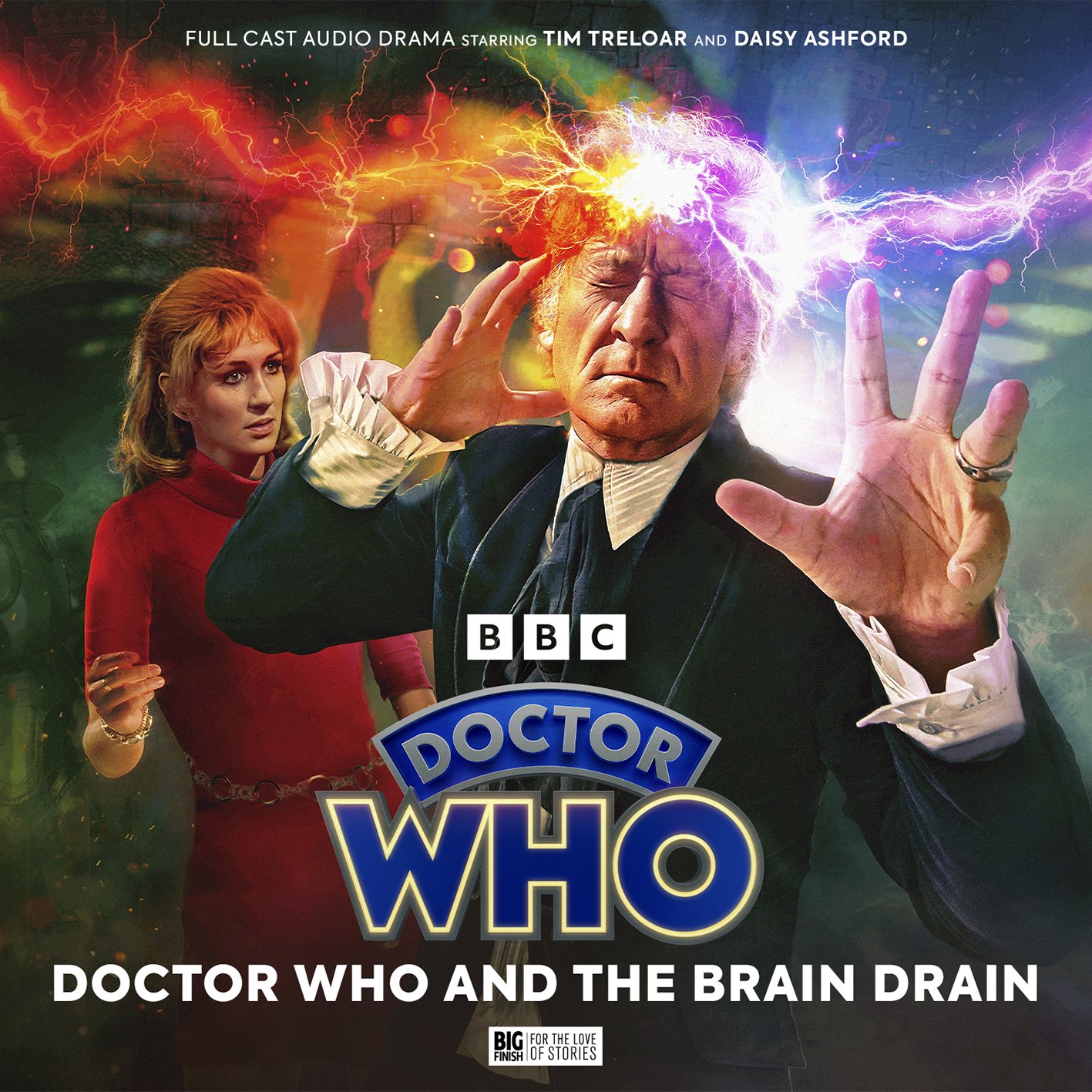
In addition to appearing in all four stories of Doctor Who Season 7, the first to be televised in colour, Liz Shaw’s time with the Third Doctor was expanded upon at the time in the pages of TV Comic. Those comic strips were in black-and-white, but were as vivid as the new palette on screen in their storytelling. Harking back to both of these introductory mediums for the Third Doctor is Big Finish’s recent full-cast audio drama, Doctor Who and the Brain Drain.
It’s set in the earliest days of this incarnation, at a time where alien involvement in events is still a fresh idea to Brigadier Lethbridge-Stewart and the Doctor is very much Liz’s laboratory assistant rather than the man always leading the action.
The story takes the Doctor and his two UNIT colleagues to Scotland, location of the iconic TV Comic strip Doctor Who and the Rocks from Venus, where a symposium is being held at a castle. They are there to see Professor MacLeod and her son, who claim to have developed a new treatment for memory loss and a possible cure for dementia.
With sound effects and musical stings that sound like they could have come straight out of the BBC Radiophonic Workshop, this seven-episode story really feels truly like it was made in 1970 and a foundational story for the Third Doctor and his two close friends.
Capturing that early tone of the era does not occur immediately in episode one, as the MacLeod family is the focus. There’s the professor, her dead husband, and their son. The second of those mostly appears as a ghostly voice trying to orchestrate proceedings.
When alive, he was a dementia researcher who then succumbed to the condition, while in death, he is a manipulative presence.
Once the Doctor and Liz are introduced, it very much is a trip back in time and within the main cast, the most attention goes to Liz. While both she and the Brigadier are not experienced with aliens at this point, the more scientific role that Liz has makes her better suited for leading the way early on.
Daisy Ashford and Jon Culshaw are brilliant in their roles, and Tim Treloar is superb as the Doctor but really doesn’t get much to do until the cliffhanger ending of episode one. Cue era-appropriate musical sting.

Episode two is dark, but very human and allows Liz to shine but now away from the heart of the action. The Third Doctor’s later companions were better known for their befriending of locals, and giving Liz the chance to do the same is not only another acting highlight but also proves to be very important later in the story.
There are 1970s horror inspirations in episode three, rubbed in by having lightning strikes by the castle, but for fans of Treloar’s performance as the Doctor, the story may lose its appeal at this point because he is absent from proceedings. Like the first two episodes, it ends with a big cliffhanger.
Episode four is somewhat similar in terms of the Doctor’s presence, but while he is gone, there is plenty of sleuthing done by Liz. It truly is her story, and actually, it means once the Doctor returns to the plot, it feels even more rewarding (as it would for Liz and the Brigadier) to have his voice in the room.
The TV Comic tone returns to the story with him, alongside mythical creatures and the Doctor’s memories being eaten.
There is a twist that plays out fully in the final episode, which very much feels like a full-cast endeavour and wraps up the Doctor, Liz, and the Brigadier’s trip to Scotland.
Doctor Who and the Brain Drain is even reminiscent of the Virgin Missing Adventures novel range at times in how it captures the Third Doctor, and dementia is also an interesting topic to base a story around. The boundaries of technology have repeatedly been looked at when combating the condition, but companionship and location can be effective treatment strategies too. The desire to outdo science has driven people mad as much as dementia itself, particularly in fictional worlds where the mad villain is a long-lasting archetype. Although there is a clear villain in this story, the maddening effects of dementia could also be to blame for their actions. The door is left open if that is the case.
Aside from giving Liz plenty to do and grow in confidence away from her usual UNIT setting, this story is also a key narrative point for the Third Doctor. He is gathering the Brigadier’s trust, establishing his working needs at UNIT and how he actually is as a character. There is assertiveness, comedy, curiosity, and also a fierce feeling of responsibility despite his obvious disillusionment with being exiled on Earth.
Doctor Who and the Brain Drain is available now from Big Finish.