Two books from Candy Jar, which I read back-to-back this month, are both reliant on some knowledge of a particular televised Doctor Who story and take their starting point from that story. However, one took me several weeks to read, while the other just two weeks — and that was only because it was such an absolute delight of a book that, by the closing chapters, I was stretching it out. I didn’t want it to end…
‘The Invasion was over.’
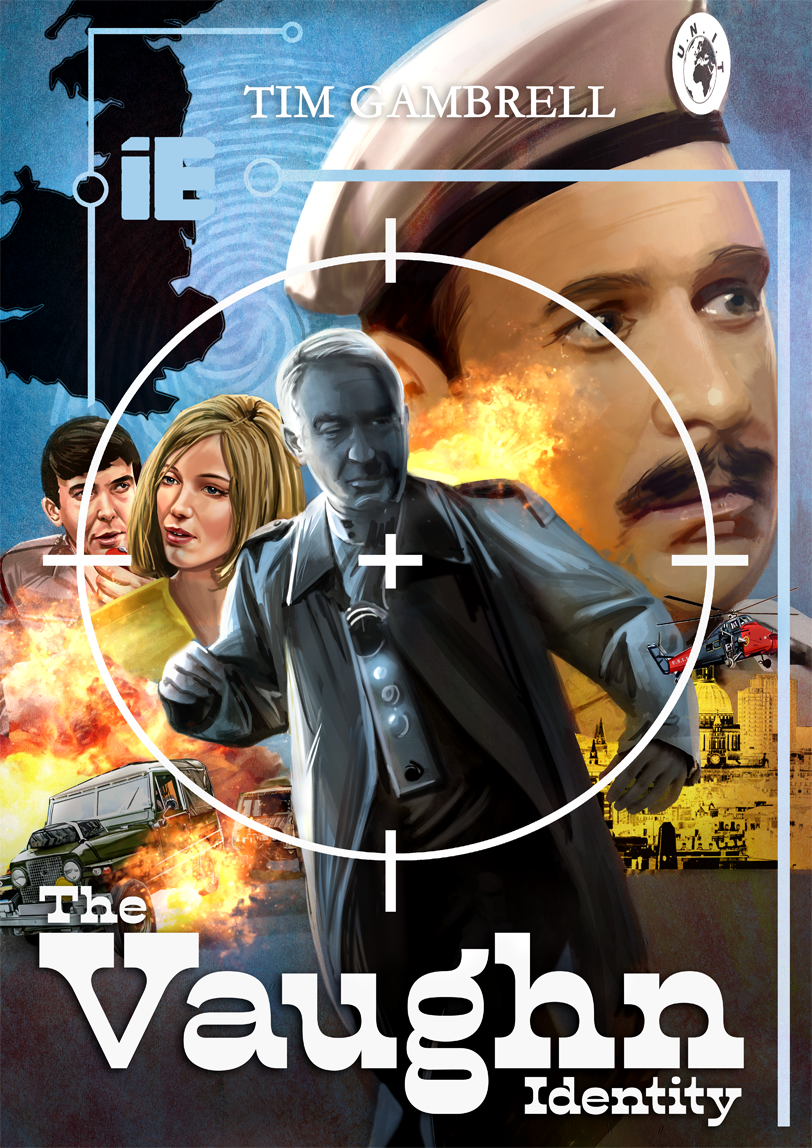
So begins Tim Gambrell’s vibrant sequel to the 1968 Patrick Troughton story, The Invasion, though as I made it to the halfway-point in the book, it occurred to me that the title, The Vaughn Identity, though based on The Bourne Identity, is a puzzling one. As I read through the story, it became gradually apparent that it doesn’t seem to represent anything going on in the book’s actual plot, and in the aftermath, it is still a title that only begins to make some small sense by the story’s closing chapters… but even then, it’s a tenuous connection. The Vaughn Identity is a 190-page story that very much has Tobias Vaughn’s formidable shadow cast heavily over its entire length; so heavy is his shadow that even in death we get to see the fear that the British government has when just the rumour of his possible survival begins to swirl. As things get fully underway, the story is fuelled by what Derrick Sherwin’s script for The Invasion left unaddressed.
And with some terrific character work, spread across a variety of characters, a steady flow of well-judged reveals and turns peppered throughout, what Tim Gambrell puts down on the page is a very impressive testament to the sheer quality of the superb story engine that was Doctor Who in its prime, especially in the medium of prose fiction. The Vaughn Identity is almost a writer’s masterclass in how to both pace and plot out a thoroughly engaging and gripping adventure novel: 22 chapters, each usually ending on a big reveal or sudden danger, and purposely designed to emulate the golden-age of the WH Allen/Target style of gripping, confident storytelling.
So: Tobias Vaughn is dead. The British government has been left bruised and embarrassed by the way in which it had allowed itself to become so beholden to the global industrialist who very nearly succeeded in comprehensively taking over the planet with his Cybermen allies; and in the wake, they are taking out their shame by making UNIT the scapegoat for the government’s own failures. It is Brigadier Lethbridge-Stewart who bears the brunt of this political pressure and career gerrymandering, and we see the stresses brought to bear on him by this, and how he internally deals with that as those above him threaten the future of both UNIT, and more immediately, his own position as its day-to-day commander-in-chief.

Seen in a particular light, you might think of this plot as a basic rehash of The Invasion, but I assure you that, while the narrative reuses many of the same story-beats and turns, their use is actually very logical in the way the mastermind behind it is operating.
The Vaughn Identity takes place just weeks after The Invasion. Set in a warm July, the attention to detail from Gambrell is part of the backbone to his narrative, as he sets up his cast and the mysteries begin… A cyber-conversion chamber is discovered in the International Electromatics (IE) compound, deactivated partial converts are suddenly reactivated, while simultaneously, similarly converted humans come to grotesque life in UNIT’s morgue. But why? How?!
There is the IE workers compound seen in Episode 1 of The Invasion that comes into play: what has happened to the roughly 200 men who lived there while working for Vaughn’s vast Sussex-based company? What became of the communications array on the IE site that was used by Vaughn and his Cybermen allies? And just how extensive was Vaughn’s infiltration of government (considering Rutlige and those ‘vanished’ civil servants) and his reach into other areas of governance — including UNIT?
There is something bubbling away, under UNIT’s very noses, and yet so clever is the mastermind pulling the strings that UNIT is left five steps behind in working out what is actually going on – if there even is something going on. It will take a team effort, and the last-minute return of the gifted Anne Travers from America at the Brig’s request, to begin a fight back… and what we come to see is the UNIT of this era at its finest!
Logical plotting is something I came to love about the Doctor Who novels I read in the school library. There’s a long heritage in Doctor Who fiction, a style of storytelling, that has its foundations built on the WH Allen/Target novels of the 1970s and ’80s, where writers’ huge imaginations were channelled into prose, and the results were superb books like The Dalek Invasion of Earth, The Face of Evil, and The Talons of Weng-Chiang. And it is this spirit that Tim Gambrell’s work embodies. Plotlines are laid out, characters introduced and skilfully sketched out in just a few lines of dialogue, and just when you think Gambrell has forgotten some detail in the plot, or overlooked a previous event, he’ll return to your unspoken query and answer it!
I love that attention to detail from a writer. But it is the attention to story logic, married to fine character-work, that makes this debut UNIT novel from Candy Jar a match for anything I have previously read from the WH Allen, Virgin, and BBC Books stables. Tim Gambrell’s gift for action-thriller narratives is a match for any of the best of the authors of yesteryear…
The Brigadier is tested, John Benton is tested, Captain Turner and Isobel are tested, and in the end all are the stronger for their ordeals. And in a final example of well considered plotting Tim Gambrell drops one last reveal in the form of a familiar name to Doctor Who viewers in the 1980s — one very familiar to those who follow the extended universe in Big Finish and Candy Jar as the Brigadier discovers he has a new and much-needed ally to relieve the pressure between him and the government. And what a sensible and logical choice it is from Gambrell to sign off on for now… Such a well judged ending.
The Vaughn Identity is Doctor Who storytelling at its best.
UNIT: The Vaughn Identity is available now from Candy Jar Books.