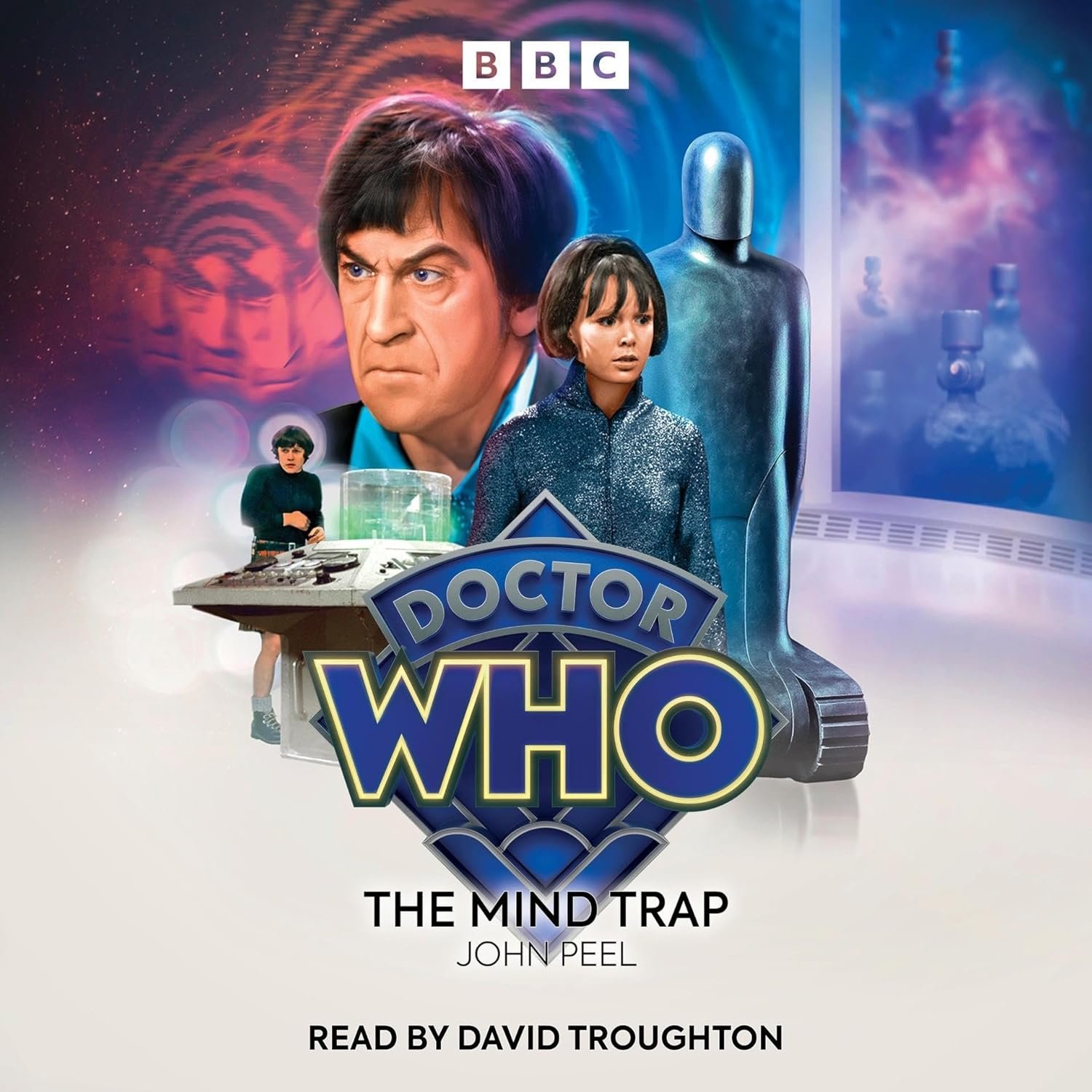
“What good am I if I can’t trust my own mind?”
It all looks so gripping on paper…
The Mind Trap, in many ways, appears as a fine example of a premise that would fit into the 1960s era of Patrick Troughton’s Doctor Who very easily.
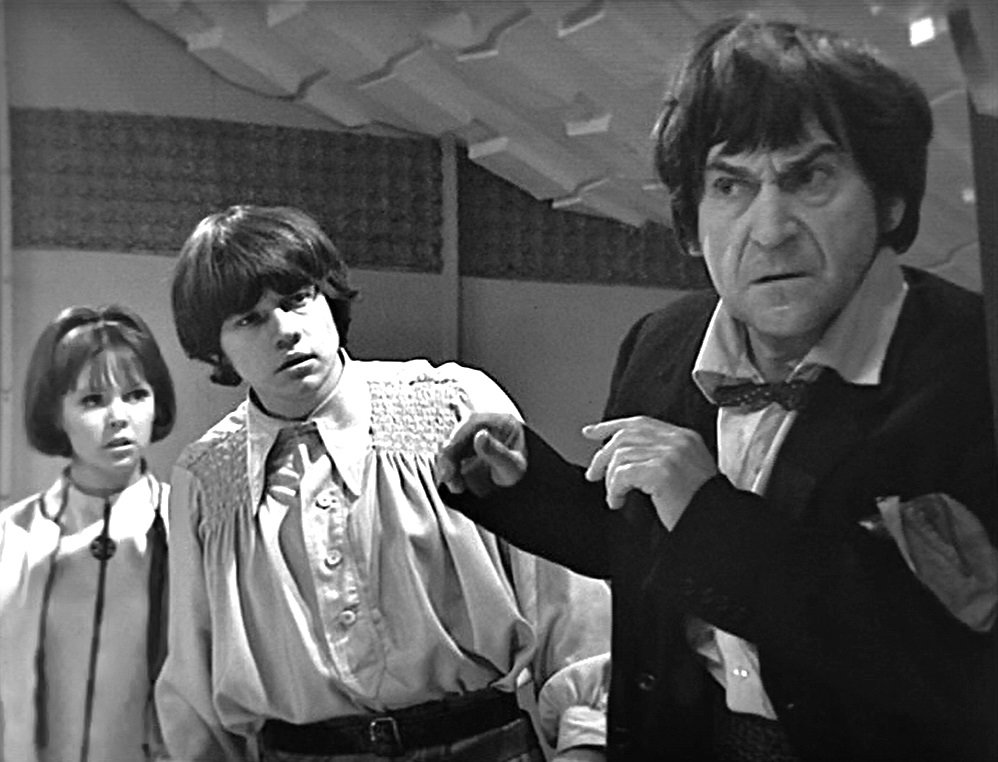
It has a confined setting and intriguing plot, concerning the Doctor, Zoe, and Jamie arriving aboard a heavily protected space station to discover it is in fact a prison, inhabited by one man, and a featureless robot guardian that at first evokes memories of Gort – the Doomsday weapon in cinema classic, The Day the Earth Stood Still. A test of fortitude ensues as this prisoner then begins exerting his will and resources over the Doctor in order to engineer an escape from this isolated and near-impenetrable structure. What you should have, therefore, is a thoroughly engaging, and tense, thriller…
But with a fine idea for a story that slots into the era so well, John Peel’s other 1960s faux pas comes into play — by delivering a pace that is so incredibly slow, so heavy in repetitive scenes, that it harks back the worst of the William Hartnell era, where characters would spend great chunks of episodes standing together in one spot and delivering reams of dialogue that didn’t so much advance the events at hand, rather than just pad out the episode’s airtime. And that was the experience I had in listening to this 78 minute long story (I can’t quite call it an adventure as that suggests excitement).
All of the ideas are in there for a good adventure, or moral quandary, and yet thanks to the lack of good pacing and a good script editor, Peel’s delivery falls largely flat and unengaging — another unfortunate test of the listener’s stamina for tolerating audio drama.
This is not to say that Peel’s story premise is in any way poor. But it is a tale that begins by presenting an unusual occurrence, that of the Doctor arriving somewhere, sensing the nature of the place within minutes, and immediately determined to get back to the TARDIS to leave the place. With the utmost determination. The Doctor being so quickly reluctant upon an arrival was only previously used in The Celestial Toymaker, his first near meeting in the other-dimensional home of the godlike Toymaker. Here, the reasoning is a lot more strained as this, at first glance, is just one more space station, a heavily fortified place on the exterior, but still nothing too different to any other similar space installation this Doctor was regularly seen arriving within by TARDIS.
Upon meeting Markan, the non-threatening resident of this place, the Doctor begins to probe and learns that he’s here in isolation as he apparently killed the people of a small island, to test some undefined thesis. Placed here with a silent, watching automaton, the scientifically gifted Markan has managed to reprogram the robot to partially serve him, but still has no way of leaving this facility. Until now…
There is a lot of potential here. Gerry Anderson’s Space 1999 had a similar story premise (End of Eternity) with an imprisoned mass murderer (Balor) being unwittingly rescued by the moonbase, and them slowly beginning to realise just how unimaginably dangerous this man was to any society he came into contact with. That story stands as one of the most memorable and tense in the series thanks to Peter Bowles’ superb performance as Balor. But Peel’s amoral scientist Markan is no Balor; the enormous threat level and genuine sense of fear are never there as they were with Balor. Indeed, Markan’s crime is only ever one that is suggested: it’s never explored. It’s never quite ‘important’ here. And so for the first fifty or so minutes, this is a tale that sits (literally) in one or two rooms, as three characters talk. And talk. With no soundscape present, and with often banal or meaningless dialogue only slightly lifted by the marvellous skills of narrator, David Troughton!
It’s really that last 15 to 20 minutes where things pick up a little as the Doctor is shown suddenly outwitted by some very unconvincing means, and is now a prisoner of his own senses, his perception of reality now within Markan’s control. It is only Jamie and Zoe who stand in Markan’s way to stop the Doctor from taking the TARDIS off, and giving Markan his freedom, with the TARDIS as an extra prize. Zoe has a very nice role here as she works out how to override Markan’s programming of the robot, but all of this is really more like witnessing a writer’s outlines jotted on a notepad, and which are never quite brought together on the finished page. I felt I had to take a break at the halfway point and going off for a walk — something I very rarely do when listening to an audio. But it’s not so much the story premise that is poor; it is the grindingly slow pace of its construction on the page, and the lack of satisfaction in its pay-offs.
It was David Troughton who kept me on board, however. What a fine example of a skilled and capable actor — full praise for him at least. There is also a distinct lack of any music or soundscape here, other than the hum of the TARDIS. This likely does contribute to the lack of any sense of pace or real urgency, but it’s still the failings within the character interactions and lack of tension that are the real problems. Nothing is as exciting as it should be: the threat level is never at all convincing, and the only actual dilemma offered is in how to free the Doctor from Markan’s control. Something the Doctor should be managing for himself, but doesn’t.
The cover design and story synopsis for The Mind Trap is far more exciting than the actual finished story. I advise you to pass over this one; there is a First Doctor release upcoming shortly in this BBC range, and then in May, an Eleventh Doctor story from writer Dan Starkey: these may well be more worthy of your time and money.