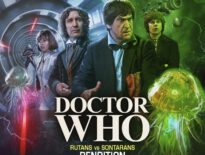
“Planets materialising out of nowhere, across eternity… the same planet… It’s Skaro, the home planet of the Daleks… But weren’t they wiped out?!”
Think of the black and white era of Doctor Who, and imagine it as a closed system.
From the frailty of his first incarnation to his second, more vital incarnation, the Doctor spends a lifetime waging a vigorous war against the evils of reality. Routing the Dominators’ advance, destroying Martian invasion fleets, repulsing the Cybermen’s repeated genocidal schemes against Earth and all of mankind, and ultimately stopping the ambitions of the War Lord and his empire from expanding outwards into the cosmos… All of those were militaristic empires, at pivotal junctures in their history and expanding their ambitions to overwhelm the unprepared and weaker civilisations of the universe. But pre-eminent among these threats the Doctor warred against in this era was the might of the Dalek Empire.
- The Daleks
- The Dalek Invasion of Earth
- The Chase
- The Dalek Master Plan
- The Power of the Daleks
- The Evil of the Daleks
All told 45 episodes, and if you consider the context of being a viewer in that era, one episode per week, you can imagine that by the time The Evil of the Daleks aired in 1967, the familiarity with Daleks might have been… enough. No matter how exciting the story was, there had to be a point where it felt like it was time for a break from these creatures, and in fact it would be around a full five years after The Evil of the Daleks seemed to close the story of the Daleks that they would be revived by a new creative regime, in the era of colour television – and only after some encouragement from the powers up above in the BBC. Very up above.
The Doctor’s earliest encounters with the Dalek empire saw him struggle to a victory; by the time he intervenes with their schemes in The Dalek Master Plan, he is more prepared for them. More determined. And by the end of this battle across time and space, he delivers perhaps their most devastating defeat yet – all coming to a head on Kembel, and the fallout scarred not just the planet itself forevermore, but left its mark on the Doctor himself. This, without doubt, was war being fought.
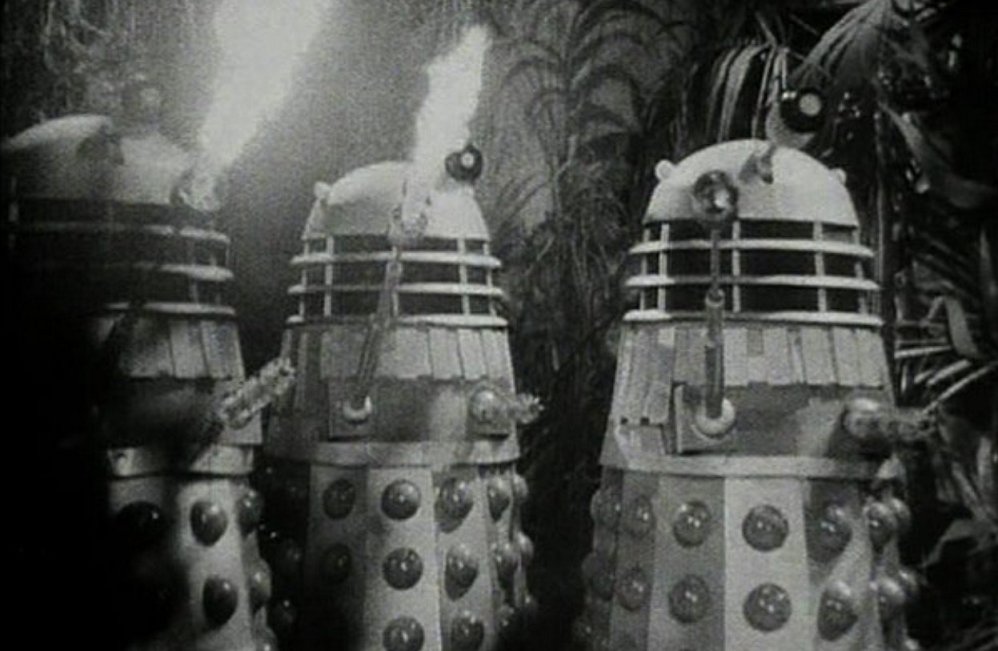
It’s with The Evil of the Daleks, though, that there came the more decisive end to the Doctor’s war against them, as through the span of seven episodes we see an ambitious and ruthless test of wits between him and the Daleks, and their Emperor on Skaro, that concludes with them coming undone, and the Doctor’s cunning and manipulation reaching it’s objective: “The final end.”
It stands as perhaps his greatest victory. If he can wage a solo, semi-ruthless, campaign against the Daleks themselves, with all of time and space as his battlefield, and eventually claim final victory (twice technically – The Daleks in 1963, The Evil of the Daleks in 1967), then, in a way, his own final fate at the end of The War Games is both fitting, and darkly ironic — he wins the battle, but loses the war. Or does he…?
He has just engineered a one-man campaign and victory that even his own people, the seemingly all-powerful Time Lords, may not have been able to achieve as a whole. But is it perhaps more a case that it was the anarchic Doctor who was in the wrong here, and the Time Lords who had the greater wisdom and the true understanding of the greater picture? Is it the Doctor’s role to stop all wars?!
This philosophy, and the paradox of the Daleks’ final end, is where the revival of the Second Doctor at Big Finish takes its cue from… and what a treat this range is proving to be because of it!
It was a recurring feature of the latter Dalek stories of this black and white era that the Daleks had developed their own time travel technology, and could even establish ‘Time Corridors’ between their base and a target anywhere in the universe. For the purposes of The Evil of the Daleks, it was never made explicit whether the Daleks and Skaro seen here were of the 19th Century locus, the 20th Century, or some-point else altogether. It’s this unique time travel aspect, and ambiguity in placing where exactly in the timeline the Doctor ended the Daleks on Skaro, that seems to be forming the undercurrent of the plot we have seen slowly unfolding here in The Second Doctor Adventures… It seems as if the final destruction of the Daleks wasn’t just physical, but due to the mechanics of time, may have been on the conceptual level too. Because as one revelation follows another in Nicholas Briggs and Mark Wright’s tightly plotted storyline, The Potential Daleks, we learn that the Daleks are apparently trying to re-enter existence. And, impossibly, are pushing against all the laws of time and space in order to do just that.
Despite being completely destroyed, wiped from existence, they are somehow slowly but inevitably willing themselves back into the fabric of time and space. Back into reality…
Humpty Dumpty
“Humpty Dumpty sat on a wall, Humpty Dumpty had a great fall…”
A nursery rhyme through time is on the brink of causing a cosmic catastrophe. And for the Doctor, Jamie, Zoe and Raven, this is just the beginning of a final battle.
A battle which began on Skaro.
The opening minute of Humpty Dumpty makes clear that there is no attempt being made to follow the television format that this audio-only series is based on. No 1960s Doctor Who story would open with snoring! And an elderly patient being tended to and discussions over a ‘doctor’ being expected… but this isn’t at all to the detriment of this latest release of The Second Doctor Adventures. While quality across the Big Finish line does vary on these things, this particular range with the Second Doctor is being directly managed by Briggs and Wright themselves, and is very much their passionate effort to tribute those black and white era Dalek epics. There is a fastidious effort to make the storytelling have a modern edge to it, but without interfering with or at all diminishing the main cast of characters. As a result, this is a range that manages the great feat of being both modern and yet faithful to the original material it is based on.
And so we have a very heavy opener to the release which is so laden with exposition and ‘The story so far‘-style catching-up that even I, a devotee to this range, am left looking at my metaphorical scorecard.
It has been a year and a half since the last release, which ended on a gripping cliffhanger, and here we are left with the task of trying to remember every thread of where the story left off — this is not ideal. And it definitely isn’t friendly to anyone who tries this new release out of curiosity.
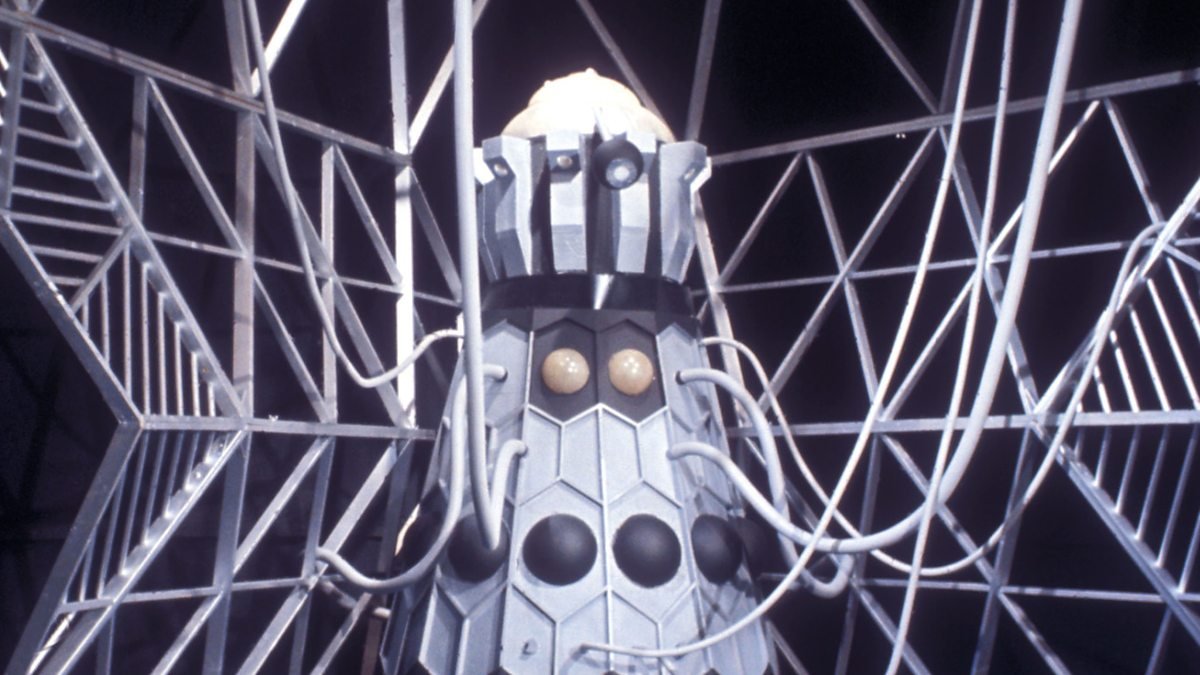
We are still in Vanishing Point, a facility outside time and space where the Doctor, Raven, Zoe, and Jamie have been pursuing the origins of strange Kippers, flocks of small floating entities roaming space-time. The last episode ended with the Vanishing Point window out onto space-time showing the sudden incursion of new worlds onto the flow of time – all Skaro, as the Doctor recognises. An impossibility as Raven notes, “Weren’t they all wiped out?!” Zoe is the pivot here, as she makes the point that, with her memory, she can potentially take them back to when the first Kipper appeared on the space-time window, and so, retreating to the TARDIS, the crew manages to take off but unexpectedly are drawn to Earth in the year 1877…
The narrative then becomes split between 1877 and 1951, linked to the lifetime of a small child. It’s a nice nod to Mawdryn Undead. In the 1877 timezone, the Doctor and Jamie discover a poor family has a daughter who, impossibly, has managed to invent the phonograph, at the same time as Thomas Edison is doing so in America. There is a space/time corridor forming between the two timezones thanks to this child, and this crack in reality is what the Daleks are then trying to come through.
I’m simplifying the plot here, as it is a densely written opening story with a good deal to it and too much to really go into. Suffice to say, this is a very smart storyline: lots of lovely ideas are being packed in, fine character-work, and it stands up to relistening. Indeed, it demands a relisten! Dense as they are in plot, I thoroughly enjoyed these opening two episodes. I feel my intelligence is being fully respected by the writers and cast.
One of the quirks in this series is its insertion of an older Zoe and Jamie. On the face of it, this strikes as odd given this is audio and so visuals like aging actors do not tend to matter. But there is actually a very fine reason developing for this injection of these aging older friends for the Doctor — it isn’t clear as to who or what is manipulating events that the characters are now immersed in (it may be the Phantom Daleks out there somewhere, or it may be someone else), but it is becoming clear that the benefit of an older Zoe, for example, is that she is wiser. It is something seen in the previous release, where Jamie and Zoe show that they no longer have the same impulsiveness or the sense of invulnerability they had in their youth. And as such they are not shy of criticising the Doctor’s actions in the present. But by the same turn, as seen here, the wisdom of age also gives Zoe far more self-assurance and faith in herself than she once had. Which makes her assertive, confident, and so a very potent asset for the Doctor and the objective at hand… while Frazer Hines has taken more of a backseat for this story, that’s really just a case of the situation being more natural for Zoe’s abilities to manage than it is for the simpler and less scientifically aware Jamie. Wendy Padbury is in great form, being given this more mature Zoe to work with, and the results make an excellent companion and advisor for Michael Troughton’s Doctor!
Secret of the Daleks
The Daleks have returned… or have they?
Following the lingering trail of the Daleks’ space-time corridor, the time travellers are surprised when the TARDIS arrives on a tropical forest world. Taking refuge with the population of a peaceful village, the Doctor wonders if he has finally defeated his most terrible enemy.
Is the secret of the Daleks about to be revealed?
It’s asserted by Raven, his junior but typically superior Time Lord handler, that this is a Doctor who has been taken out of time, and is existing as an offshoot simultaneously with his third incarnation, who is now marooned on earth in imposed exile. The concept of these two, radically different, incarnations co-existing simultaneously is fascinating to think on. Is Raven being truthful here? She says she believed she was working on behalf of the Time Lords and assigned to guide and prod the Doctor on his missions. But as the Doctor proved too clever and too willful, he was able to show to her that something far different was going on here: the Time Lords were not who she was answering to, and yet whether it is actually the Daleks, or something else, is something being kept secret for now. It does leave this character standing as a very dubious and untrustworthy figure; one suspects the Doctor is well aware of this privately, and, as we have come to appreciate in this series, he is probably already one step ahead of this question.
Michael Troughton’s recreation of his father’s performance has been a pleasure to follow through these four releases so far. Initial fears I had were that this would be a series where the Second Doctor would be a victim, a powerless pawn of the Time Lords. But that notion was never in the minds of Nick Briggs and Mark Wright: right from the very first release, the first story in the series, they were presenting Michael Troughton with a Doctor who was nobody’s pawn — this is the David Whittaker Doctor being channelled, the Doctor introduced in The Power of the Daleks, and followed through into The Evil of the Daleks. Intelligent, observant, secretive, manipulative, and strategic.
For Secret of the Daleks, in particular, however, his delivery is noticeably stiffer, much more stilted. It does sound as if he is perhaps recording his lines separately from the other cast members, and they are being played into the final edit. That stiffness in his delivery is a shame, as everything else about this production is top-notch in quality! This story slows the storytelling pace a little while and allows for some valuable character-work to take place, with Raven and Zoe benefiting in particular, and Jamie becoming a little more prominent than he was in the previous chapters. Whether Raven is a tragic pawn of the Daleks, or an active participant, is yet to be determined. But underneath the arrogance and aristocratic superiority, we do begin to see the vulnerability and inexperience… facets that would make her very vulnerable and easy for Dalek manipulation to be enforced.
It’s astonishing because, having just listened to Secret of the Daleks, what you have is the equivalent of a seven-part Dalek serial, distilled and compressed into one 40-minute episode. There is so much happening here, different layers, all of it being well considered, but at such a pace that it will leave you breathless at the end of it.
The Daleks and Emperor seemingly return. Was the Time Corridor strategy responsible? The reasons are too glossed over for my liking. The Doctor learns the Emperor is now time-sensitive — a reveal which seems to be a Nick Briggs nod to the Dalek Time Controller of the Eighth Doctor’s Dark Eyes era of Big Finish. However, there is still the time and space in this chaos for an amusing diversion as the Doctor’s consciousness is projected into the Dalek neural-web and causes mischief to all around, ending with the time-honoured staple of a huge explosion, and on to the next story segment.
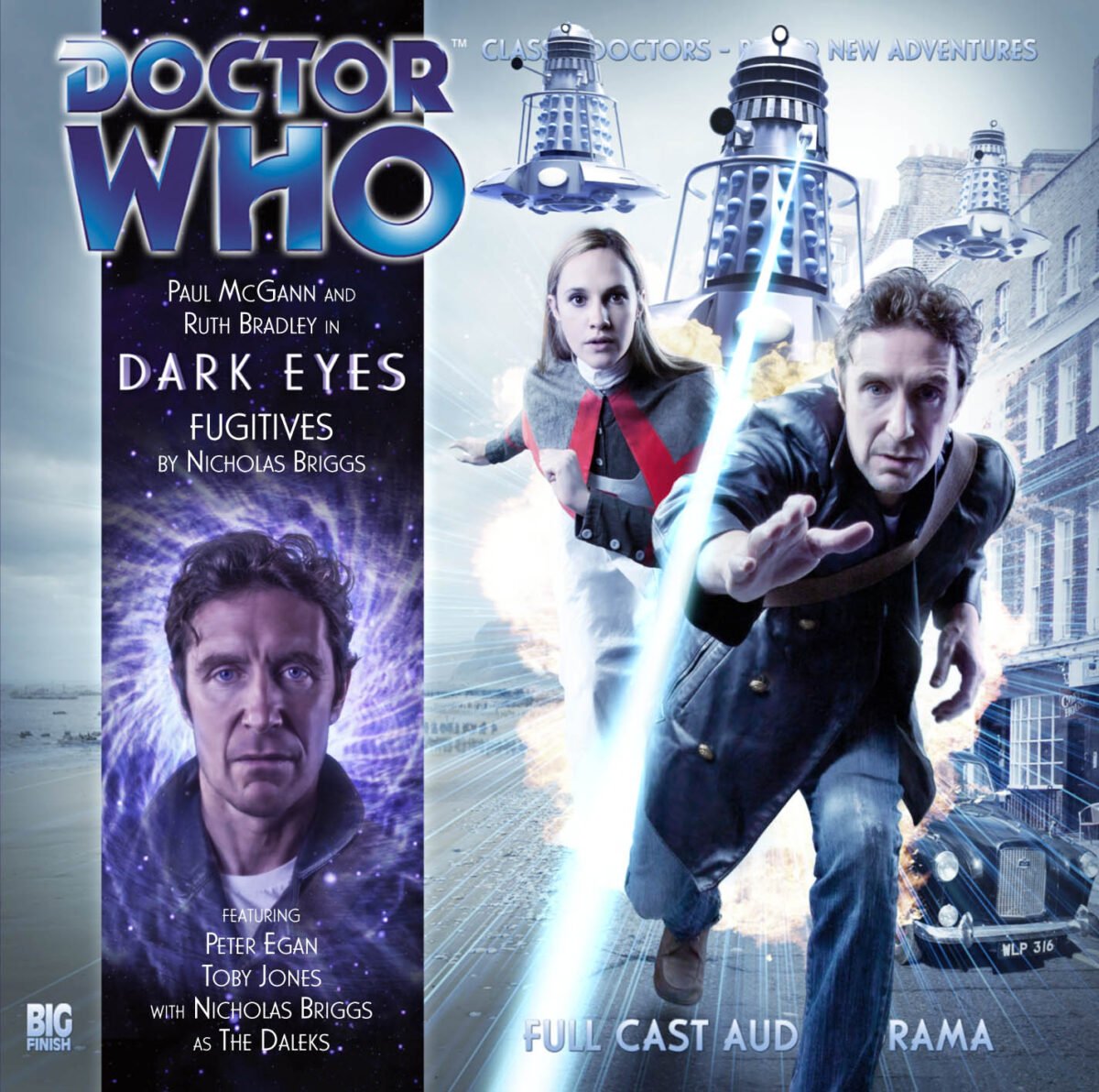
I’m not left disappointed. At the same time though, I am left with my head swimming… This is incredibly fast in its pacing, and lots of questions are left unaddressed over just what is going on here, and where these Daleks and the Emperor really came from. Were they really a resurrected Evil of the Daleks cast, or some temporary manifested time paradox, like the Doctor himself here?
War of the Morai
The Doctor and friends dash back to the Vanishing Point, hoping to warn Ananke and the Morai of an impending invasion. However, what they discover is a fiendish plan in operation and a population in exile.
Zoe must resort to an extraordinary use of her own mental powers, while the Doctor, Raven and Jamie fight to restore order and save the universe.
“The Dalek invasion of time and space begiiinns!“
It’s a retreat back to the Vanishing Point facility, as the gang tries to head off the resurgent Daleks who are now in possession of the knowledge of where and what this facility is. We have a Dalek Emperor who has Time Lord DNA, and is apparently trying to fully restart his empire and restore Skaro to dominance, and everything is moving so fast at this point that this entire Second Doctor range may be in danger of throwing itself over the edge! The two authors are in danger of leaving the poor listener behind.
It’s Zoe Herriot who gets to shine with this story. Alone, forced to face the Emperor head on, while the Doctor, Raven, and Jamie learn more about the Morai people who devised and operated the Vanishing Point. It’s a play on the pacifism versus affirmative action themes of the 1960s television episodes, and while the pace of this chapter is rather slow compared to what came before, the way in which Mark Wright develops the dilemma is intelligently handled. I can’t quite fault this story as it does great service to its cast for the most part, and ties up its themes about the need to fight back against evil in a very satisfying way that also seems to close the entire Dalek storyline at hand…
But it also leaves behind some nagging doubts as well. The lack of care in fully explaining the Daleks’ return leaves questions in the air; Raven herself is expressing some of them as she has no idea whether she was always working for the Daleks, whether the Time Lord Council knows what is happening, or just what the Doctor’s role in all of this was intended to be. The true nature of the Kippers is quietly put aside, as if Briggs and Wright changed the story as it went along, and so made them redundant to the changed plot. And all in all, despite its high quality and strong praise from me, I am left wondering where it goes from here. I have had the strong suspicion since the last release that Briggs and Wright were abruptly condensing their original planned storyline and were having to take some shortcuts in order to get the story into the studio — that sense of haste and last-minute truncating appears with this latest release too. Were plans changed?
This release was scheduled for an April/May 2025 release. Delayed a number of months for whatever reason, it was finally recorded in only June 2025, and as such, because all the stories since 2024’s release are interlinked and flow straight into the other, this current release is a demanding one, even to the devoted listener like me. I certainly cannot say I could hand this latest release to someone and expect them to have any real idea what is going on.
In real terms, this Second Doctor range is Briggs’ passion project. He is its chief architect and champion; he weaves in threads from his Dark Eyes storyline and Dalek mythology, and along with Mark Wright, he does wonderful storytelling work here on the whole. But it is a series that you have to be devoted to from the very start: you cannot come into this series with the third or fourth release, as it will leave you too far out in the cold. But if you love long-form storytelling, want a Dalek-themed full-on epic, love the Troughton era and would like a revival of it, then this series is just for you!
The Second Doctor Adventures: The Potential Daleks is out now from Big Finish.