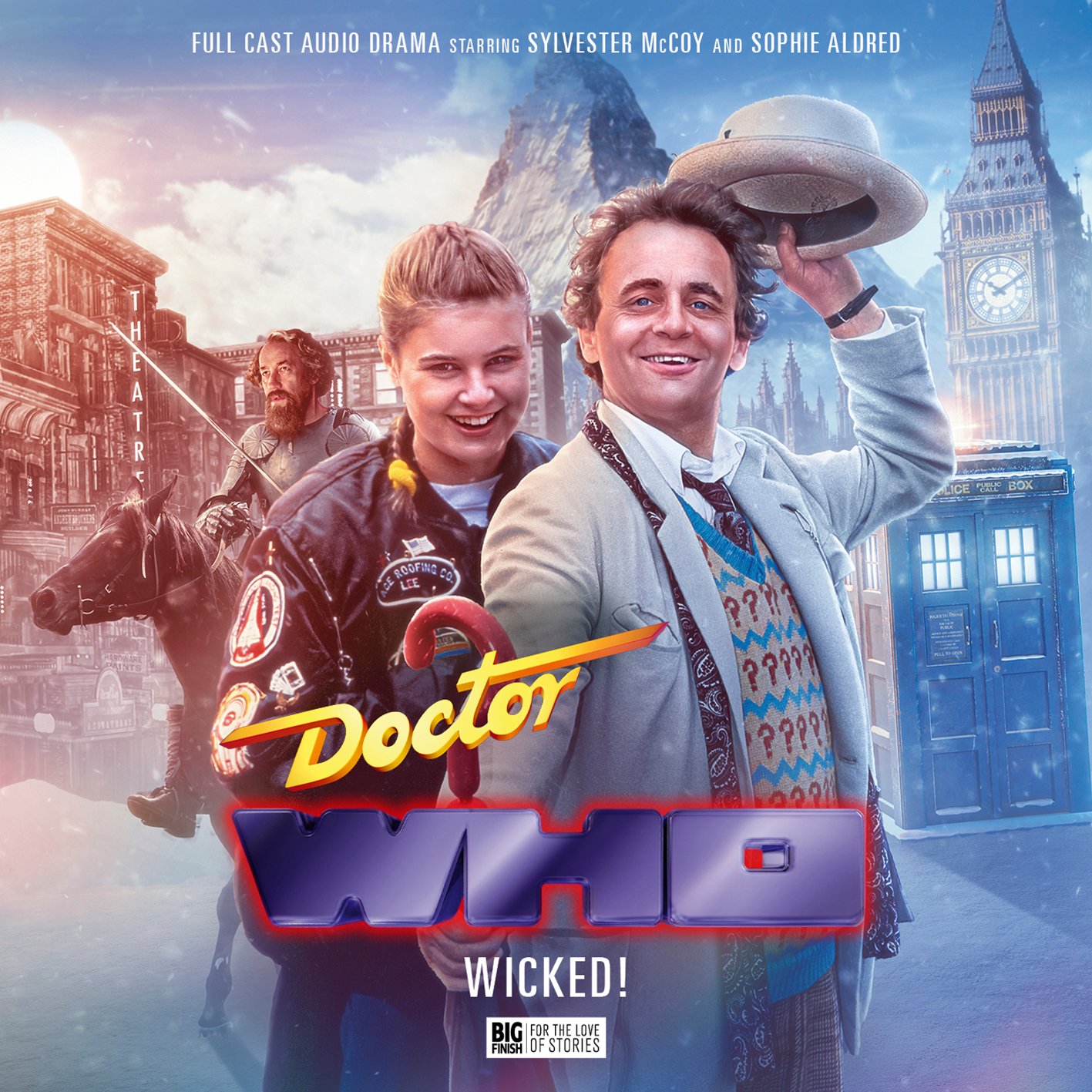
In hindsight, it is a remarkable point to note that in all of the considerable 30-odd years of output of Virgin and BBC Novels, Big Finish audio plays, and even comics, there has rarely, if ever, been an exploration of the gap between the 1987 series of televised Doctor Who, and the recalibration of the style and tone that came with the following 1988 season — the distance between what was seen in Dragonfire (1987) and Remembrance of the Daleks (1988) seems to encompass at least two years of naturing for new companion Ace, and an equally dramatic shift in mood and outlook for this new Doctor in Sylvester McCoy. Clearly, some extensive amount of time has passed for the two, and allowed for this maturing of both their individual characters and their relationship.
It’s a fascinating evolution to experience on-screen. But the question of what went on between these two series, to allow the immature sixteen-year-old Ace seen in her debut in Dragonfire, to the older and more restrained woman in Remembrance of the Daleks in the next series went unaddressed in the 1990s Virgin novels, and even Big Finish didn’t see the obvious need for some exploration of the gap… until now.
Wicked!, therefore, has a lot of expectation being put upon it. I suspect, like myself, it is a release that has drawn in a lot of people who don’t usually follow this Sylvester McCoy range, and we all expect it to be that bridge ‘season’ between the 1987 and 1988 series on television. It needs to feel ‘authentic’; it needs to recapture the style and feel of that era; and given that its two lead actors are being asked to go back to 1987 and recapture their performances of that time, and the mood of the series at the time, this is surely too enormous a bridge to ask them to cross… Surely?!
As it stands, I am very impressed, because I can tell you that recapturing that time in their lives is exactly what Sophie Aldred and Sylvester McCoy do! Aldred is at retirement age today, so being asked to recapture the sixteen-year-old she played back then seems slightly absurd, but Aldred defies all expectation because I cannot tell the difference between the Ace that she played in Dragonfire, and the Ace she plays in this boxset’s opening story, Running in Heels. It is a flawless continuation that she somehow manages to achieve, and so, along with Sylvester McCoy, the relationship and special chemistry the two has together does half of the job in selling this new release to us. Two great personalities, with a lot of warmth for the other, and in their own way, every bit as appealing and successful as the Tom Baker and Elisabeth Sladen partnership.
There are three stories with his release, all varying in terms of content and quality, but all three serve a shared purpose in examining different aspects of the early relationship between the Doctor and his rebellious new teenage companion, and getting to the root of just what that relationship was, what was it that the two were looking for from each other…
Backwards and in Heels
by Alison WinterThe Doctor has offered young Ace a lift home from Iceworld, promising the scenic route home to Perivale.
But when they are diverted to 1920s Soho on what appears to be shady business, Ace wonders if she’s making the right choices, let alone in the right order.
Picking up just minutes after the close of Dragonfire, this story opens with an impressive jumping on point as young Ace walks into the TARDIS for the first time and the Doctor (and Alison Winter!) takes the opportunity to reintroduce the audience to both these two characters, and the show itself. The way it is constructed is similar to new companion Victoria’s arrival into the ship at the start of The Tomb of the Cybermen, and the whole sequence is played by Aldred and McCoy with amazing energy, and feeling as if it came right out of that 1987 series on television. The positive aspect here is that this is, therefore, a release that you could hand to most people, and they would be eased into the series and its format with a friendly invite to do so, and with both leads making you feel you are a welcome part of it… Alison Winter’s dialogue and pace here sparkles, as does the two leads’ performance.
Out of the three stories on this release, this is the one that feels the most faithful and authentic to this era. This is the story that bridges the gap between the 1987 and 1988 television series, and, in a neat and quiet way, Ms Winter sets up what is to follow in 1988 and 1989.
We have the rebelliousness and immaturity of a young Ace – running away from her past, from everything, and yet at the same time looking for something to hold onto. The Doctor is an ideal ‘father’ figure, Alison Winter seizes on this aspect by having Ace be the Doctor’s daughter for this story as a plot-point, and, arriving in 1920s London, the two become embroiled in a game that sees a disembodied entity rigging the odds in order to win the prize… and this set-up again allows Winter to address this Doctor’s gradual shift between television seasons to become a more manipulative and secretive figure.

It isn’t that he is malicious — this isn’t the extreme Doctor seen in the Virgin Novels in the 1990s; rather, it is a question of him entering a phase where he is now having to face challenges and beings who operate on a level beyond the human, and who are capable of playing the environment around them in a way that stacks the odds in their favour — most notably Fenric, but also The Gods of Ragnarok, and the entity now operating here in 1920s London.
How do you fight back against beings who have partial omniscience? Beings who can influence the minds of the people in their vicinity? Who can play a long game, patiently stacking the odds in their own favour? You do it by operating in stealth, keeping your hand to yourself, and minimising the risks to others. Which is why the Doctor slowly shifts from the clownish babbling figure seen in 1987, to the more reserved and focused one arriving in 1988. It’s a point that Alison Winter puts over quietly here, and as in other areas, gives her audience the intelligence to spot as the story unfolds, and draw their own enjoyment from seeing how the Doctor is beginning to adapt his approach, and find the strategy that works for him.
It’s one of the strengths of this 1980s era Doctor Who that the loss of the sonic screwdriver pushed the format into a more natural pace of storytelling, and evolve the Doctor to become a more cerebral figure. It’s seen in the McCoy era the strongest as this was the Doctor who was physically the weakest since Tom Baker, and so needed to adapt his approach to offset that physical limitation. Choosing Ace was one way of balancing his needs; the other was becoming much more strategic in his methods, and a good deal more thoughtful, and patient, about everything he was doing…
This is an excellent story. It is everything you would want from this ‘bridging season’ of Doctor Who, and every element is served up beautifully from all concerned – the cast, the writer, the backroom production staff, and a special mention here for the music: a well judged incidental score that uses Keff McCulloch’s (terrible!) 1987 synthesiser style, and balances it with the quieter and considered style of 1988’s Mark Ayres. The changeover in musicians was one of the great contributors to the creative success of the 1988 series.
The only fly in the ointment with this story is a jaw-droppingly poor insert in the second part of the story, as Tales From the TARDIS intrudes into the story… It is so out of place here that it pulled me out of the story. It reminded me that this isn’t 1987; it is some fan-audio production made 30-odd years later by fans, for fans. I am not going to dwell on this scene, however, as apart from this, and the very unlikely story title of Backwards in Heels, everything else in this story was so well judged and produced. Put that scene aside, and this is a fine example of a story that is Big Finish at its very best — all aspects of production coming together in a very professional and committed manner, to produce excellence!
The Price of Snow
by Katharine ArmitageSki resort Val du Cam Belle is ‘the place to be’ for the 1% of the near future. But the Doctor and Ace discover sinister shadows beneath the surface of this winter wonderland.
The sun is too hot, the shade is too dark and nothing is quite what it seems…
I’ve enjoyed Katharine Armitage’s work elsewhere at Big Finish; this story, though, is a bit of a lapse from her previous standard as, while the basic idea is a good interesting one that involves killer alien beings inhabiting snow on the slopes of a ski resort in France, and concludes with a logical enough ending, the rest of it between those two points feels to me like a first-draft script.
There isn’t much of any chance that this story could have been filmed on a 1987 Doctor Who budget. It relies on outdoor settings, on a ski piste, and snow fields, and skiers seen to be disappearing on it… So this is a story that can only be produced with an audio landscape. Fine. But then there is the actual content, which consists of an ill-fitted cast of characters with very bad accents: the year is 2076, so why is there some chap who has apparently stepped out of turn-of-the-century Eton College, complete with the accompanying posh accent, and a French chap with an equally unconvincing OTT Accent? But wait, then we find the owner of the resort is a Scotsman, with as Scots an accent as it is possible to have! Why is there a cash register heard ringing and opening, in the year 2076?! And why is it that… oh, never mind.
This unevenness is actually quite faithful to the 1987 season of Doctor Who, so it’s not fair to be too hard on all of this. But there is also a running thread with Ace’s immaturity and rebelliousness that quickly becomes irritating; her simplistic and muddled take on the class system is childlike and to be expected of her character at the time of Dragonfire, but combined with a shaky premise where a mad Scotsman is happy to let alien beings devour 10% of his and the area’s own hospitality guests, and that no one is really noticing this massive loss of people in such a tight and focused area, and the story loses most of its credibility.
It’s not disastrously poor; it’s just not been thought through properly. But then, that was typical of the 1987 season too, and so I have to admit that it adds to the ‘faithfulness’ of this boxset of stories…
Interestingly this story uses a complete Keff McCulloch style music throughout. So that places it very nicely into that distinct and very shaky 1987 era in Doctor Who seen on television!
The Ingenious Gentlemen
by Alan RonaldFiction and reality collide when a mad man with a box and a mad man with a horse encounter an ancient evil in 15th century Spain.
But the adventurer-and-companion setup is a little too familiar to Ace, and she begins to question if she is anything more than a Sancho to the Doctor’s Quixote.
A story that takes its cue from Vincent and the Doctor, and sees a first with the TARDIS landing inside a Windmill(!), and the Doctor meeting his hero and inspiration – Don Quixote.
This is another story that is a little hard to see being produced on-screen at the time it is set (1987), but on the other hand, the style and tone of it is farce, and so would actually sit well in the 1987 season… Unquestionably, though, the star here is the superb Simon Callow as the eccentric and excitable Don Quixote. Even though much of the script and story is intentional madness, Callow is never less that 100% committed to selling both it and his character. His mania is what holds it all together.
The story is derivative of Vincent and the Doctor; it follows similar story beats. Here, the Doctor and Ace find that Don Quixote is apparently a real person, not just a work of fiction, and while Simon Callow presents a mentally unbalanced man who thrives on fantasies and conspiracies, there are also clear traces of the heroism underneath the madness — it’s up to the Doctor and Ace to pull it forth, however.
Underneath the rambling plot and repetitiveness, this is a nice character piece, one that uses Quixote and his loyal squire to both contrast and prove the relationship between the Doctor and Ace, with the latter trying to work out just what that relationship is and establish its boundaries. But while McCoy and Aldred’s strong rapport is the very bedrock of these three stories, Callow here in the final story is excellent. Too excellent. By having such a dominant part, and a huge portion of this story’s runtime, he shows off all of Sylvester McCoy’s shortcomings… but then this is what is to be expected if you cast one of the finest actors currently working in England.
I’m not familiar with writer Alan Ronald, and as far as I can see he has written very little for Big Finish to date. This story does drag; I found it a chore for much of its length and without Simon Callow’s energy and commitment, I wouldn’t have seen it through to the end — he is the one element in it that makes it worth staying with. But this is possibly as much a matter of taste as it is of quality: if you are in the mood for a rambling farce, then this might be for you.
Overall though, this is still an impressive set of stories. It’s an uneven set of stories, yes, but as a demonstration of what the bridge between the 1987 and 1988 television series might have contained, this release does a very good job indeed. The icing on the cake is the amazing Sophie Aldred, recapturing a part she played in 1987 flawlessly, and Sylvester McCoy joining her in so successfully recreating a relationship from over 30 years ago…!
The Seventh Doctor Adventures: Wicked! is available now from Big Finish.