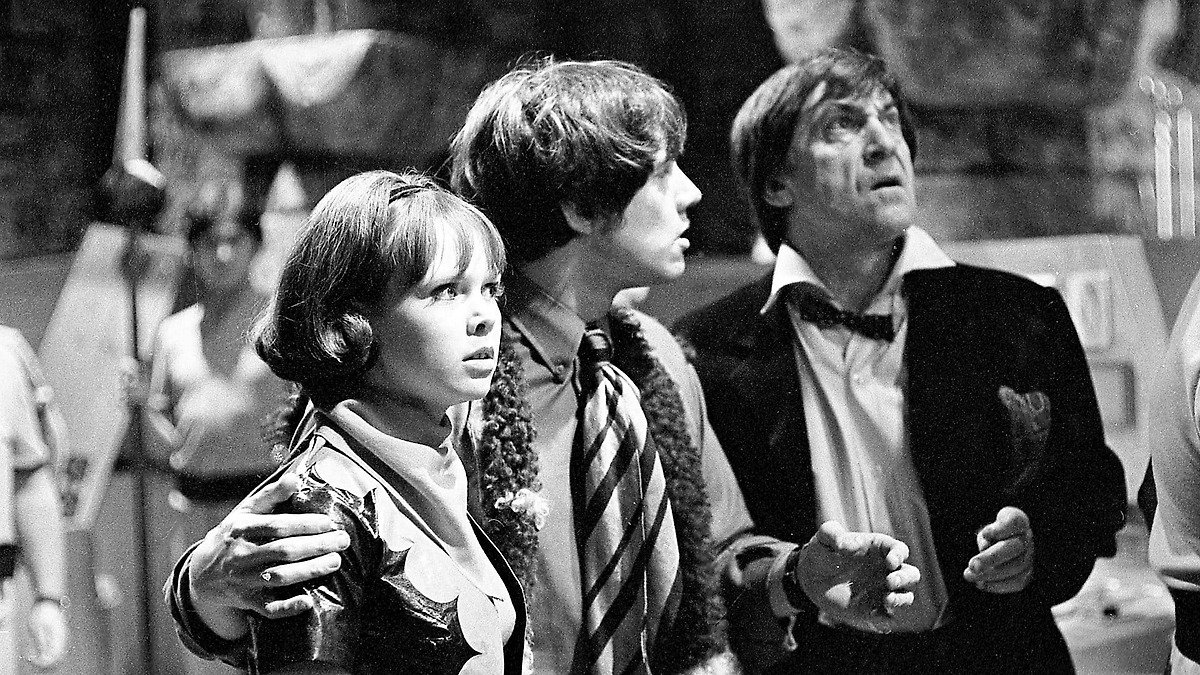
In Exterminate! Regenerate!, John Higgs writes extensively about the abandoned 1968/9 Patrick Troughton story, The Prison in Space. Higgs opines that the story was a departure for the series, in that it was the first sex comedy ever commissioned for Doctor Who; he goes on to explain that it was so dreadful that Derrick Sherwin abandoned it at the last minute. It was replaced by The Krotons.
Intrigued, I downloaded and read the script of The Prison in Space, still available from Nothing at the End of the Lane as a PDF for £5.00. Given its reputation, I was surprised that I actually quite enjoyed the story and thought it was not nearly as bad as most reviewers thought.
Who was Dick Sharples, the writer? Well, he wrote for the script for the second movie of On The Buses, a huge hit for ITV in the 1970s and synonymous with some cultural commentators for smut and sexism. The Prison in Space is certainly of its time, as Sharples admits in an interview with Nothing At The End of the Lane.
The Prison in Space is the story of a future Earth society ruled by women, in which men are classed as inferiors and generally bossed about. This was the stuff to make male viewers chortle in the 1960s. The prison itself is where convicts, all male, are sent: some of them, like Albert (described as a “Bernard Cribbins type”), end up there because they question the rule of the all-powerful ruler Chairman Babs. The script is certainly sexist; it’s the sexism of the early 1960s Carry On films rather than the toxic, hate-filled misogyny we sometimes see in the present day. The story as a whole recalls the tone of Carry On Cabby. This 1963 black-and-white movie features Hattie Jacques as Peggy, wife of Charlie Hawkins (Sid James), who owns a cab company. Wanting to get back at her husband, Peggy secretly starts a rival cab company – Glam Cabs – under the name of Mrs Glam. These Glam Cabs are driven by conventionally attractive women, and Glam Cabs, surprise, surprise, starts to steal Charlie’s business: not least because their drivers are more appealing to men than Charlie’s singularly unglamorous cabbies.
Carry on Cabby was regularly shown by the BBC in the 1970s and I was allowed to watch it as a very young child. That my father, a vicar, thought that the movie was suitable for me suggests that Derrick Sherwin was not completely off his rocker in thinking that The Prison in Space might work for Doctor Who. After all, the show was often regarded in the 1960s as primarily for children, although it was loved by adults (audience research soon demonstrated that most of its original BBC viewers were adults).
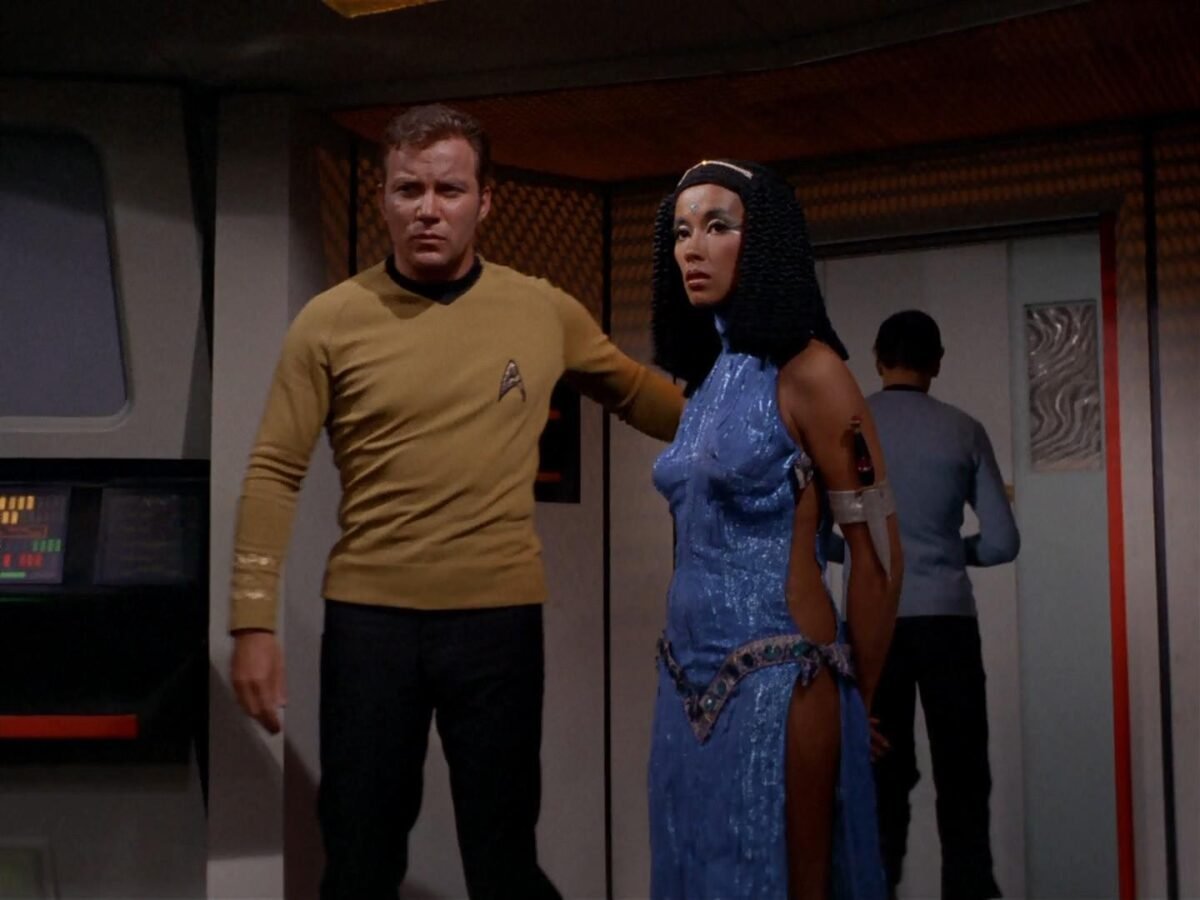
The sexism of the script is very apparent in Sharples’ descriptions of the costumes of the female Guards. Sharples specifies that the costumes should be revealing of cleavage, tummy, thighs, and so on – not entirely dissimilar, then, to the costumes women were expected to wear in contemporaneous episodes of Star Trek. Bobi Bartlett, the costume designer, said she was excited to be working on the production and had done some sketches of leather costumes; she was very disappointed when the production was cancelled. The guards are unfortunately called Dolly Guards in the script, but they are never named as such on screen. This makes us wince now, but was contemporary slang: attractive, and usually subservient women in the 1960s were sometimes called “dolly birds”. Indeed, an interviewee in the 1977 BBC documentary, Whose Doctor Who? recalls that her boss asked her, “Have you seen Doctor Who’s new dolly bird?” (Presumably Leela due to the year).
Sharples has lots of fun in making Jamie McCrimmon dress up as a Dolly Guard in episode three: the Doctor reasons that he is used to wearing a skirt and is the only one of their fellow prisoners who could get away with disguising himself thus. Higgs correctly comments that Jamie in a microskirt would have been a treat for all ages.
The leader of the totalitarian society in The Prison in Space is called Chairman Babs. This is presumably a reference to the senior Labour Cabinet Minister Barbara Castle, Prime Minister Harold Wilson’s number two in the Labour cabinet of 1968. The joke is lost now, but would have raised a smile among some, perhaps especially among those dinosaurs who thought it absurd that women should wield power. (Britain didn’t get its first female Prime Minister for another eleven years.) Chairman Babs is depicted as a Big Brother figure – the sets were to be adorned with posters announcing, “Chairman Babs is Watching You” – and, in the first draft, she was alarming and powerful. Sharples said to the production team that they should “think Hattie Jacques” when imagining and casting her, and this link to Carry on Cabby (did Sharples have that movie in mind while he was writing?) carried over to his suggested casting for Minnie, Chairman Babs’ sidekick: Esme Cannon. Cannon had played Hattie Jacques’ deputy Flo Sims in Carry on Cabby.
Apparently responding to instructions from the production team, Sharples amended the character of Chairman Babs in his second draft, to make her fancy the Doctor – the first real man she’s ever met – and she sighs and swoons over him for four episodes. This interesting innovation anticipated the development, 40 years later, of Rose and Martha’s noisy pining after the Doctor. Chairman Babs’ crush peaks with her chasing the Doctor through her roof garden, Patrick Troughton protesting throughout, as he tries to reach the TARDIS.
Zoe is hypnotised and turned against the Doctor. She becomes a Guard and Jamie takes the initiative, as an unreconstructed Highlander, to spank some sense into her – thus breaking the hypnosis. Spanking and science fiction were also yoked together in the Star Trek episode, Elaan of Troyius – broadcast on NBC at almost exactly the same time that The Prison in Space was in pre-production, 20th December, 1968 – when Captain Kirk threatens to spank Elaan if she doesn’t behave herself on the Enterprise.
Spankings and sexist uniforms aside, The Prison in Space is actually quite an engaging story, and there is much fun to be had along the way. There are some good, strong characters in Chairman Babs and her deputies. It would have been one of the first stories since Galaxy Four (1965) to feature a largely female cast: this at a time when many Doctor Who stories had no female characters other than the Doctor’s companion, and the story would have provided much work for under-employed actresses at the end of the 1960s.
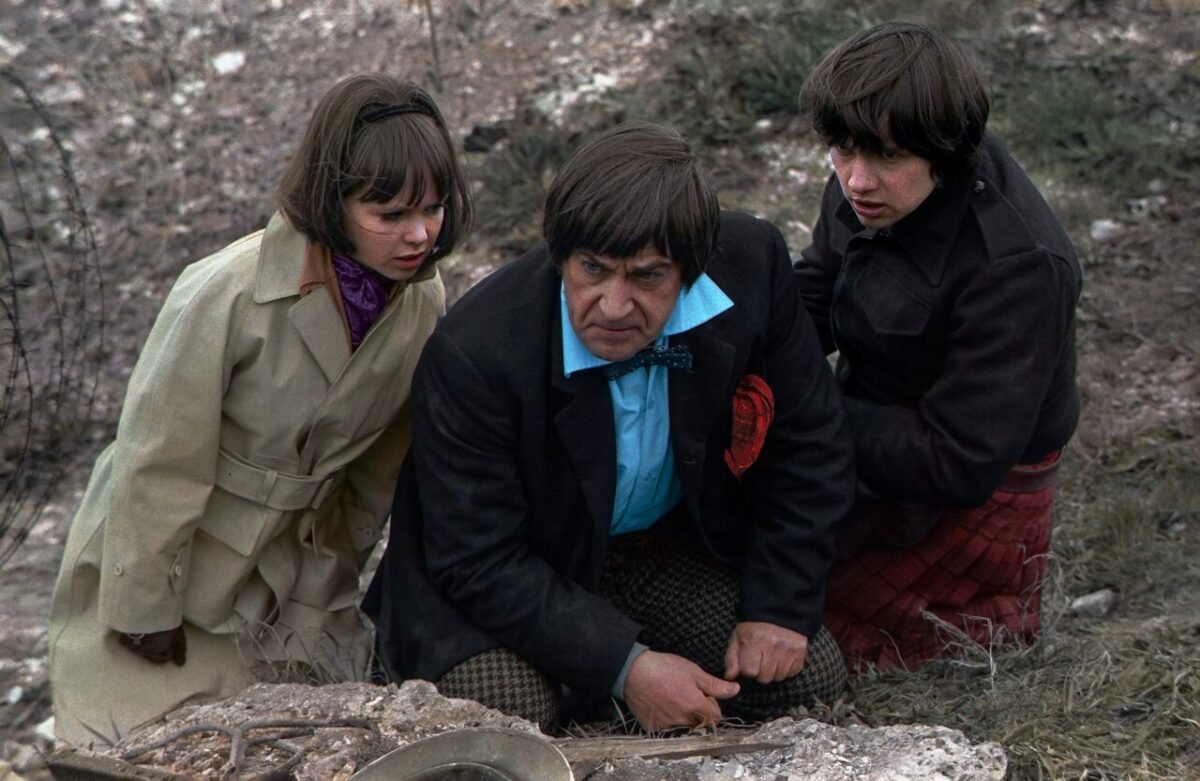
Perhaps the reason the story was abandoned was not, as legend has it, because of its tone and sexism but simply because it becomes a little dull and repetitive in episodes three and four. Script editor Terrance Dicks and producer Derrick Sherwin were unhappy with episode three in particular, which features lots of escaping and being recaptured, and running down corridors – making the story a pretty standard one of its era. Sharples includes a huge number of characters and non-speaking extras (guards and convicts), which would have perhaps been expensive, and the female characters are, aside from Minnie and Chairman Babs, very undifferentiated. Dicks could have amalgamated some of the subsidiary characters to save money, but there really isn’t enough material to sustain four episodes. There is plenty for three episodes, but Doctor Who didn’t really make three-parters, and the repetitive script, rather than the sexism, is presumably why The Krotons was substituted at the last minute. This is ironic as The Krotons is far from a classic, and it could be argued it’s not nearly as good as The Prison In Space. Frazer Hines said at the 1981 Panopticon convention that he, Troughton, and Wendy Padbury thought The Krotons was a very poor script and one of their least favourite episodes from their time on the show.
With a bit more work, The Prison in Space could have been a lot more fun than The Krotons. Had it been made, I think it would be seen today as a period piece as interesting, and offensive or inoffensive, as Carry On Cabby, which it strongly resembles.


