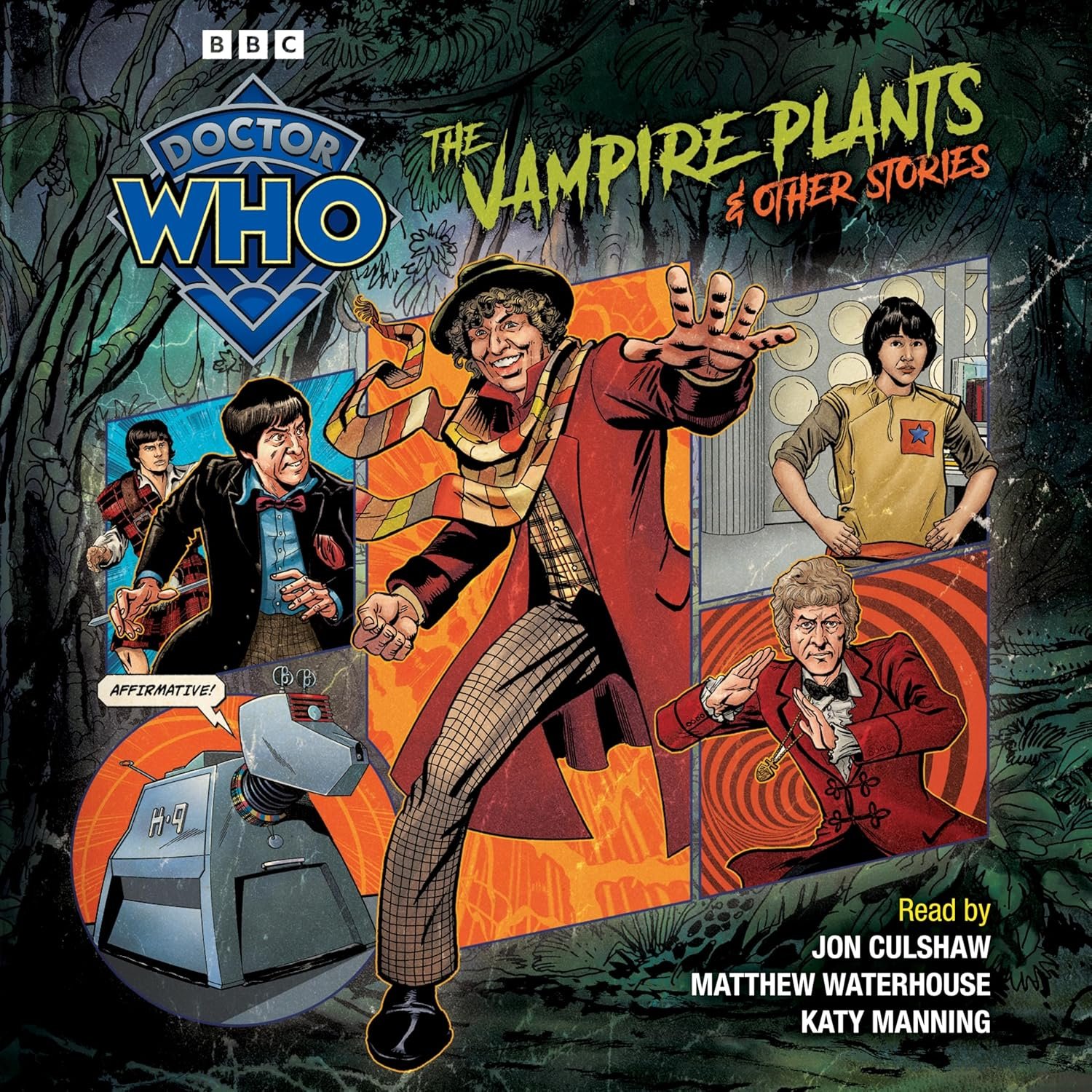
Within the context of a now saturated audio market and ideas for new lines of interest to tempt an audience, and help fill up a publisher’s release schedule, no subject or concept is out of consideration for exploitation. This has proven especially so, as there are some truly remarkable choices for a release out there! And whoever it was who came up with the idea of tapping into old and dated Doctor Who Annuals from the Sixties, Seventies, and Eighties can certainly be accused of scraping the depths of the metaphorical barrel…
No one was asking for these Audio Annuals, and it may be comparatively few are actually purchasing them. But, what are they actually like? Is the prejudice justified, or perhaps a little unfair?
The Vampire Plants
Jon Culshaw reads a very accessible and audience-friendly translation of a story that appeared in the 1967 Annual. With a gentle and almost childlike wonder, Culshaw’s delivery is instantly involving to listen to, and the introduction to the TARDIS, Jamie, Zoe, and the impish Second Doctor does make you realise just what is very often missing from Doctor Who drama on audio: this is a BBC Audio release, and I could hand this to anyone! It’s wonderful.
Anyone old enough to remember the BBC’s Jackanory will recognise the delivery style by Culshaw; an in-person, friendly, and engaging reading of a story, interspersed with him supplying the voice recreations of the characters to add variation to the delivery. In truth, I was apprehensive about this release: the stories in the Doctor Who Annuals were often not the most faithful to the television series and were written and drawn by people with only a distant knowledge and understanding of the show and its characters. These stories would often read as very strange to young fans who were watching the television counterpart!
Confusingly, the disc inserts for this story show the Cyberman annual cover; this was the annual that actually featured Victoria, with one comic strip featuring Polly as I remember. In fact, though The Vampire Plants actually comes from the final Patrick Troughton annual, with a photo cover of him leaning over the TARDIS console, and with nothing more than a six-page comic strip within. This a very simple (and crudely drawn) strip that has been considerably expanded by Paul Magrs, for the better, and yet with an impressive attention to keeping to the spirit of those annuals, and the audience they were aimed at. The action for this story involves the Doctor and Jamie arriving on Venus to visit a famous botanist and scientist, and muse on the dangers and wonders of outer space. Magrs also delivers a dark and amoral conclusion that seems a little out of place with the overall tone and context of these stories and annuals. You will either love it, or frown on it.
Menace of the Molags
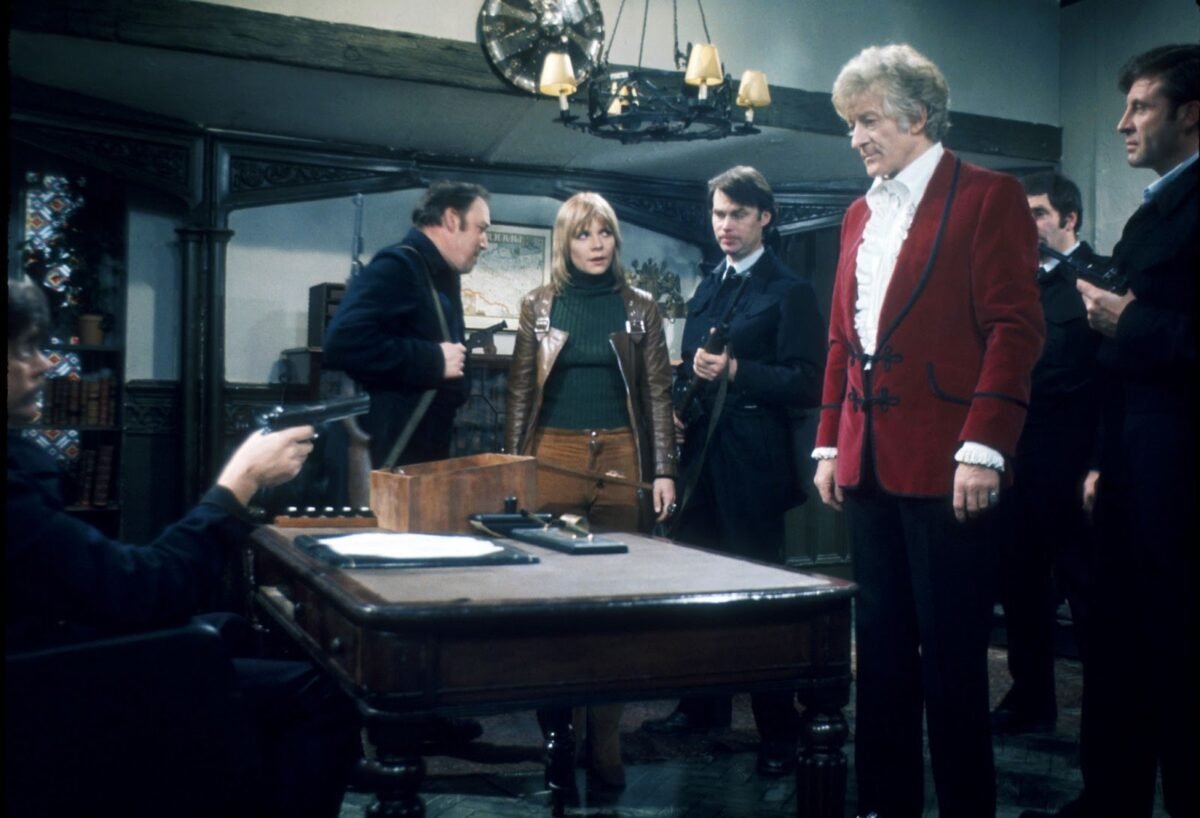
Off to the latter Jon Pertwee annuals and a tale read by a very excitable Katy Manning this time. This one is bare bones UNIT era pastiche — a world where the irate Brigadier spends his time sitting around waiting for the next alien invasion, and duly gets one that involves spacecraft arriving all over the capital cities of the world. All before lunch.
It’s a little hard to tell whether it is Paul Magrs’ doing, or Katy Manning’s with her tongue in cheek delivery, but this one is quite droll to follow initially — so simple and innocent in its telling that you cannot help but find it a charming take on what the UNIT era was about.
It’s actually a lot of fun; it does meander three-quarters through, but makes some neat if basic points about not judging by appearances by the story’s conclusion — completely in-keeping with the era it is set in. It starts as a bit of fun, but then poses some worthy questions and dilemmas. Magrs even links it in to the previous story, The Vampire Plants. Which emphasises the considerable hand he has in producing this release as a whole, and an effort to have it all boast a little more consistency than a typical annual did actually have back in the day…
Menace of the Molags, again, was another six-page comic strip originally. Illustrated by Steve Livesey, this 1974 strip is a more polished and sophisticated effort than the one seen in the 1969 Annual, marking how the television series itself had matured and evolved in the years since. Magrs has more to work off here as it was a wordy comic strip, but again, he does expand on it nicely by simply extending the individual scenes seen in the strip, giving each some proper context and background. And for the sake of modern aesthetics, he takes time to make sense of some of the artist’s choices at the time.
After the Revolution
“I’ve been away from the Universe too long. I need to check up on how everyone is getting by without me!”
The Doctor takes Jo off on a trip in the TARDIS, to a world he once helped out in a time of turmoil, and discovers things haven’t developed as he would have wished…
Based on another six-page — and surprisingly dense — comic strip in the 1975 Annual, this one had quite nice art by Edgar Hodges, but his work is swamped-out with truly horrendous two-tone colouring that makes it hard to look at.
The strong story gives Paul Magrs a very good grounding for his adaptation here, morally shaded and with different points of view involved. ‘Dr Who’ discovers a society that isn’t as free as first appearances would suggest, and his own ethics are tested to the full. Katy Manning is astutely responding to the more serious tone of this story and delivers a calmer, conventional reading than the previous story.
It’s still thoroughly engaging, however!
Plague World

Another six page comic strip, in the 1981 Annual, forms the basis of this final story. While visually impressive to look at, with its clear and strong artwork and in full colour at last, this story is also a noticeably grislier affair. An insectoid race harvesting human flesh to feed to their young – there’s a fair bit to say here on how times were changing by 1981 — darkening — but given Paul Magrs left the first story, The Vampire Plants, on a similarly unsettling tone, it’s fair to say there is good symmetry at work here. The plain truth is, though, that Magrs takes what is in the Plague World strip, and carries it to another level of unpleasantness. It nudges the release as a whole out of being all-ages entertainment, and into something adults-only. I am amazed that the script, and finished sound design, made it through the BBC editorial stages to being accepted for publication.
Matthew Waterhouse reads the story, and the first words are taken directly from the first paragraph of the comic itself; I found that fascinating as a choice as it shows that Paul Magrs might not have been as enthralled by this 1981 strip as he was with the previous three. I can possibly see why this might be: the pairing of the Fourth Doctor with the space waif that was Adric simply doesn’t have the grounding and energy that Jo Grant and the Doctor did, or, for that matter, Jamie and the Doctor. The dynamism simply isn’t there: all there is is a mechanical and very basic pairing of master and assistant…
Waterhouse’s delivery is stark, and devoid of the warmth or sense of companionship of Katy Manning or Jon Culshaw. In a sense, you can argue it suits the bluntness of the material, but after bubbling along merrily on those three previous readings, ending with this final, funereal, sombre reading is an unwise choice. Waterhouse could be defended as merely responding to the grim nature of the material, and it is grim. You could argue that the four stories act as a measurement of how the annuals evolved, as a reflection of their times. But that isn’t what this release is packaged for — it is being produced as all-ages entertainment. To launch the first three stories as bubbly adventure and escapist, then produce the closing story as a post-apocalyptic misery of flesh-eating insects, shows a failure in the delivery. A sad flaw in the overall packaging.
That’s more of a criticism than an absolute damnation though. This was a very interesting, and in the end very entertaining, release that shows off the difference between BBC Audio and Big Finish. The BBC is conscious of the mass audience, the public, and it may also be a factor that, since a large percentage of their customers will be brought in from online stores (primarily Amazon), this is the wide potential audience they produce the discs for. BBC Audio is still focused on physical media releases, hence appealing to mass-market platforms is vital. But the openness of their Doctor Who productions is something I have found increasingly refreshing — and this Audio Annual is a very fine example of their approach.
These Audio Annuals are oddities. If you like an accessible and easy-to-follow set of short stories on audio, please do give these a go! Despite what the source material and first appearances suggest, these are actually a lot of fun to listen to, and have been well crafted: these are not lazily thrown-together releases. In a surprising way, they don’t talk down to you either…!
Doctor Who: The Vampire Plants & Other Stories is available now.