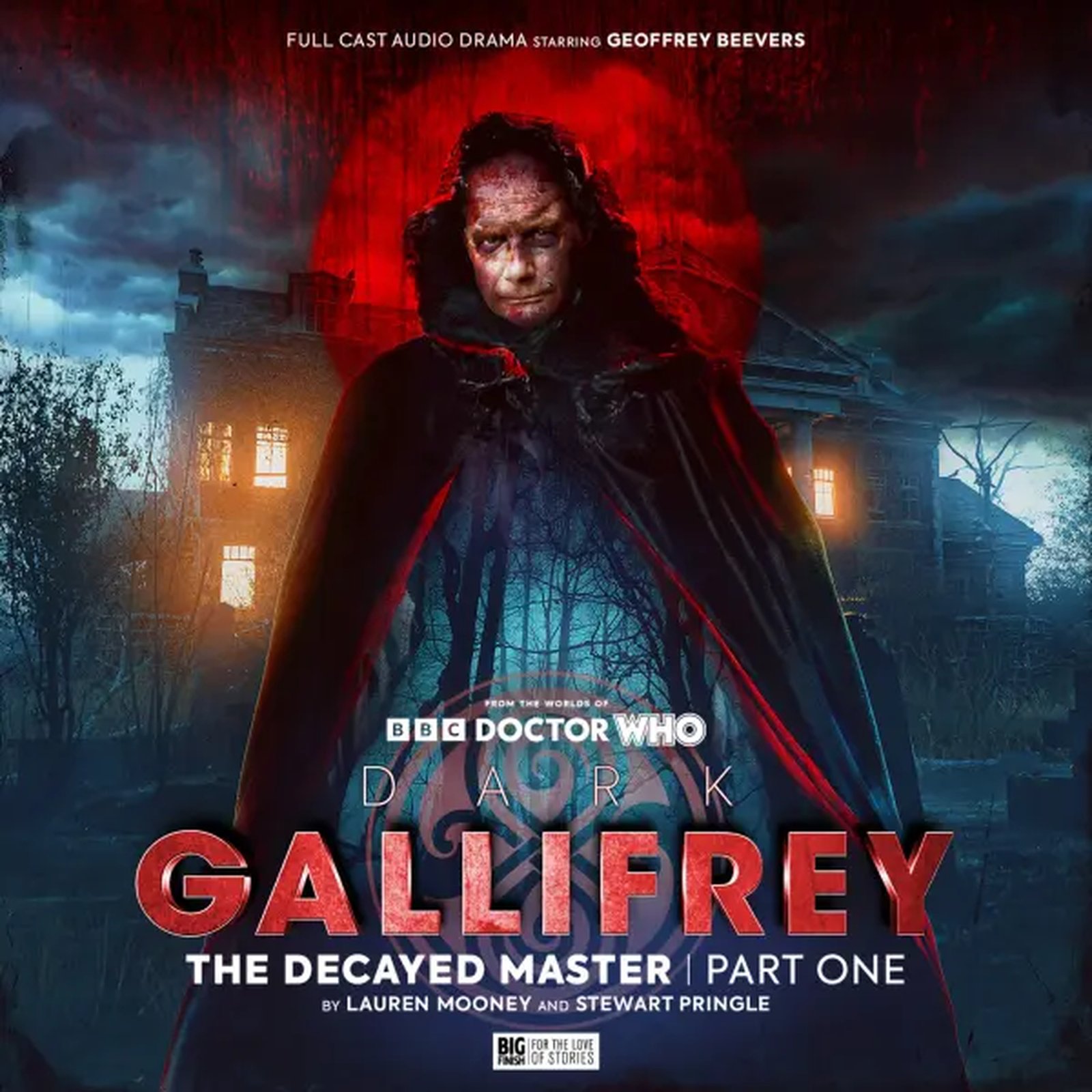
It’s all about Geoffrey Beevers when you come down to it. Anyone looking at this Dark Gallifrey strand from Big Finish is going to be left with puzzlement, and quite possibly indifference due to the sheer opaqueness of its marketing and premise. But when you look past that, and note who and what the latest star of the release is, that will be the element that triggers your curiosity as an onlooker, and hopefully in turn your interest…
And while on the one hand, I can be cynical and say that that’s about as smart as the marketing is here from Big Finish Productions, I have to also make the point that the actual selling point will be the star appeal of the particular character featured in the latest set of releases in this very niche range. That, and the calibre of actors involved. And so we come to a trilogy of single-disc 70-minute releases, scheduled over July, August, and September, featuring the grisly charred and disturbing version of the Master seen in 1981’s televised story, The Keeper of Traken.
It’s never been fully explained where this Master came from, just how he came to be diminished to the uneasy stature of this shuffling living corpse – “Like something that’s crawled out of a grave,” as one terrified character in this release notes. Keeping to shadows, clinging barely to existence, covered in a tattered cloak and hood, he is the stuff of nightmares. But it was the memorable performance from Geoffrey Beevers that cemented his enduring appeal across the decades. And the vocal presence of such a seasoned stage actor, just like David Warner and Derek Jacobi, is tailor-made for an audio drama! Which is precisely the reason I bought in and decided to try this release – and so proving my observation on just what the selling point to the Dark Gallifrey strand actually is!
The first in a trilogy then, each a lean 70 minutes in length, all self-contained stories with a thread running through connecting them to a finale. And the neat thing is that, if this first installment doesn’t compel you to stay the course for the next two, then this story does at least more or less stand on its own merits, albeit with an ending that is a little too abrupt and unclear for my liking… but more on that in a bit.
Locating this story in the Gothic confinement of an in-decline country estate in the year 1896, just before Christmas Eve and with the winter weather moving in is an immediate success for establishing an atmosphere of some tension and austerity; there is the subtle but tangible sense of slow decay. Longmoss House has fallen into hardship. Since the man of the house disappeared, presumed dead, his widow has reached a point where crisis looms, and desperation motivates her to begin planning the marriage of her seventeen-year old daughter. It’s one of a number of strands that writers Lauren Mooney and Stewart Pringle create, and as the few members remaining in the house are introduced and developed, we can look back and see the subtle effects of decay that permeates the day to day passing of time in this house — the east end of which has been sealed off, ostensibly for financial practicalities, but in reality we will discover it was done for far more grave reasonings. The unseen presence of the Master will turn out to be not the only dangerous influence in the Longmoss household, and three 19th Century women who are slowly ensnared in events they simply cannot comprehend will be shown as being nothing more than pawns — collateral damage — for two inhuman forces that, in the end, care not at all about their well-being or needs.

Here is a story that is a little remarkable, for it doesn’t have the main character appear at all until at least halfway through it, and then only in brief segments. The narrative, instead, is driven by three members of the household, the tensions in their relationship to the other, and the subtle pressure of living in what they cannot quite recognise as being a home that has, over the passing of time, become soul-destroying. It isn’t entirely down to the changing fortunes and the loss of man of the house and money-maker. For there is something embedded in the closed east wing, a force so malevolent and corrupt that it poisons the environment, and the very spirits of the four people left inhabiting this large country house.
A servant in the lower wings, a Master in the east wing. Both turn out to be the opposing, but underlying driving forces in the decline and fall of Longmoss House here. This whole story is really a character piece, spread between the four women of the isolated estate, and with the ‘thing’ in the east wing only gradually making his existence known, and then only to terrify or manipulate, to get to what, and who, he is really after. And as the story reaches its climax, we are reminded of the title of this series, and just why this is devoted to exploring Dark Gallifrey.
It isn’t quite clear what happens as the final end title music falls in, which isn’t necessarily a requirement; ambiguity can be fine storytelling. But the presentation of these last few seconds was a little too clumsy for my liking, and perhaps the problem lies in the lack of the sound designer using their imagination to better communicate the final action — the desperation and terror that is now moving the trapped and isolated cast into taking the most extreme of measures as the seemingly supernatural undead predator that is the Master descends on them, here to take his now uncovered prize…
That final few second aside, this is a fine release: a good example of the strengths of the medium. The cast is very good at conveying the time this story is set in; the sound design is very good as well, though incidental music is perhaps too overpowering as one chapter ends and another unexpectedly begins. But the star of the whole release is Geoffrey Beevers, who as always, conveys a lot — by doing very little, in fact! The Master as a character is never better than when played by seasoned stage and screen actors, playing the part straight, and underplaying the ‘supervillain’ nature of the character. Roger Delgado, Derek Jacobi, Peter Pratt, James Dreyfus, latter John Simm, and (on occasion) Anthony Ainley. Beevers’ interpretation of the character has received a welcome second life thanks to the outlet of Big Finish, and with The Decayed Master, we have a new opportunity to revisit the character in a story and setting that fit his nature perfectly. And shows off why this version is indeed the stuff nightmares are made of…
The atmosphere is strong in this one!
Dark Gallifrey: The Decayed Master — Part One is available now from Big Finish.