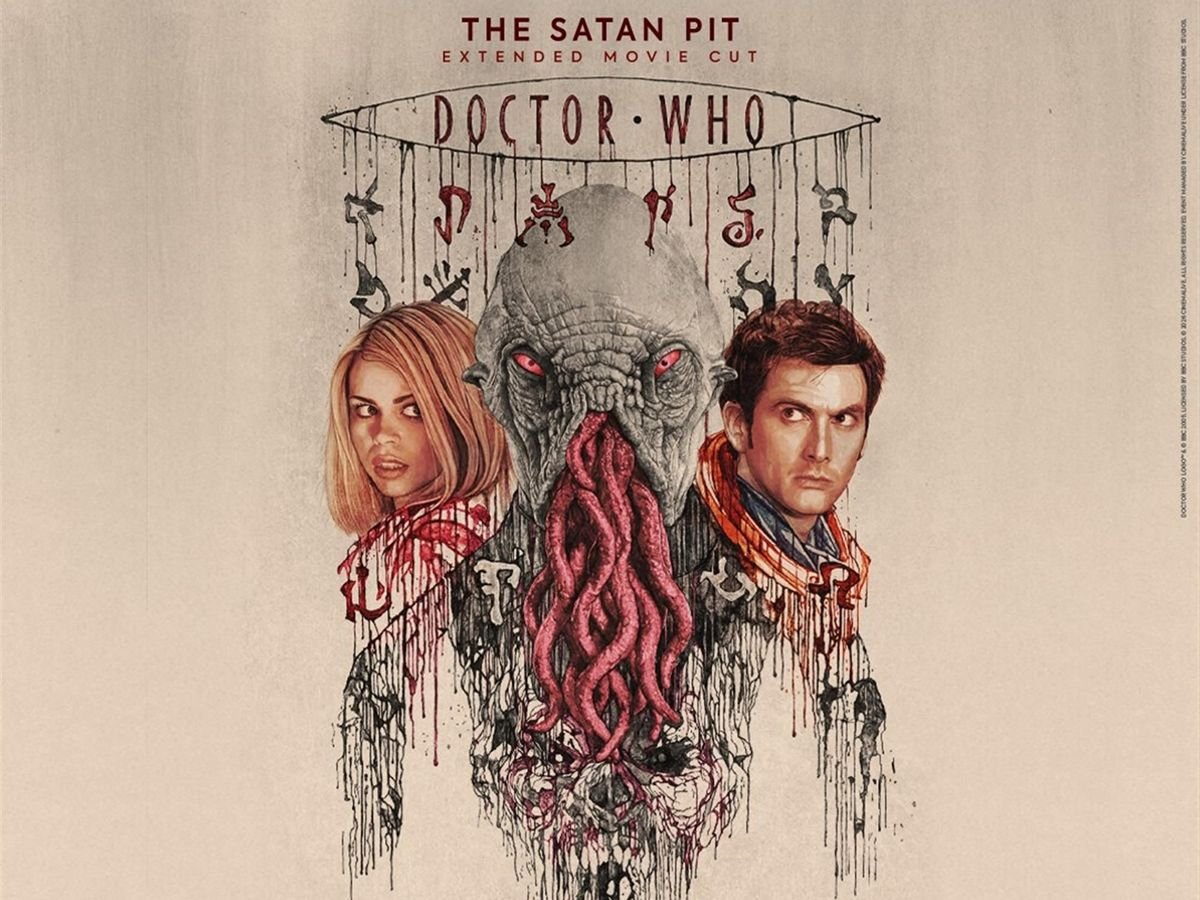
The Impossible Planet/ The Satan Pit is my favourite Tenth Doctor story, so as soon as I saw that there were plans to screen it internationally in cinemas on Doctor Who Day — that is, of course, 23rd November — I knew I had to see it. I’ve not actually seen any Doctor Who on the big screen before: I wasn’t fussed about The Legend of Ruby Sunday/ Empire of Death or Wish World/ The Reality War, and, back in 2013, I wanted to watch the 50th anniversary special, The Day of the Doctor, at home with my family. I remember that time very fondly, so it was worth missing out on the cinematic extras. Nonetheless, for this extended cut of The Satan Pit, I was drawn to my local theatre, charmed by the idea of firstly seeing the Beast larger than life; secondly, by the temptation of reliving 2006, a shocking twenty years on; and being surrounded by other fans during the screening.
The Series 2 two-parter was a strong choice for the big screen: it’s what Doctor Who does really well yet comparatively rarely — combining a cinematic story with an intimate atmosphere. The things the Doctor and Rose Tyler (David Tennant and Billie Piper respectively) face, alongside the Sanctuary Base 6 crew, are massive, monumental, existential, terrifying; but this is set on Krop Tor, a planet “impossibly” in orbit around a black hole in an apparently forgotten and forbidding corner of the universe, so it feels like something universe-changing could happen in the darkness and no one else might notice. That, likely, is the scariest possibility: horrifying things happen in the blackness; people can die, scared and alone, and the universe will carry on turning.
(Of course, it’s not impossible to orbit a black hole; not exactly anyway. We’re doing it right now. Our whole galaxy is. The “impossible” part is provided by the fact that Krop Tor is so close to K37 Gem 5, and held in geostationary orbit, meaning it’s held there, not getting closer to the event horizon. The point, either way, is that this planet breaks physics and the Doctor’s looks of horror are worth the slightly muddied exposition.)
Even twenty years on from its initial airing, there still seems to be a lot to say about The Impossible Planet/ The Satan Pit, a testament to how smart a production it is. That’s another reason it was ripe for being screened in cinemas. But Doctor Who wasn’t regularly filmed in HD until 2009’s Planet of the Dead, so how did it stand up projected many, many times larger than its 2006 destinations? Obviously, it’s been upscaled, and the upcoming Blu-ray release should better show how well this has been done, seeing as the quality seems to depend on the cinema itself; at my local theatre, it looked great, but there were still fuzzy outlines to some sections, perhaps most notable when the TARDIS lands in the first place and those sharp blue lines aren’t quite as defined as in, say, The End of Time, Journey to the Centre of the TARDIS, or The Giggle, i.e. those filmed in HD. And I loved it. It did take me back to 2006. Sometimes, a slight drop in definition is nothing to be feared; in fact, it’s really quite charming and adds to the general foreboding feeling of this adventure. It’s almost as if you’re seeing something forbidden — a transmission from outer space, sent as a warning.
And it still looks beautiful. James Strong is an exceptional director, one of Who‘s best, so everything is incredibly well done. Iconic, actually. Toby (Will Thorp) being possessed for the first time; Mr Jefferson (Danny Webb) firing at the Ood (the frame rate appears to change and it’s wonderfully realised); the Doctor falling into darkness. These all stick in the memory so nicely. Despite having seen it many, many times before, seeing my favourite scene on the big screen still felt like a revelation to me: Scooti’s dreadful death, punctuated by Murray Gold’s haunting score. Oh, I had an immediate crush on MyAnna Buring, so seeing her thrown out of a shattered window by a creature delighting in a breathless storm was similarly shattering; I forgave writer, Matt Jones, however, seeing as the scene also features the stunning line, “He bathes in the black sun.”
Jones’ script really is superb, though there’s plenty of ambiguity about who wrote what, given that showrunner, Russell T Davies, had a hand in it too. (That’s a remarkable fact, given the serial poses lots of great questions about faith and religion in an adult manner, and seems to genuinely appreciate the importance of belief, yet Davies is really quite scathing about religion; fortunately, “nuance” wasn’t a dirty word twenty years ago.) Things are set up really beautifully. Let’s take Scooti’s death as an example. She’s registered as being in Habitation 3 so they all head there, only to find… nothing. Her biochip is above Habitation 3, floating towards the black hole. The Doctor isn’t the one to realise the truth, exactly: he sees her. That’s only because, earlier, he asked for the window shutter to be left open. It means we don’t have any clunky exposition with realisation dawning and a mad rush to open it. We can just bask in the absolute horror of this innocent soul who’s about to be consumed, to be compacted into nothingness, to be lost forever, 500 years from home.
And Mr Jefferson, the man who’s quick to threaten and pick up a gun, quotes Horatius by Thomas Babington Macaulay: “For how should man die better than facing fearful odds? For the ashes of his father and the temples of his Gods.” Perhaps from that moment, his death, too, is destined, because he knows that, to every man upon this earth, death cometh soon or late.
The added scenes also show how smart the Doctor Who writing team was: in an edited-out scene, the Doctor and Ida Scott (Claire Rushbrook) wander the inner planet amid snow and the former marvels that Krop Tor is so large, it even has its own ecosystems within; of course, even those are out to kill, as the snow is an icy version of acid rain. Strong explains that, during filming in the quarry, it started snowing heavily, so they had to account for that; he rang Davies, who hastily sent out a scene to explain it away. Then it stopped snowing and heavier rain washed it all away, so they just reshot any scenes impacted by the snow! The televised edit does lose something with that omission — the scale of Krop Tor should be overwhelming and the crisp white flakes contrasts really nicely with the very alien, hostile environment — so it’s great to see it added back in here. Similarly is a lovely interaction between the Doctor and Ida in which he tricks her into a game of rock, paper, scissors.

You can see why they deleted one brief scene edited into the theatrical cut. Soon after arriving, the Doctor and Rose are surrounded by Ood apparently intent on feeding on them; actually, they want to feed them. One Ood then explains the “proteins” on offer, which are the constituents of something it’s just told Rose they don’t have. It’s a good gag and it leads into their being reported to the Sanctuary Base 6 crew, so explains why Mr Jefferson is so quick to get there. Still, it does slow down what is otherwise a very punchy opening. It’s still good to see it. In fact, it’s just good to see more of a story you’d previously considered to be resigned to the past.
James Strong unpeels further layers in the Q&A session after the credits. His enthusiasm for the story and for the show is wonderful; you can see why he’s such a great match for Doctor Who. He balances those intimate moments with what he admits is a very “sci-fi” plot. I love hearing about the logistics of filming, so his mulling over the difficulties of shooting those scenes in the not-ventilation shafts was fascinating. It would’ve been better if they’d spliced behind-the-scenes footage into the interview (perhaps taken from Doctor Who Confidential, although that might be considered a separate production with more hoops to jump through).
I’m slightly baffled they picked Christel Dee to interview Strong, seeing as she’s something of a divisive figure in fandom — not to mention being better associated with a different era of the franchise — and she does a fine job. Nothing amazing; nothing awful. It’s frustrating that she reads all her questions from some ever-present cards (go to many conventions and presenters can just go with the flow or remember, say, ten questions), and even more so that she doesn’t know the production order of Series 2, suggesting it came early on in Tennant and Piper’s schedule, whereas it was actually towards the end, meaning their friendship was firmly established by then. Still, Dee comes across well otherwise: she’s a friendly face and matches Strong’s enthusiasm.
The Q&A is a strong addition to this cinematic cut, so does add a lot to your viewing experience.
And what an experience! This version of The Satan Pit is fantastic. It’s dark, it’s complex, it’s funny, it’s scary. It’s a 21st Century classic, and it’s still my favourite Tenth Doctor story. There are some strong contenders — Blink, Midnight, The Waters of Mars — so others will no doubt prefer another story with Tennant. But I hope this extended cut does win some more fans over into the light. It deserves to: it’s devilishly good.
Doctor Who: The Satan Pit Extended Movie Cut is available to pre-order now on Blu-ray and DVD.