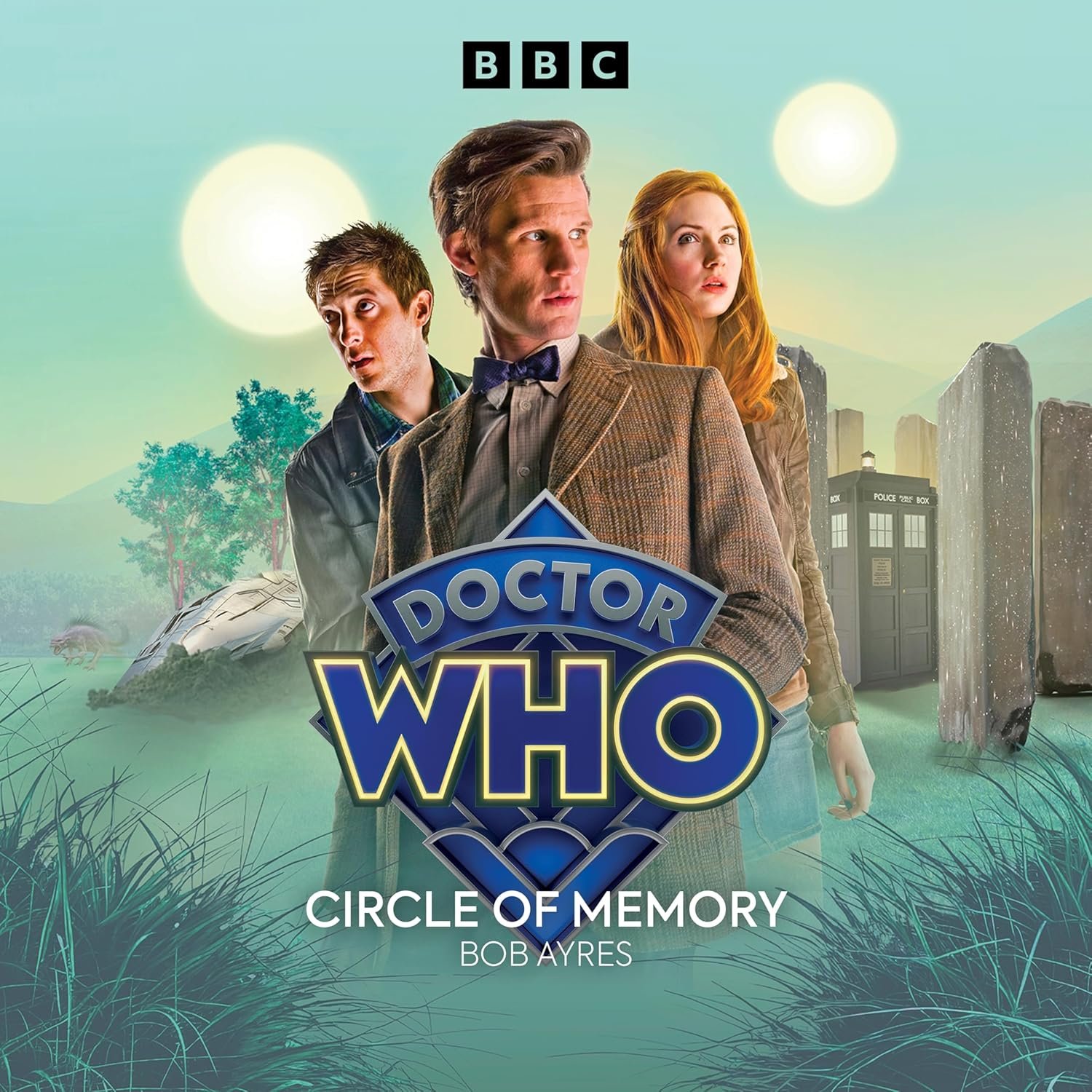
“Hello, I’m the Doctor… Doctor someone… Can’t remember who at the moment. Hoping it will come back to me.”
Circle of Memory is read by BBC Audio regular Dan Starkey and featuring the Matt Smith Doctor along with Rory and Amy (respectively played on TV by Matt Smith, Karen Gillan, and Arthur Darvill), complete with the appropriate theme tune – we are, therefore, off to a grand start!
And then Dan Starkey’s reading crashes straight in…
On reflection, it’s an opening three minutes that is failed by a lack of any good editing, the director not being active, and then the sound mixer not turning up. All of them are not doing their jobs very well. This combining with a way too loud and perky Dan Starkey, who reads Bob Ayres’ story in such a rapid-fire direct manner that it seems clearly to be aimed at wide-eyed little children, rather than the late teens or adults who are almost certainly the people who are actually buying and consuming this release from BBC Audio.
There is the compounding hurdle in that initially there is only a superficial attempt from Starkey to capture the voices and mannerisms of the Eleventh Doctor, and of Rory and Amy, meaning that this unfolds as a very basic and simple reading of the story — not an attempted performance! I was only five minutes in, and all of this was disorientating to have to take in; generally, BBC Audio does (did) tend to make some efforts to make these releases professional productions. The BBC Audio Original line has always been a disposable range, fully intended as being disposable one-hour readings, and yet thanks to strong writers and shrewd production choices, they have also produced many releases that I would be very happy to listen and relisten to. But of late, the quality in sound design and directing has been slipping at a worrying speed… and with Circle of Memory, we are at a stage where it seems very little effort or attention is being invested into manufacturing the content to a high standard anymore.
The plot itself is familiar: it is a hodge-podge of ideas taken from the television series itself and very little of it has anything new to say or add. The basic concept is a take on one of the Peter Capaldi television episodes (Time Heist), where we have a cast who have been memory wiped, to the point they don’t even know their names. In that episode, we, the viewer, have an advantage in its being visual and we recognise the Doctor and Clara immediately, and so we’re ahead of them in understanding what might be happening. Ayres script’ though is obviously audio-only and therefore with the main characters not even knowing their names, it has to fall to the narrator of the script to be the driving force, to do the work needed to sell the three amnesiac cast and their identities to the listener.
Is it Starkey’s fault, or is it a failing with the director?! It has to be both, because while the story premise is a good one, it simply cannot work on audio without careful thought and preparation from those bringing this ambitious scenario to life.
So as we open, Starkey tells us flatly that there is ‘a man’, who is speaking into a dictaphone trying to recall recent events… but who is this man? The Doctor? Rory? Who knows? What do they sound like? Don’t know. There is ‘a girl’ with them: what does she sound like? Don’t know. These opening cast members are complete ciphers, because Starkey gives them no character, whatsoever.
Things do begin to slowly improve, to a degree. It appears we are on an island somewhere; there is a standing stone circle and two suns in the sky. With a spaceship and three sleeping bags containing sleepy disorientated figures, Ayres’ script kicks in to describe three people at the camp-site who we can quickly surmise are the Doctor and two friends. And so we have something to begin to focus on, as we see that none of the three have any idea who they are… All they can do is try to make sense of the few possessions in their pockets, and discover the vague clue that one of them is a Doctor.
By the halfway mark in the story, we have entered a flashback sequence that begins to explain the background of these events and Starkey finally slows down his delivery a little, thereby allowing both the three main characters and the story to breathe a little and unfold at a more natural speed. The story is certainly a love-letter to this television era, and apart from Time Heist, the other borrowed source for material is The Rebel Flesh/ The Almost People, and as the three meet doppelgangers and wrestle the question of ‘identity’ and a sense of self, Ayres delivers some very nice philosophising about how memories are one aspect of time itself, how time cannot exist without memory to experience it. And as the three struggle onwards and reach a point where they begin to piece together how they arrived in this situation, it’s clear that, while Ayres’ story isn’t exactly original, it is at least not at all bad despite the fact. If the delivery of it had been a little more thoughtful, the choice of narrator been better considered, someone other than the perky but straight-down-the-line Starkey, this would in fact likely be a memorable release…
As it stands though, there has been far more thought and care put into crafting the visibly very impressive cover, disc, and inner sleeve design than there has the actual production of the story. Circle of Memory is not outright terrible as a release overall — it does hold together by the end and the story is solid, great for fans of this era — but hand on heart, I cannot quite recommend it either. It’s more filler than thriller, quite frankly.