“Cybermen are the ‘mechanists’ of the universe. For as long as we have souls, humanity is free.”
September 1981, and young actor David Banks is scanning keenly through an exclusive (and therefore expensive!) specialist casting directory when he spots a casting call for tall actors to play a ‘Cyber-Leader’ in the BBC television Doctor Who series. It is a request and offer that immediately intrigues him.
Little can he ever guess that in responding to this advertisement from the BBCTV Doctor Who office, this strange role he is quickly cast in will go on to develop into part of the backbone of his career for the rest of his life…
Reflecting on a just-completed reading of A Cyber-Leader’s Memoirs (Bank’s own labelling) brought into focus just what a pivotal influence newly arrived producer John Nathan-Turner had on Doctor Who when he officially took over the management and the direction of the series at this time. Today, Doctor Who is probably the most lucrative and important commercial property the BBC owns — a very important asset in commercial terms. But Doctor Who certainly wasn’t always this important to the corporation; it did well in terms of overall audience popularity from 1963 to 1979, but the question of when Doctor Who began to move to being an actual aggressive commercial property can be pointed out as the arrival of the 1980s — and John Nathan-Turner!
JNT’s approach and outlook lay partially in being a promotionalist; unlike all of his predecessors as producer, he was someone who was very aware of publicity, how to get it, and how to promote not just a product, but also personalities. Not least of which his own… And for David Banks, bit-part extra who would be hidden from all view behind heavy-duty costuming and voice modulation, the irony of this casting would come to lie in his own developing relationship with the series and the struggle of a jobbing actor hoping a role like this wouldn’t hinder future career opportunities, while at the same time accepting whatever work the role of ‘Cyberman’ offered him in the years to come. It’s a contradiction in his outlook Banks doesn’t shy from, but then the very title of his book here is, of course, an example of smart-minded wordplay: Memoirs of a Cyber-Leader. Not ‘Memoirs of David Banks, Jobbing Actor’. Complemented by its equally gaudy cover design, Banks knows full well where he wants this book aimed at, and it isn’t meant for anyone other than the dedicated, and therefore niche, audience. The rump Doctor Who fan.
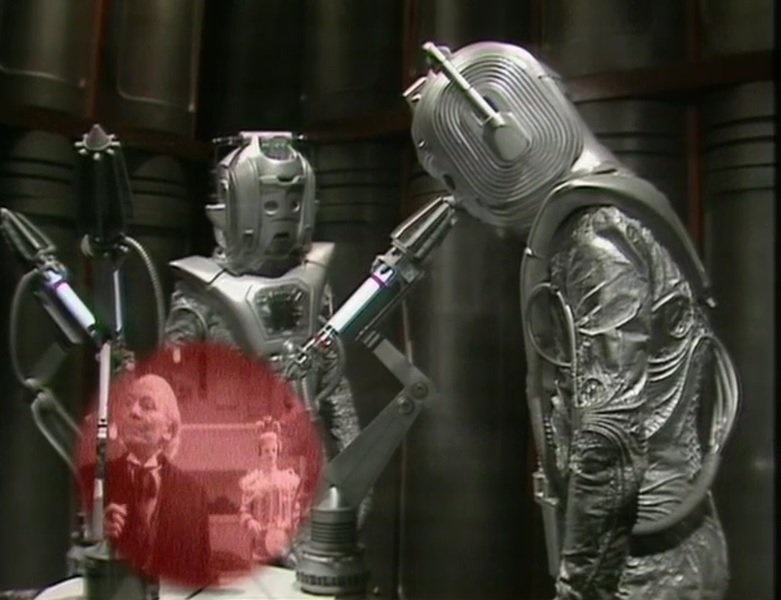
And so we open with some philosophising which examines what it is to be a Cyberman. Banks’ intellectual stripdown of the theoretical realities of Cybermen is ground he first trod in the late ’80s, with the Cybermen book he published in partnership with artist Andrew Skilleter; he will devote chapters later on that talk about this illustrated production in some fascinating detail — initially a small venture printed in the hundreds and sold privately, and as it gained traction in the fanbase, WH Allen approached and offered the two a commission for the rights, which led to a 40,000 copy print run being sold through a commercial distribution system! But in the meantime, the early chapters here in his Memoirs, are devoted to his youth, upbringing, and what influenced him to get involved more in acting and writing. It’s interesting, as, often in these actors’ biographies, the subject and writer don’t make their influences and motives all that clear. With Banks, though, it is an early grounding in Christian faith, gradual immersion in classic writers such James Joyce and DH Lawrence becoming strong writing influences, and listening intently to BBC Radio presenters to help his voice and develop clear intonation by relation. It is faith that acts as a pillar in his early years, especially with Leslie Weatherhead, a controversial Christian theologian at the time who also became an intellectual influence; indeed to the point of even directly inspiring some of Banks’ professional stageplay writing in more recent years, thanks to his books making Banks question something of both the religion and his own needs of it. Theology is an element often glimpsed in Banks’ future writing output.
There for the launch of new television series Doctor Who in 1963, young David Banks is initially unimpressed with the whimsical new BBC Television series; it would be 1966’s first appearance of the Cybermen that made the young David Banks take real notice: strong impressions of machine-men with half human features blended with equally haunting impressions on the young boy of The Wizard of Oz, and the strange half-human Scarecrow and Tin Man. This symbology will come back to him in later life when cast in 1981 by director Peter Grimwade, and, after only ever experiencing stage work up until then, he entered the world of television studios
“Once you have padded around BBC TV Centre, especially in a Cyberman suit, helmet under arm, trying to find your way from wardrobe to your dressing room, or to the Studio, you will no longer be surprised that corridors feature so extensively in the world of Doctor Who. They will be embedded in the imagination of everyone who works at the BBC – including the script editors, the writers, and the set designers.”
The title of the story is Sentinel. This will be altered to be Earthshock. As seen through the perception of newcomer Banks, the first visits to costume fitters, then first read-throughs of the script, followed by his first entry into an active television studio, are rendered on to the page with fine detail. For those wanting to learn about the difficulties in donning this new and revised Cyberman costume, Banks takes you on the journey – from initial costume fitting to final scenes in the studio. He will then take you through his subsequent appearance in The Five Doctors and his delight in meeting Patrick Troughton; he drops the correct degrees of gossip and observation, and details such as revealing Attack of the Cybermen‘s Cyber-Lieutenant was recast at the eleventh hour with the part given to one of the already cast regular Cybermen, and with Anthony Ainley’s nephew John Ainley then taking the part of the vacant Cybermen. We take in his insights of 1988’s Silver Nemesis:
“On the set of Silver Nemesis, there was generally a strong feeling that the twenty-fifth season may not be followed by a twenty-sixth. The eighteen-month hiatus before Sylvester became the Seventh Doctor had introduced a mood of anxiety or fatalism that there would not be an Eighth Doctor.”
A particularly strong chapter is devoted to the origins and production problems with stage play, The Ultimate Adventure. Written by Terrance Dicks and initially starring Jon Pertwee, this is a very insightful look into the various ups and downs of that play; describing the ambitious laser displays and set-changes, Banks then pays tribute to Pertwee’s professionalism, and what seems to be his deteriorating stamina as he dries completely on one occasion and walks off the stage, leaving Banks to hastily change costume and replace him for the performance. This may be the chapter I enjoyed the most, as in a way, when Banks unexpectedly has to take the part of the Doctor himself, we get a version of the character who seems to precede the modern treatment for the character in David Tennant… It’s a fascinating footnote in the span of the 1990s that Banks’ Doctor never got any wider exposure than to those who could actually get to see him perform on the touring production.
Doctor Who fans are therefore well served with this memoir. But as to those wanting to know more of his wider career, well, that too is quite well laid out! It is slowly evident that David Banks isn’t one to chase the limelight; it isn’t something he really states as such until near the close of his book as he relates his experiences in the early ’90s, while appearing in popular Channel4 soap Brookside. But in between his involvement, and occasional distancing, with the world of Doctor Who, he gains a new agent who he learns is a Doctor Who fan… and yet whose energy and effort then re-energises Banks’ career into getting much more regular stage-work and wider media opportunities. One surprising fact I learned from all this is that audio-work and David Banks are no strangers: from 1984, he read audio stories for the RNIB (Royal National Institute of Blind People), something he would go on to do for a full 22 years!
In the final analysis, though, this is a book that left me pondering how and why it even exists. Few will remember the name Reg Whitehead – he played a Cyberman in the first three Cyberman stories of the 1960s, and then, like Stuart Fell and Pat Gorman, disappeared into a private life and obscurity — a time before there was a Doctor Who fandom. David Banks played a Cyberman in four Cyberman stories through the 1980s, but under the umbrella of JNT and this new commercial era for the series that was the beginning of his career with Doctor Who… He makes his first appearance at a Doctor Who convention in 1985 at a charity event in Bath called Fan-Aid. He develops a book with Andrew Skilleter in the late 1980s, stars in The Ultimate Adventure stage play, writes a (very good!) New Adventure Cyberman story called Iceberg for Virgin Publishing, and only in 1999 does he decide to step away from the Doctor Who world – but not for too long as he steps back in again in 2005.
This is a memoir. Banks himself declares it so, and that differentiates it from an actual autobiography. Something that became clear to me as the book suddenly staggered to a too-hasty close after 230 pages, as if Banks had decided that this is as much as you will learn about him and his life. Which is his prerogative, yes, and yet it is still a book that is only possible to get published today due to the Doctor Who connection, something he is very aware of, and has pivoted both the book’s title and the content to servicing: this book is for the Doctor Who fan. And can only exist because Doctor Who has allowed David Banks to stay connected to, and be employed by, Doctor Who. From the very first day, he spots that advertisement in 1981, to the present day of 2026, and beyond.
It’s a fact that I haven’t been able to get out of my mind. Is it a marvellous thing — something to celebrate — or is it a sobering reflection on how some people have made a good part of their living off staying connected with the Doctor Who world?
Ruminations aside, Memoirs of a Cyberman is a decent enough read. If, like me, you want the details and insight into David Banks’ long association with Doctor Who, and some insight into his broader career, then this fulfills those expectations. It’s well written. Banks offers his keen insight into the philosophy and nature of the Cybermen. Explanations as to why it is the race is asexual and so utterly conformist. And he sets out a compelling basis on what forces drove them to become both ‘immortal’, and yet so very averse to free will. It’s just that for me, as I got to the final pages, it felt like a book, a memoir, that was a little too unfinished. I had gotten to know a good deal of David Banks’ history with Doctor Who, his early literary and film influences, an insight into his philosophy for life, a small insight into his ever-developing writing career, but in the end, his private life is kept very private, and so it left me with a sense of some detachment as he closes the book. It’s a good memoir of one man’s career, yes, but don’t go into it expecting to learn all that much about David Banks the man.
“From the age of around 16, I had started looking at ‘literature’ in a new way. It was no longer something to be passively enjoyed or copied, but a seam of energy to power the imagination…” – David Banks
You can order Man and Cyberman: Memoirs of a Cyber-Leader from Telos Publishing.