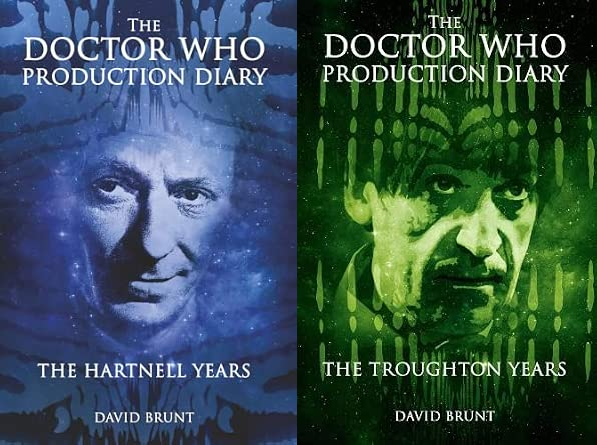
The Hartnell Years and The Troughton Years are excellent books, packed full of gems and information.
David Brunt has trawled through the BBC Archive Centres, transcribing, and summarising all the available information on the making of Doctor Who from 1962-1969. Unlike other accounts of the making of the programme, Brunt doesn’t, 99% of the time, include later revelations culled from interviews conducted after the event. What is here is the raw documentation, day by day, of what happened in the production office, in the rehearsal room and in the studio.
What’s really special and valuable about both books is that we don’t, as with other publications, just get the odd glimpse into, or extract from, the BBC Archive files. Brunt gives us, in readable form, the whole lot.
We have: details of drafts and rehearsal scripts, so we can see how they differed from the televised versions; episode by episode summaries of stories sent in on spec; summaries of phone calls, including David Whitaker not being at all happy about Gerry Davies phoning him at home at the weekend to ask if he’d finished revising the scripts for Power of the Daleks; correspondence between different production team members, including Innes Lloyd’s angry memo expressing his dismay at the very bad Macra prop and the exorbitant sum Shawcraft charged for it, which led to the BBC parting company with Shawcraft.
There is a lot of new information here. I didn’t, for one, know that David Whitaker wrote the final screenplay for Daleks:Invasion Earth, 2150 A.D. : knowing that he did so certainly accounts for the second Cushing film being a much better and grittier movie than Dr Who and the Daleks, and much truer to the spirit of the original television show.
One thing that strikes me on reading is just how hard the production team worked, on at least three stories at once. Lots of script editors and one producer, John Wiles, succumbed to exhaustion. For six years, one story was in rehearsal and in the studio, at the same time as one was on location or having scenes filmed in Ealing – the Ealing filming necessitating the release of the regular cast from rehearsals – and as a third story was having its scripts polished for filming.
At the same time, other stories were being prepared, edited, read or rejected. The Hartnell Years, which covers the changeover between Doctors, notes how disappointed everyone was with Geoffrey Orme’s scripts for what became The Underwater Menace – well, would you commission a story originally called either Dr Who Under The Sea or Dr Who and the Fish People? It only went into production because the team had nothing else ready.
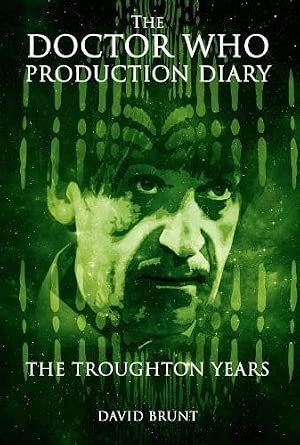
I didn’t know that Troughton became increasingly exhausted and irascible as the show reached its sixth season, nor that The Mind Robber had episodes cut to twenty minutes in length to help him cope with his fatigue. I didn’t know that Frazer Hines was considered quite so much of a dish by teenage girls, nor that he had a biographical comic strip in Jackie magazine devoted to his career and love life.
(For those who don’t know, Jackie was a hugely popular magazine aimed at 17 year old girls in the 1960s and 1970s, full of romance and sex tips and thus actually read avidly by 13 year olds of both genders, though certainly not by me, oh dear me no.)
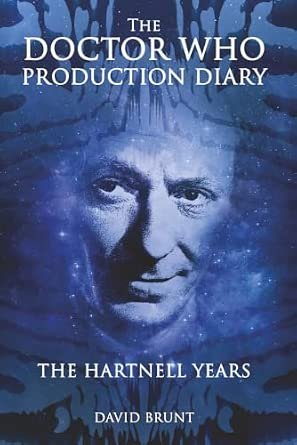
The Hartnell Years is just as excellent as the Troughton volume and has much the same format. Again, we see how hard the production team worked, and how hard it tried to accommodate Hartnell’s declining health in the second half of his run. We have notes from John Wiles documenting Hartnell’s rows with Derek Martinus over the making of Galaxy 4 and advising other team members how to cope with him.
In the end, the production team worked round Hartnell, giving him weeks off when he was ill or wanted a holiday, cutting his lines to the bone and, at some expense to the limited budget, paying for a car to take him home to his cottage in Mayfield at the end of the week’s recording.
Hartnell was exhausted after travelling by train from Cornwall to London, after location filming for The Smugglers, and so messed up the rehearsals for The War Machines that same week, causing actor William Mervyn (playing Sir Charles) to quip that they should have sent a helicopter to collect him so that he wouldn’t tire himself out so much.
We read through the lines to see how angry and frightened Hartnell was at his declining health, and how difficult he was to work with, asking that Innes Lloyd stopped the cast playing table tennis in break periods in the church hall where they rehearsed because it interrupted his concentration. And, at the same time as the team worked round him and cosseted him, they quietly planned to replace him with Michael Hordern or Pat Troughton.
One gem I relished was in the description of Ben and Polly to new writers, dated 20th May, 1966, which still holds true for companions and should be adhered to by whoever gets the contract to make more Doctor Who in 2027:
They are not merely the Doctor’s acolytes but thinking human beings from this age, capable of individual thought and action. They do not always agree with one another or with the Doctor… neither of them must ever lose a sense of awe and amazement at the form of travel they find themselves undertaking e.g. they are real people transported into real situations in incredible adventures in space and time. They are ordinary people, with whom we sympathise, to whom extraordinary things happen.
These are big books, weighing in at 670 pages for Hartnell and 774 pages for Troughton. They bear close reading and I couldn’t put them down. And, in preparation, is The Pertwee Years vol. 1. I ain’t going to miss that.
The Doctor Who Production Diary – The Hartnell Years and The Doctor Who Production Diary – The Troughton Years by David Brunt, Published by Telos, 2024 and 2026