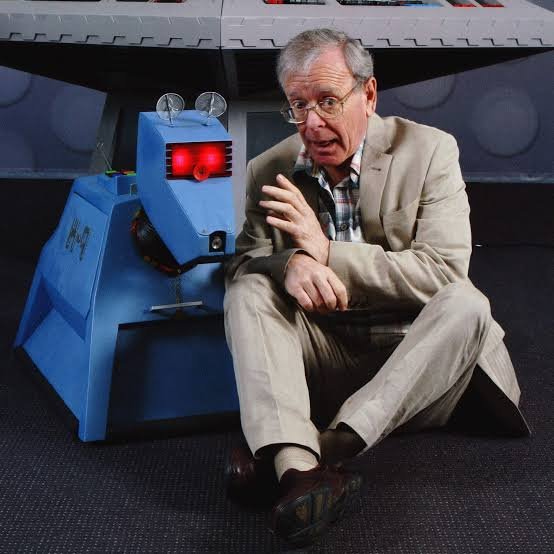
John Leeson passed away on 1st November, 2026.
John contributed so much to Doctor Who, voicing K9 from his first appearance in 1977’s The Invisible Enemy to his final appearance in The Sarah Jane Adventures over thirty years later.
As with the Daleks, much of K9’s enduring appeal depended on the unique blending of voice, script and design, and John’s perky characterisation of K9 was central to the companion’s enduring appeal. Eleven year old Frank and Simon Danes immediately loved K9 when he first appeared in 1977, at a time when other contemporary (older) fans despaired of the lurch towards childishness in the programme.
As a tribute to John, and in his memory, The Doctor Who Companion republishes an interview conducted with John in Simon and Frank’s fanzine Fendahl back in 1978. We wrote John a series of questions; he answered them on a cassette tape and we transcribed it. John had just left the programme (temporarily, but we didn’t know that) after The Armageddon Factor and K9 was to have a new voice for the new season.
Originally published in Fendahl 4, January 1979
This interview was originally published when the Key to Time season was being broadcast for the first time on BBC 1 and John Leeson had announced his departure from the programme. We had no inkling that he was going to return in Tom Baker’s final season. Simon and I wrote to John c/o the Doctor Who office at the BBC, asking if he’d be willing to do an interview for our fledgling fanzine.
John recorded his answers on a cassette tape, which he mailed to us, and we transcribed his answers. He didn’t get paid for his time and, once again, I’m amazed at the kindness of actors and behind the scenes personnel who, in the 1970s and early 1980s, did so much for the fans of the programme. I suppose it was a simpler time then…
How did I get my jobs in Doctor Who? Honestly enough, I got them by accident. A friend of mine, who I’d worked with as a director many years ago, appeared in my local pub. He was working on Z Cars or something some time ago and he asked me what I was doing, and I told him the usual stuff. The next thing I knew was that I was put up for the parts of K9 and the Nucleus in The Invisible Enemy. Both names meant nothing to me at the time, although of course I’d heard of Doctor Who. So I went to [producer] Graham Williams, and he told me what he thought the characters might be like, and I said I’d go away and play at a few funny voices on my tape recorder. Having done that, I went back to Graham and said, this is what I think, and he said, why not come back and play these things for us? And it’s all taken off from there.
The voice for K9 was really a sort of co-production, if you like, between me and the BBC sound men. I characterised the voice as high pitched and squeaky, and the sound people put a fuzz over the top. The Nucleus sort of reversed the process and stepped it down, so that it became “puddingy”, rather rotten. Suitable, I thought.
The voice I do as K9 is pretty much me so there’s no problem with characterisation.
No nasty moments, other than when K9 mark 1 was first introduced to the studio. The signals that were fed to him from the radio control panel his operator was using interfered with the signals from the [electronic] cameras, so whenever K9 came near them they “snowed up” and K9 would go careering off into the furniture and was totally uncoordinated. I remember watching all this on a monitor and thinking the BBC would never employ me again…

As you know, in rehearsal, I go and run around Tom Baker’s feet, so come the studio I know all the moves K9 should make. His handler makes notes where I go and then reproduces them for the screen.
Generally speaking, the voice in the studio is done live. I’m sitting way at the back of the studio somewhere on a separate microphone and the engineers take a clean feed of my voice in order to treat it. If the voices of the other actors spill over onto the tape it’s obviously very difficult for them to sort it all out. I sit there with my microphone and the studio monitor in front of me, so I can see what’s going on, and a pair of headphones so I can hear what’s going on.
Do I see K9 as a character, a person, or as a machine? You have to draw a happy medium… although he’s a machine with a great character and personality.
There’s also what’s known as a fold-back speaker on the studio floor, so the other actors can hear me. The exception to this is filming. Generally speaking, they don’t take me on filming trips, although there have been exceptions. When they come back with the film and it’s been cut together, spaces are left on for K9’s lines and I dub them on then.
K9 wasn’t in Image of the Fendahl because he hadn’t been introduced as a character [when Chris Boucher wrote the script].
Do I see K9 as a character, a person, or as a machine? Well, this is a very difficult one. You have to draw a happy medium because K9 is a machine. There’s no question about it. He is not a dog, although he’s a machine with a great character and personality. The temptations are to go too far in one respect and have an enormous amount of fun playing the character for all it’s worth at the expense of the mechanics of the thing. The other extreme is, if he was just a machine for relaying facts and figures, he wouldn’t be very amusing. The stories are a sort of melodrama and you’ve got to keep the characters in perspective. Even machines. I didn’t have a different personality in mind for K9 mark 2 because the personality’s sort of built into the mechanics of the thing.
I really enjoyed Doctor Who. It was great fun. If people took it too seriously, I don’t think the show would have been running for fifteen years.
I do not think K9 is an attraction for the younger children and is a gimmick because I know he has an enormous following amongst adults. He is not really a gimmick to jolly along the Doctor’s quests. I think K9 comes in useful when it comes to getting the Doctor out of scrapes. You see, it’s all very well to have K9 as an omniscient computer, capable of any action, because if you pursue that argument and have a four part story, the story will be wrapped up by page seven of episode one. So you have to limit K9, so he [sometimes] can’t leave the TARDIS or is damaged.
The promotions I’ve done? Well, I went to [DWAS convention] Panopticon ’78 but that’s not a public appearance, really. When the character was first introduced he appeared on [BBC children’s magazine show] Blue Peter and Shep, John Noakes’s dog [Noakes was a Blue Peter presented and Shep appeared on screen with him] was madly attracted to K9 and wouldn’t leave him alone for the whole show. The result of it was that K9 had to go back to the workshops to be repainted.
I’ve done one or two tapes for the Doctor Who exhibitions [at Longleat and Blackpool] and one for a model of K9, which I have yet to see. Apart from that, I haven’t done much in the way of publicity. Nothing like the amount Tom does for the programme.
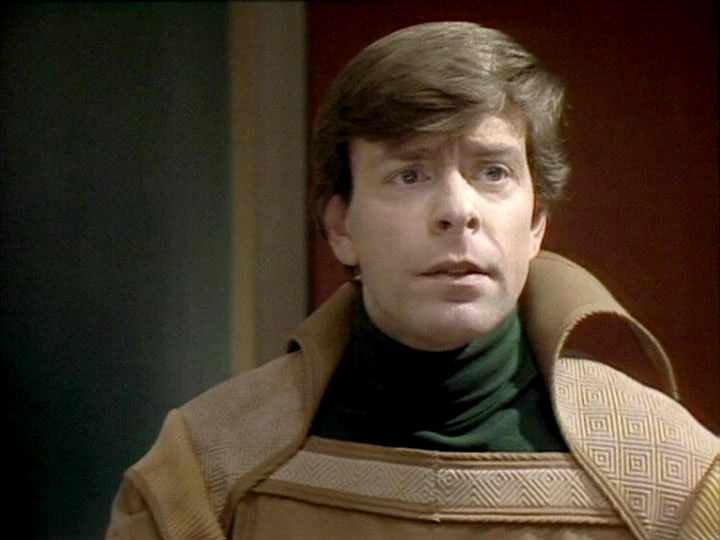
My parts in Blake’s 7 didn’t come about because I’d been in Doctor Who. I was just convenient at the time and the director opted to use me.
I can say that K9 will be in the forthcoming series starting in September but beyond that I don’t know and I don’t know if even Graham Williams knows. All good things come to an end and K9 may well die a natural death.
The voice of K9 has gone to an actor called David Brierley, who’s very experienced in radio, and I wish him every success as he follows in my paw prints.
Anyone who met John knows what a kind and generous man he was. He gave so much to Doctor Who and will be much missed. R.I.P.