I’ve been watching Doctor Who since late 1970, when I was eight. In that sense, Jon Pertwee is my Doctor. As a child, I loved the Doctor Who of this period and it got me hooked. Truth be told, I grew to prefer Tom Baker and to look back on the Pertwee years as inferior. I somewhat grew away from Pertwee’s portrayal, which wasn’t helped by my Dad’s scathing comments about what he saw as his corny and pompous performance. Many years later, I have come to reappraise Pertwee’s Doctor and return to being fond of his commanding and distinctive take on the character. It was in this frame of mind that, about four years ago, I re-watched the Third Doctor stories. This re-watch was going well — until I reached The Green Death.
As I started to watch the story, I found myself finding the Doctor’s relationship with Jo Grant to be sickly sweet, patronisingly paternalistic, and at points faintly disturbing. When I then got to the scenes set in Wales, the Welsh Stereotypes were the final straw and I gave up. I wasn’t enjoying The Green Death. Sacrilege.
Winding forward to a few weeks ago, I started to wonder if I had been right to be so harsh on this generally well-loved classic, or just in a bad mood. I decided to re-watch. If by some miracle you haven’t seen The Green Death, spoiler warning! Abandon this now and go and watch it immediately… then come back.
It starts well. I like the fact that the Doctor defiantly decides to go to Metebelis 3, rather than to Wales as the Brigadier instructs. Given that he has only relatively recently regained his ability to leave Earth, this makes sense. The Doctor has an emotional exchange with Jo before he leaves. Would this be the start of his twee, nose tweaking behaviour that put me off before? Not really, it’s not that bad. But oh dear, the Welsh stereotypes start in earnest with the milkman who is asked for directions by the Brig. Jo is then soon on the receiving end of one of the weird insults she tends to get in her run as a companion, when Professor Jones calls her a “silly young goat”. It’s not quite up there with “ham-fisted bun vender”, but it’s odd all the same. Years before Ryan repeatedly fell off his bike, Jo demonstrates that she is clearly Dyspraxic, knocking over just about everything within a two-meter radius. This results in another insult, as she gets called “clot-headed”. Frankly, Professor Jones is patronising and not very nice to her… so we can see where this is going in terms of romance. Good job Jo has had years to get used to being patronised by the Doctor. Meanwhile, on Metebelis 3, the Doctor is menaced by a pair of giant chicken feet.
The Brig is admirably sceptical about Global Chemical’s claims to being environmentally friendly. He is very good in this story, as is Yates (not something I would say often). I remember that it was at this point, when the Welsh pit workers first appeared, that I had previously started to cringe. Yes, there are a lot of “Boyos” and dodgy accents, but it’s not as bad as I remembered. Back at Global Chemicals, the manager, Mr Stevens, is convincingly played. ‘Hinks’ is a wonderfully nonchalant henchman. ‘The Boss’ is a computer from the same vocal training school as Zen and Orac, from Blake’s 7.
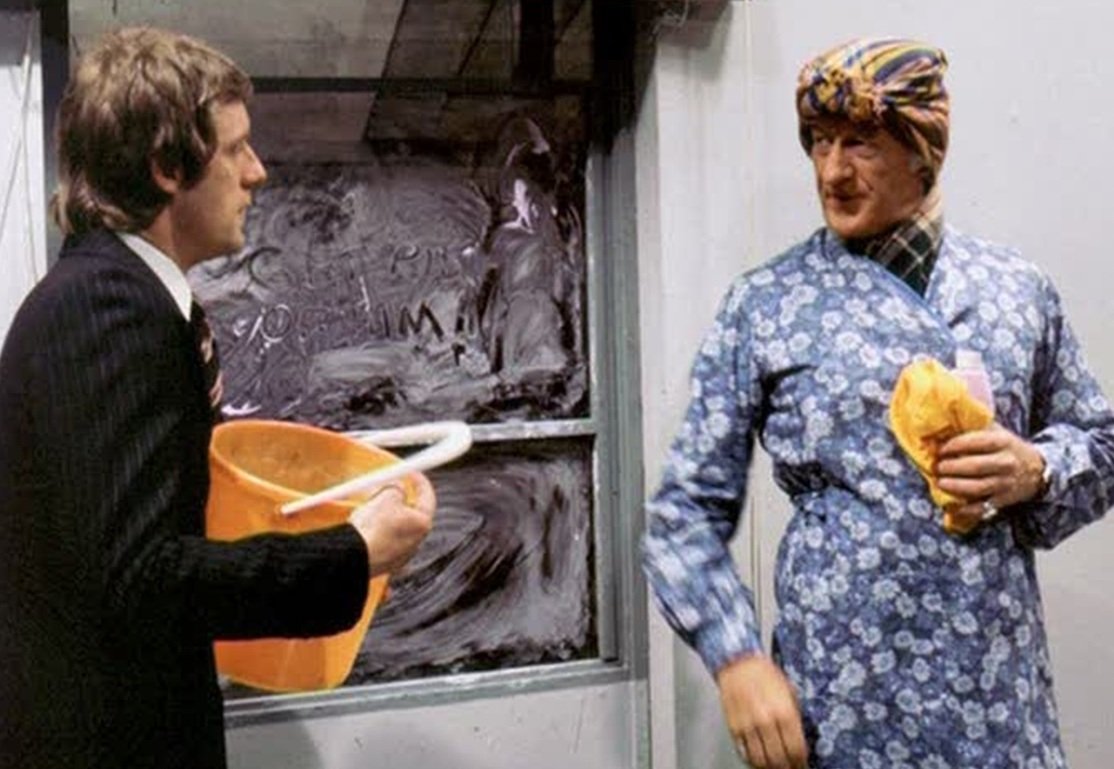
I have to mention clothes. At one point, Jo wears a cricket jumper-style outfit, presumably having gone for a spin with the Fifth Doctor in between scenes. She sports a collar so pointed, it could take your eye out. Later, she wears so many clunky rings, it’s a virtual knuckle duster. Otherwise, her outfits are in keeping with the generally hippy-style clothing of the time that I remember. The Doctor wears a Sherlock Holmes-style cape, years ahead of The Talons of Weng-Chiang… and there is the obligatory use of his Venusian Akido. Incidentally, there is a continuity error involving the cape in episode 5, as he is thrown into an empty cell not wearing it, only for him to be wearing it in the subsequent shot. We also see the Doctor dressed as a milkman. Milkmen feature heavily in this story. The power plant seems to have a constant delivery of milk. Is milk part of the energy-producing process?! Then we see something that nobody should have to see. Pertwee dressed a cleaning woman. Now, I have nothing at all against crossdressing, but can you imagine any of the other Doctors dressing up as a cleaning woman. If you can, I’d probably keep those fantasies to yourself.
My fears about Jo being repeatedly patronised by men are somewhat further justified. When she is found to be unhelpful, she is called a silly goat again. When she is helpful, she is called a “good girl”. The Doctor is clearly disappointed that Jo is more impressed by the Amazon trip that Professor Jones has planned, than his jaunt to Metebelis 3. He drags Professor Jones away from Jo on the pretext of a scientific chat. Are his feelings a paternal jealousy, or romantic jealousy? On this viewing, I actually quite liked that this was not clear to me. It is open to interpretation and could potentially be a mixture of both. Bit weird, but interesting.
It would be remiss of me to get through this without mentioning the giant maggots. On the whole, they are well realised and, in some scenes, quite revolting. The fly version is rather less good and is absurdly easily killed by having a cape thrown at it. If only the flies that get into my house were as easily defeated. The luminous green infection is also well done. Of course, everyone is obsessed with touching it, despite the clear danger it poses, but such is the way of things when it suits the story.
When I watched this on first broadcast, I was convinced that the Boss would turn out to be the Master. If this story had been in an earlier season, I think the Master would indeed have been behind things. The Boss, however, is BOSS: an evil computer. The Doctor stoops to the cheesy trope of using a non-sensical puzzle to confuse BOSS. He says, “If I were to tell you that the next thing I tell you will be true, but that the last thing I said was a lie, would you believe me?” BOSS doesn’t quite say “does not compute.. does not compute” — but gets perilously close. It’s an odd computer indeed. It shows anger and talks about pleasure… and later spends a lot of time singing.
The story ends with what could be a really cringey scene involving the Doctor and Jo’s parting. But no, it’s excellently done and far less twee than many scenes featuring the two in previous stories. The Doctor slipping out is very well played and as he drives away on his own, while everyone parties, it is genuinely quite moving. On reflection, I think my feelings watching this story four years ago were more about a cumulative sense of the relationship between the Doctor and Jo being a bit sickly sweet and patronising across a number of stories. He doesn’t actually tap her on the nose in this one. This story is not the worst offender. Yes, Jo is a bit twee at times — just about everyone patronises her and there are moments of Welsh cliches and stereotypes — but overall this story is deserving of the affection it’s held in. The Green Death is not my favourite Third Doctor story, but it is very good. It’s maybe an episode too long, but I am not entirely sure why I found it so difficult to watch just a few years ago.