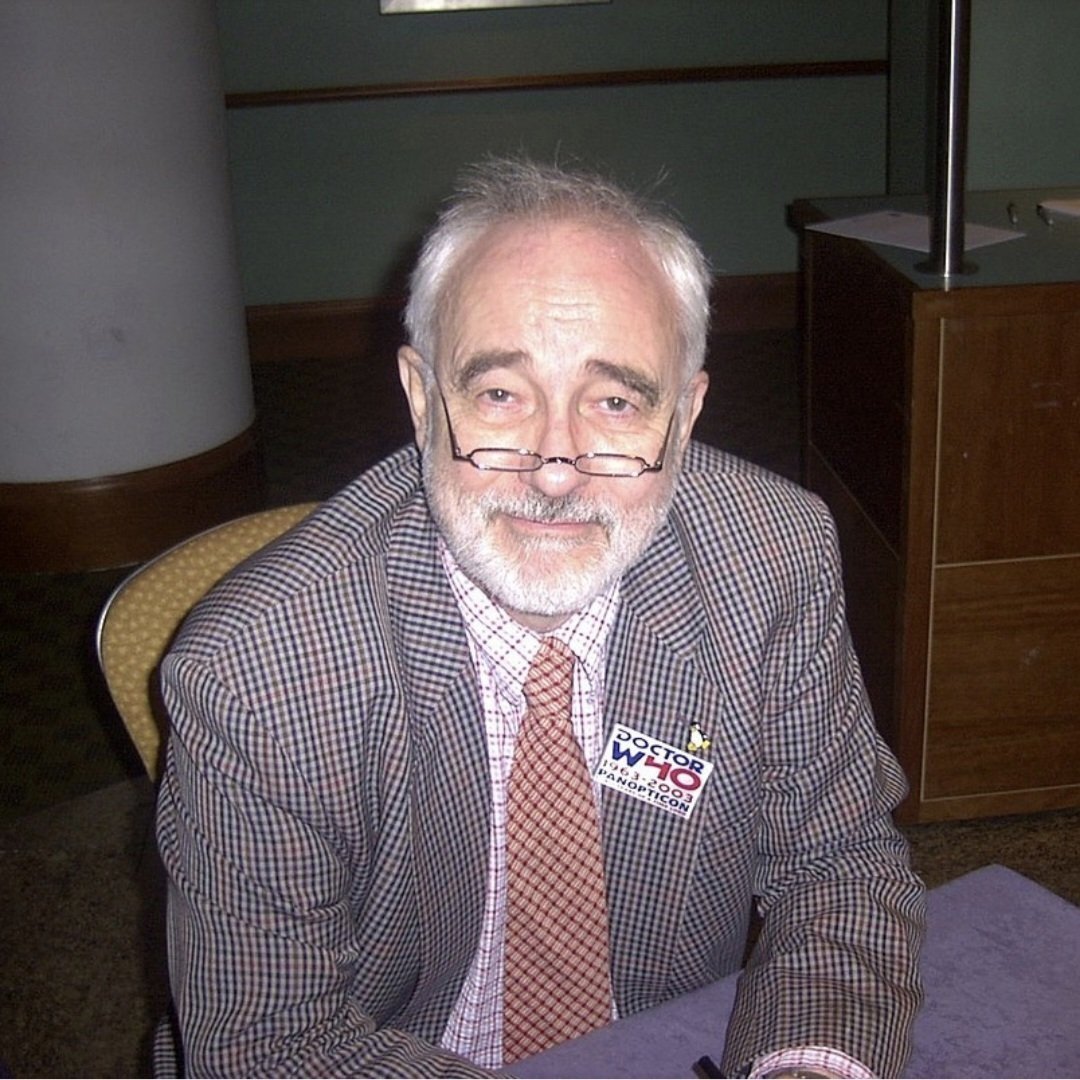
Christopher Hamilton Bidmead, the script editor of Tom Baker’s final season and writer of three Doctor Who stories, has passed away at the age of 84. In recognition of his passing, we’re revisiting and publishing an interview he gave back in late 1980.
Christopher Bidmead trained as an actor and played a prominent role in Emergency Ward 10. He always had a passion for science and contributed several articles to New Scientist in the 1970s. Bidmead moved into screenwriting in the same decade and wrote for Thames Television. When Douglas Adams wanted to move on in 1979, Robert Banks Stewart recommended Bidmead for the position of Doctor Who script editor. Bidmead was initially reluctant, saying that he hated the intrusion of “magic” into the show’s stories. (He may have been thinking of the scene in City of Death, in which Romana suggests that she and the Doctor fly – Superman style? – down from the Eiffel Tower.) John Nathan-Turner assured him that the eighteenth season would dispense with such whimsy, and Bidmead signed on.
He oversaw a season of hard science fiction which radically contrasted from the comically inflected tone of such Season 17 stories as Horns of Nimon. Nonetheless, Bidmead included some of Douglas Adams’ script editor notes on Doctor Who in his writers’ brief for the show; he also sent them the “useful” [his word] essay by Harlan Ellison, which opened each Pinnacle American edition of the novelisations. Bidmead wrote three Who novelisations himself, each of his own stories.
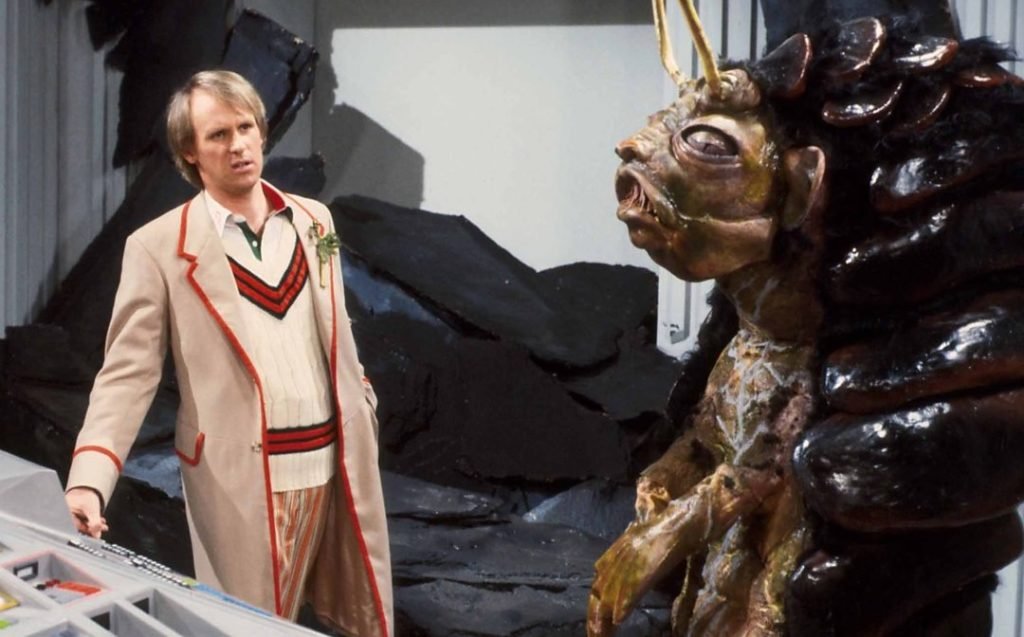
Bidmead wrote Logopolis, Castrovalva, and Frontios for Doctor Who. The first showcased Bidmead’s passion for science, to sometimes confusing effect; the second was based on the graphic works of M.C. Escher. The genesis of the Tractators of Frontios was more prosaic: Bidmead said he had been inspired by the woodlice which invaded the flat he lived in as a young man.
He commissioned a story from the 18-year-old Andrew Smith (Full Circle) and rewrote Stephen Gallagher’s Warriors’ Gate from scratch: Gallagher had submitted a script that read more like a novel. It is said that Bidmead also rewrote Terrance Dicks’ State of Decay (originally submitted as the first story for Season 15 as The Vampire Mutation, and vetoed by the BBC for possibly undermining their consanguineous production of Dracula, starring Frank Finley) into the hard science fiction style of Season 18. It is also said that the unimpressed Dicks asked for, and got, Bidmead’s changes to State of Decay changed back. Bidmead rejected Terence Dudley’s screenplay for a historical story set in the 1920s. It appeared in the following season as Black Orchid: Bidmead, after seeing it, commented that he had been right to pass on it.
Many years after he left the programme, Bidmead confirmed that he and John Nathan-Turner, the producer, had not always had a good working relationship; he and Nathan-Turner traded accusations about excessive alcohol consumption by the production team.
Christopher Bidmead married Rosalind Earlle in 1987 and had two daughters.
***
Fendahl 13, published in December 1980, carried an interview with Christopher Bidmead, which DWC reprints here:
Christopher Bidmead, who had no previous connections with Doctor Who, was rather chucked in the deep end by being given the post of script editor.
“Robert Banks Stewart, who wrote several Doctor Who stories in the past, and is currently the producer of Shoestring for the BBC, suggested me to John Nathan-Turner. We met, got on like a house on fire, and I got the job,” he explained. “As a writer, I decided that to sit in the script editor’s seat was a very good way of seeing the writer’s role from the other point of view. I have, in fact, watched Doctor Who on and off for many years.”
With the recent success of Andrew Smith, how do you decide whom to accept as writers?
“John and I decide which stories are accepted or rejected. I usually invite writers to submit a two- or three-page story synopsis. If the idea appeals to us, we commission a scene breakdown. Then usually, after lengthy discussions have taken place, we commission a full script.
“I receive dozens and dozens of unsolicited scripts, story lines and scene breakdowns from both professional and amateur writers. I receive so many that, due to production pressures of the programme, it may be several months before I am able to reply to this unsolicited material.”

Would it be possible for us to have a look at the writers’ guide for Doctor Who?
“We do have a writers’ guide for Doctor Who, yes, but I feel if you published it, I would be inundated even more, and I consider this would be unfair to the writers.”
Continuity is a point dear to many fans. Such mundane series as Coronation Street have continuity advisers, so why not Doctor Who?
“We do not have a continuity consultant, although in my office there is a copy of every Doctor Who script since 1963 and we have many cassettes of old programmes.”
Another thing is humour. Many think there’s too much…
“Humour has its place in Doctor Who but it should never dominate the programme. I think what we have achieved this season strikes the right balance. Doctor Who should be taken seriously.”
Would you agree with such people as fan Anna Jean Smith, who’d like to see a story set aboard the TARDIS, showing its workings?
“I believe there was a story set entirely aboard the TARDIS, some time in the sixties.”
When quizzed about the new Doctor [Peter Davison], how he was chosen and who was considered, Chris understandably refused to comment. Apart from the fact that:
“A new Doctor is a tremendous challenge and although Tom Baker has played the part for six years, I envisage no problems with your acceptance of whoever plays the part.”
Shada was of course cancelled by the BBC last year. Is there any chance at all of it being saved? If not, will Doug Adams ever write for the programme again?
“He could well, but is incredibly busy. Shada will not be completed, due to contractual problems.”
Is there any truth in the Starlog report that special Doctor Who films are to be made for Christmas?
“No, but this is a very appealing idea.”
What’s happened to six-part stories?
“The four-part story is a very popular length. However, with a programme like Doctor Who, two-, three-, and six-partners also work well.”
With all the competition of Blake’s 7 and now The Hitchhiker’s Guide to the Galaxy [the television version], is there any chance of Doctor Who being axed?
“None.”
Any plans for the rest of this season?
“K9’s leaving in the new year [1981] and Janet Fielding will be playing Tegan, an Australian air hostess aged twenty one. She is a theatre actress who has worked both here and in Australia and how long she is to be in the series is to be decided. Peter Davison is the new Doctor and I can assure you there will be a serious regeneration scene.” [This last comment addressed the concern of some fans that the regeneration would be comic, as was Romana’s in Destiny of the Daleks: fans in 1980 were still suffering from PTSD after watching that scene in 1979.]
American viewers have been missing out. [The Time Life package of Tom Baker episodes, then showing on PBS stations, only ran from Robot to The Invasion of Time.] Is there any chance of more stories getting over to the States?
“Yes, Time Life may be distributing more episodes early in the new year.”
And the rest of this season?
“Story six is The Keeper of Traken by Johnny Byrne, with guest artists Sheila Ruskin and Denis Carey. The next story is written by myself and is called Logopolis. However, it has yet to be cast.”
RIP, Christopher Bidmead. Our thoughts go to his family and friends.