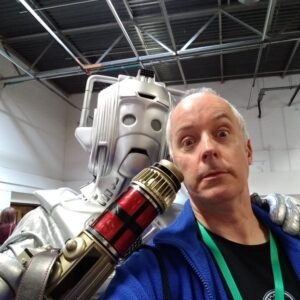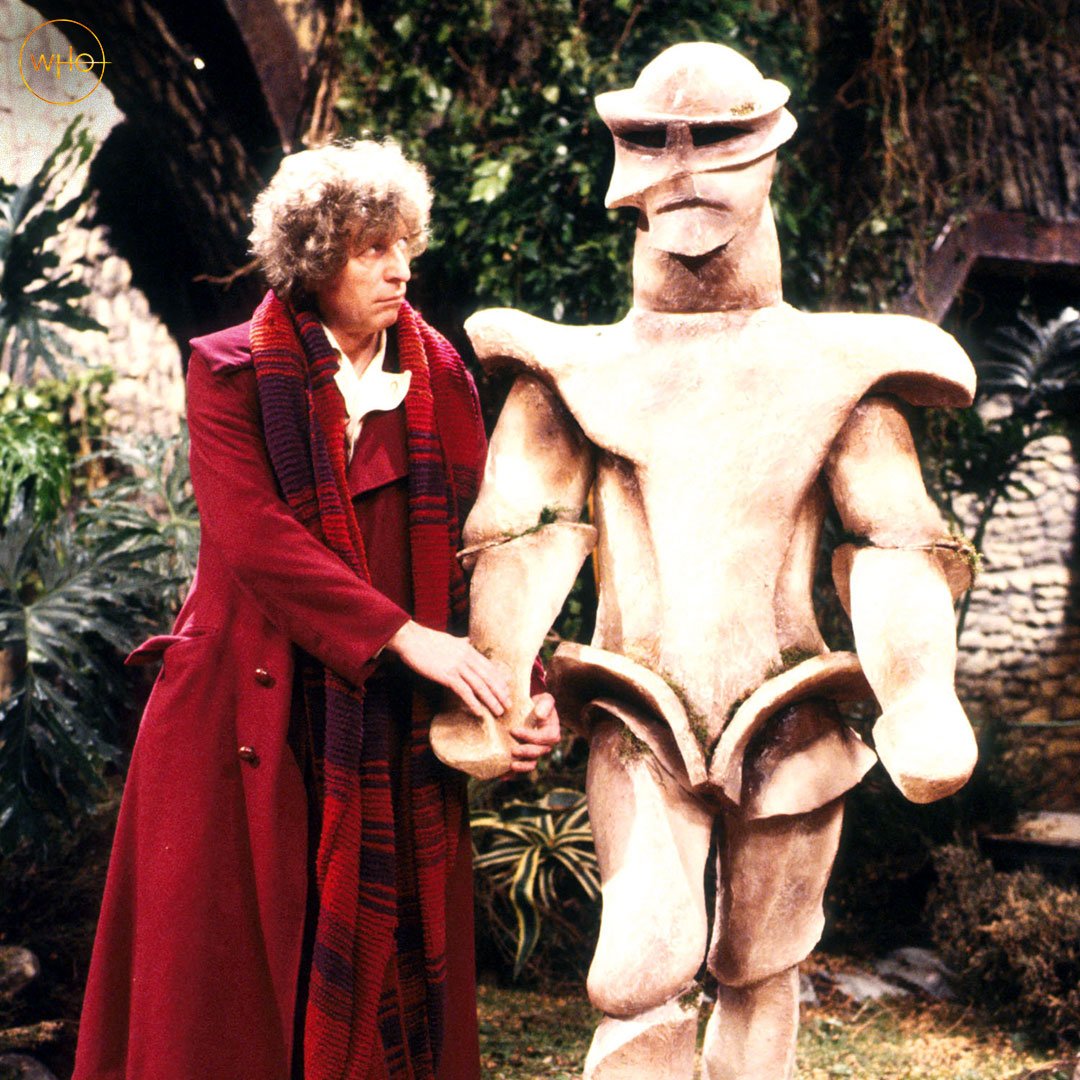
These contemporary views of Tom Baker’s final season are culled from Fendahl, the fanzine which my brother Simon and I edited from 1978 to 1981. Tom Baker’s last season was showing on BBC 1, a new producer (John Nathan-Turner) had taken charge, and Peter Davison had been cast as the new Doctor. I hope these extracts give a flavour of the fan scene of 45 years ago. I’ve tried to be fair to the original writers in editing some of their contributions.
Letter from Peter C. Jones, Brighton, June 1981
Tom Baker had just appeared as Oscar Wilde in Feasting with Panthers at the Chichester Festival Theatre – his first role after leaving Doctor Who. The play was a dramatisation of Wilde’s trials and eventual conviction for “acts of gross indecency”: he was sentenced to two years’ hard labour.
I have just seen Tom Baker as Oscar Wilde and was very impressed with his sympathetic and expressive performance. Although, at first, it was hard not to make any comparison to Doctor Who (because Tom looks the same, speaks in the same voice, and has the same grin), it did not take long to accept him fully in this new role. His acting was more controlled than I’ve seen for some time; his wide, staring eyes were sparingly used and to great effect. Having been, for some time, interested in the life and works of Oscar Wilde, I was slightly apprehensive about Tom’s portrayal of him at the time of his trials. But I need not have been. Tom Baker gave a tour de force performance and reinforced my opinion that he is a very good serious actor.
In the USA, Starlog magazine reported that Tom Baker episodes from The Ribos Operation to Logopolis had been sold to the USA… Pictures of Peter Davison in his cricketing outfit had been released.
Letter from Philip Collinge, Lancashire
I am in total agreement that we should place more trust in the BBC [Doctor Who] production team. If JNT thinks Davison is the man for the job, that’s all right by me. Davison, a fan since the age of 12, has already outlined his plans for the Doctor: “More down to Earth”; “less comedy”; “I want to make the show more frightening”; and, perhaps best of all: “I would like the audience to be a little apprehensive about his ability to solve situations at times”. Isn’t this the type of attitude we’ve been hoping for, for years?

The new Doctor has been attacked for his love of cricket. Has the new season started already? Have the critics seen all 26 episodes and thus come to the conclusion that the new Doctor is a failure? I’m certainly looking forward to Season 19. I wouldn’t pre-judge anyone before they’ve had a chance to prove themselves.
With the present production team at the helm, and JNT revealing that he was “only reasonably satisfied” with Season 18, I am convinced that Season 19 will prove these fans very wrong about the Fifth Doctor.
Letter from Mark Woodward, Nuneaton
I would love to see the return of old foes under JNT, as I’m sure they would get the treatment they deserve. His undoubted talent for production might breathe new life into them successfully. If the Daleks returned, though, it should not be in a story by Terry Nation; he has had his day with them. If David Whitaker were alive, I would obviously nominate him, but anyone who could write an original story with the Daleks in would be fine. The Cybermen have been long neglected and it’s high time they made a comeback. Perhaps a good idea would be to have them as an earlier version (without flared legs), although the voices would have to be altered as the early versions would be scoffed at in these cynical days. Maybe Kit Pedler had a few ideas that could be used as a fitting tribute. The Ice Warriors have been totally ignored recently, and weren’t handled as well as they could have been in the Pertwee years. Maybe a story set on their home planet, explaining why we have not detected life on Mars. The possibilities are numerous, though I’m sure that whatever is in store for us in the coming years, we won’t be disappointed.
Review of The Keeper of Traken from April 1981
We leave the claustrophobic E-Space for our own universe, which, being bigger, presumably has better dramatic possibilities. Bigger often means better, and indeed The Keeper of Traken towered over the previous two stories with what was simply excellent science fiction.
Johnny Byrne has proved, yet again, that new blood gives the series new life. From the opening episode to the final cliffhanger, the story was a masterpiece. We were presented here with realistic characters who were well portrayed. Unfortunately, this cannot be said for Kassia, the traitor. Why is it that there hasn’t been a decent female villain for years? Sheila Ruskin seemed to think that a dramatic line would sound better if totally hammed up: an example is her “Now, Melkur!” scream in Part Two.
Melkur was a superbly designed costume; the fact that it was not symmetrical made it visually interesting, and well disguised as a spacecraft for a new – or rather, old – villain. The voice, supplied by Geoffrey Beevers, managed to convey a great sense of evil in its gentleness of tone, and the power of the creature – amplified by it stalking about in a Robot style – created a superb alien. Curious feelings of excitement boiled up as a wizened hand snapped off two monitor screens: the Master was back, his appearance neatly coinciding with the end of Part Three. Geoffrey Beevers played the character, to whom a lot more thought had been given than in The Deadly Assassin. In the latter, he was a stock Doctor Who megalomaniac: in Keeper, he had a definite evil, grasping character. Parallels can again be drawn between Keeper and Deadly Assassin: the Master was seeking to possess a power great enough to spark off another regeneration cycle. To do so, he had to wait several decades before the old Keeper died, and, by replacing the rightful heir Tremas with Kassia, through the vehicle of the Melkur, we were again reminded of Deadly Assassin, but with the Source replacing the Eye of Harmony.
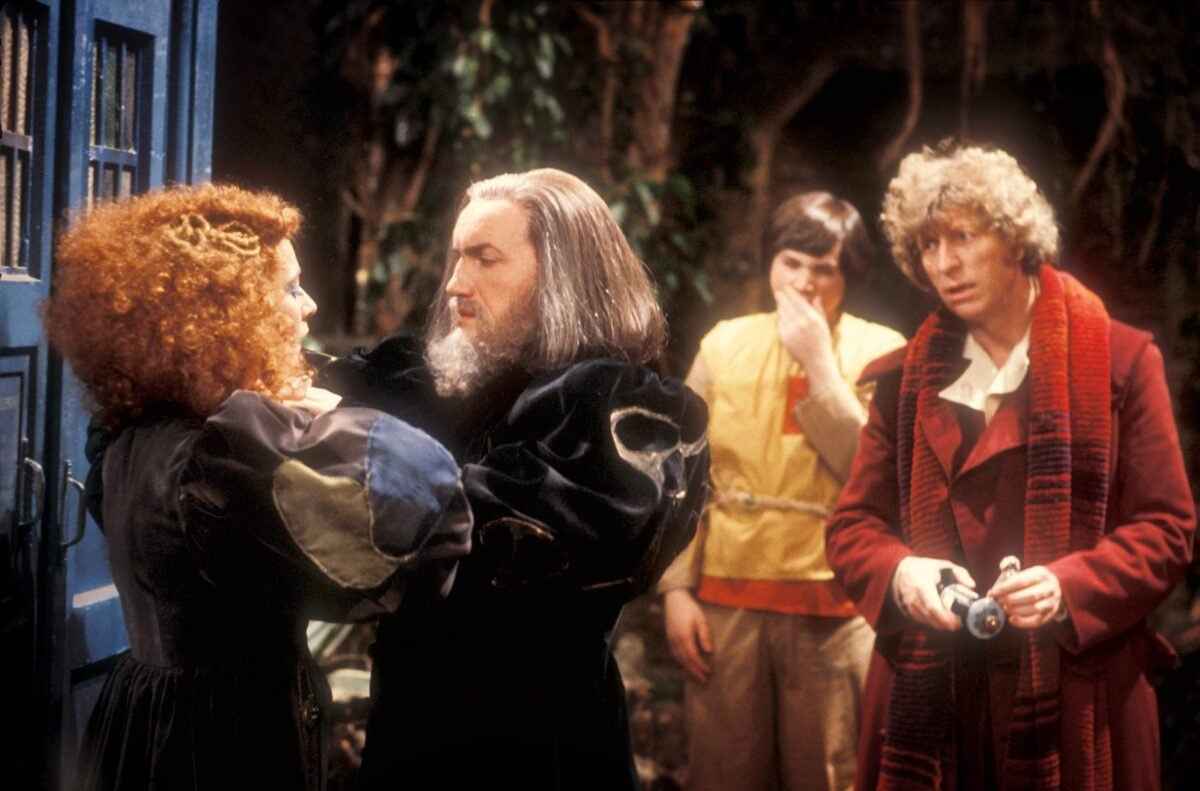
The Keeper himself was a rather insignificant person, the centuries leaving him twisted by age and presumably presenting him with a highly domed skull, unlike any of the other Trakenites. As with Melkur, the power – this time of goodness – was shown by his gentleness of speech and manner.
Tremas, the Keeper nominate, was another marvellous character, a consul who, when his world was disturbed, tried frantically to cling onto the old dignity and peace of his race. The character could have been explored more, however, and several questions were left unanswered. As Nyssa was already adult when Tremas married Kassia, who was her mother? Anthony Ainley played the part well, however.
Someone remarked to me that he loved Sarah Sutton – “a new Lis Sladen, perhaps?” This is exactly right. Nyssa is a charming, gentle character who compliments Matthew Waterhouse’s somewhat cardboard and obnoxious Adric well. However, she has not, so far, appeared in the new story, Logopolis. Are we to lose such an excellent companion for good?
One or two gremlins cropped up, both in plot and presentation. I am rather tired of new gimmicks like the Log appearing in the TARDIS: where exactly are these things stored? It’s a minor quibble but things like that get under my skin. Secondly, the wind sound effect as the Keeper died was not accompanied by any visible wind – neither trees nor shrubbery moved. Formulating a theory to cover the visual gaps is not difficult (the wind was actually a gravitational thing and therefore only affected animate objects) but I watched this episode in the company of several other fans who burst out laughing. Finally, the Doctor, once again, used a silly ploy to escape from Neman and the Fosters.
Nyssa and Adric destroying Melkur’s hold on the Source by tampering with the Source Manipulator is something of an easy way out, and a similar ending had been used in Meglos. However, this minor point did not distract from the brilliant conclusion: Tremas held immobile in order that the Master could steal his body and use it as a basis for his new form – which, thanks to a clever piece of design and directing, is reminiscent of Roger Delgado. “So … a new body. At last!” A regeneration scene, and the return of Nyssa.
The Keeper of Traken is Doctor Who as it should be, and as it should remain.
Frank Danes – aged 15 and 7 months [He is now 60…]