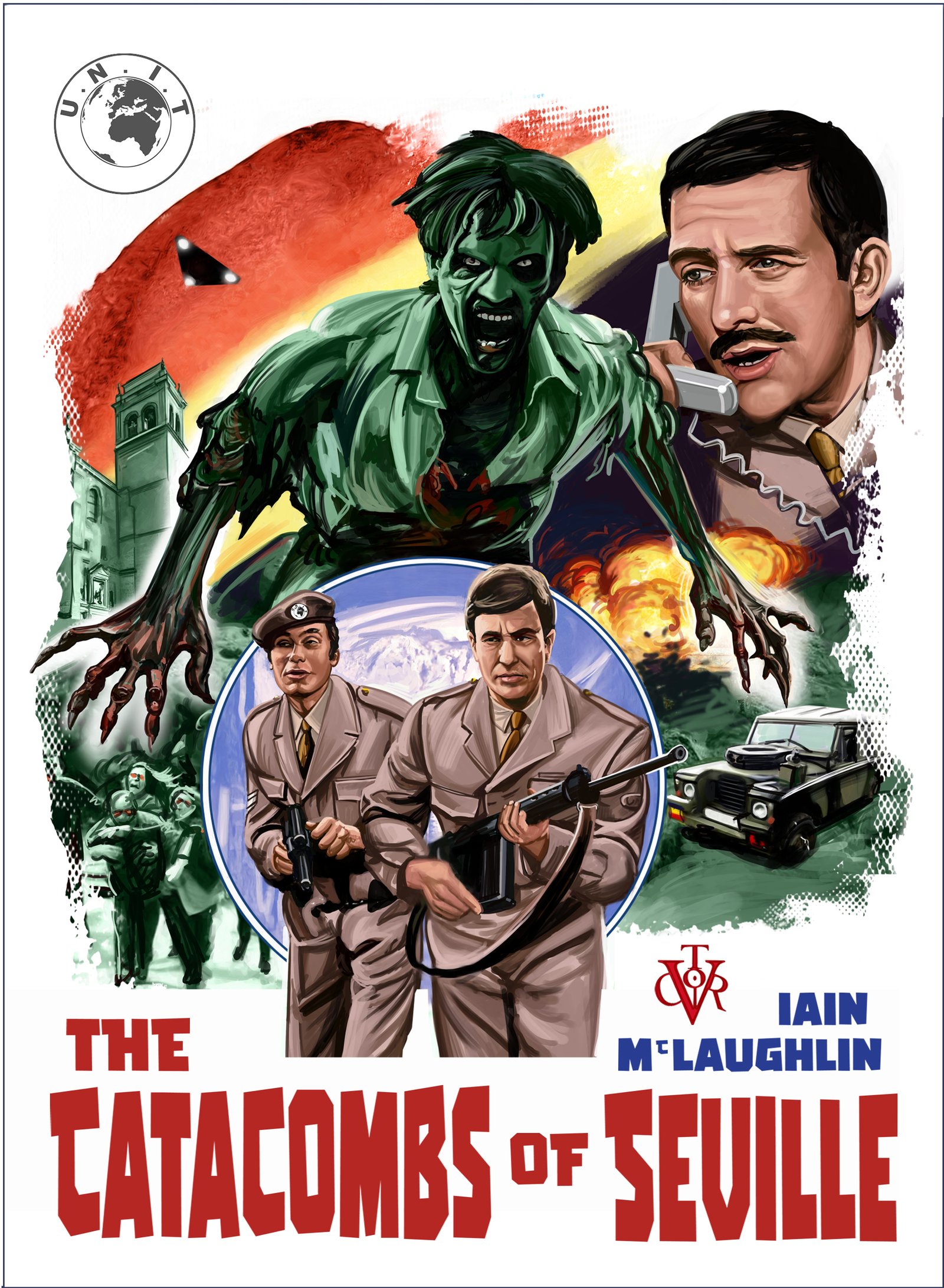
To the observer, this is a book that shouldn’t work – by what justification are the British branch of UNIT being uprooted and migrated to spend time in Spain after all…? But right from the very first page, this is a novel that surprises with its crisp and easy style of prose, and a deft skill at sketching out convincing and engaging character in just a couple of lines. Look past the garish cover, and the misleading story title: as you begin reading the opening pages, you will experience an immediate sense of confidence in the quality of writer here.
Though I am unfamiliar with Iain McLaughlin, it’s clear from the quality of his work that he’s a hugely experienced writer. The first scenes on page one are nothing more eventful than a young woman, Pilar Ortega, cycling down a Spanish lane outside of Seville, and yet, in less than one page, McLaughlin delivers a great deal of rich detail on Ortega and her environment, meaning the writer succeeds in placing the reader in the moment, racing down this country lane on a hot afternoon, learning something of her immediate family and situation as a teacher under the oppressive reign of General Franco and his military regime; you’re hooked by the end of this opening page and are comfortably eased into a day in Spain, about to join UNIT personnel on a nice vacation out of gritty grey London, and into a whole other jurisdiction. That first page is a superb example of how to open any novel, and bring the reader straight into the world.
“It’s not a secret that we exist, but what we actually do is.”
– Benton
Brigadier Lethbridge-Stewart is called on by the Ministry of Defence to despatch a small squad of UNIT personal to help the Spanish government investigate strange lights in the skies over Seville, and the mysterious deaths of local farm-workers. Although we are told UNIT has branches local in Europe that could respond, the rationale for the British branch to step in is well argued and makes sense in the context; there is word that Franco’s health is in decline, and the British government spots an opportunity here to show the Spanish government they can be allies; loaning assistance to investigate these odd events might go towards opening up future trade opportunities when Franco is no more. Lethbridge-Stewart is politically astute enough to read the undertones in this meeting, and accepts the reasoning as a worthy one to pursue.
And so, taking the reader on a trip to Spain with the focus on three main UNIT regulars, McLaughlin delivers such a warm and involving sense of the culture and uncomplicated lives of the ordinary people living on the outskirts of Seville that we have to make no effort at all to visualise the scenes he sets out, nor make any effort to feel and ‘see’ the various characters here – so confident and near effortless is the writer’s judgement of his flow of dialogue and scene descriptions that this is one of the most relaxing and enjoyable novels I have read since… well, actually Tim Gambrell’s The Vaughn Identity a few months ago!
With its relaxed recreation of Spain in the early 1970s, it’s a work Mclaughlin should be fully proud of. In the end, the best assessment of what his story is about is not the science fiction element, but the community. It is about people, and how they relate to each other. Pilar Ortega and her family are our anchors, and give a warm insight into a large closely-knit family living in the outskirts of Seville. We will meet Colonel Torres, and through him see the best and the worst of Franco’s authoritarian regime. And eventually we meet the monks at the local monastery: they have a secret, and yet, as with the general tone of these three days spent in Spain, they prove a very likable and admirable people with a good degree of humour and compassion. In a country where Catholicism is the main religion, it is heartening to see such positive characters and attitudes in these good-hearted monks.
The burden of the Spanish heat is a constant throughout the story. It is one reason Lethbridge-Stewart opts out of personally heading this operation and instead hands over to his second in command, Major Branwell. Ex-Royal Air Force Cliff Branwell is still new to UNIT, and so the Brigadier wisely sees this as good opportunity to let his Major have some hands-on experience of directing an operation, and discovering just what UNIT can often find itself dealing with… to which Branwell proves a fine operator and adept at handling the political aspects of this operation.
It’s John Benton and Jack Tracy who get particularly fine character work for this outing. Both Corporals were introduced in The Invasion, seen following the Second Doctor and Jamie in a car. We learned in previous books that Tracy sees himself as a ladies’ man and is often dissatisfied with the day-to-day realities of his job; this flippancy is present here as the UNIT Hercules transporter lands in Seville. However, one of the threads in the story leads to Tracy’s strength of character being tested by events; the attack at midnight leads to casualties, and one in particular affects Tracy deeply. By keeping the cast very small, McLaughlin can focus on the dynamics between Tracy and Benton, test their respective attitudes to being in charge of a squad of men, and when the squad takes casualties, it will be the death of young Joe Paynter that becomes a main sub-plot by which Tracy’s character will be challenged and measured against Benton’s more experienced perspective on living a soldier’s life.
Benton takes centre stage within this story. And in some ways, his handling here is reminiscent of the professional career soldier seen in Reeltime Pictures’ 1987 video Wartime — Benton as a character has had a very chequered history over the years, but with this UNIT series of novels, he is gifted with strong material as he is one of the key characters within the cast of characters – probably second only to Lethbridge-Stewart himself, in fact. A solid prescence, with a natural aptitude for getting the men in line and in place. This strong organisational aspect of the UNIT of this era is the whole reason the concept still resonates after fifty years, and the innate drive to get results is what makes it still a very thrilling story device. This is no screen-gazing focus-group a la 2025’s UNIT; this is a no-frills rapid armed-response unit that gets out there and gets on with the situation at hand.
“Keep your eyes sharp, know your training. Follow that, notice everything, stay alert, and stay safe.”
– Major Branwell
The Catacombs of Seville is a story title that suggests certain things… chiefly catacombs! But as it transpires, the catacombs aren’t really under Seville, and they only appear towards the end of the novel, and in quite an oblique manner. Meaning the title here is rather misleading. ‘Lights Over Seville’ would have been a more accurate title. And as the story progresses, the initial science fiction element of a UFO becomes more strained, and the internal logic of what this visitation means struggles in some areas to hold much in the way of logic.
The action takes place over two days and nights from the moment UNIT arrives in Seville. McLaughlin has the UNIT squad almost immediately go out on what turns out to be a late-night reconnaissance mission of the remote rural area where the bodies of several farmworkers were so recently found. It’s around midnight when the strange UFO suddenly appears close by them, and the UNIT and Spanish soldiers are pursued and attacked by unseen creatures hidden by the darkness. Benton, too, is attacked not too far away, and as the troops clean up in the aftermath the next day, he takes off to the monastery to follow up some very flimsy passing anecdote given earlier by Pilar’s mother. While he and Pilar are at the monastery, the corpses of the farmworkers stored in the mortuary in Seville come to life and escape onto the streets, infecting further people. By the end of this second day, Branwell has somehow realised that the undead zombies will be joined by the same creatures dropped by the UFOs around 20 hours previously and who attacked the Spanish and UNIT troops, as well as Benton a few miles away. Despite this unfathomable leap of logic from the Major, he does not question the overall basic implications of all this — why is all of this happening, why is it all happening so suddenly, and why is it UNIT’s arrival has triggered all of these sudden direct attacks?
Having fled without light, on foot, for several miles from the incursion at the farmhouse, Benton and Pilar find a barn to spend the remainder of the night in. How they manage to see, or light, a paraffin lamp within is not explained, and the subsequent scene of Major Branwell entering the barn just after dawn to discover the two hiding on an elevated section makes no more sense either: how on earth could he find them? Is the man psychic? It’s little lapses in the unfolding flow of events like these that weaken the sense of investment the reader has in the unfolding story. The attack on the Spanish and UNIT squad is both swift and comes virtually on the same evening they go out on a fact-finding patrol. And yet the obvious fact that they were targeted by these unearthly predators and their craft never occurs to anyone as they take stock in the aftermath…? These lapses in story logic should have been spotted in the subsequent proofreadings. And even as the story concludes, there is no explanation at all for why this ship, and its vicious inhuman occupants, chose now to come to Earth, and seek out a long-lost breakaway group of their people. How do they even know they are here after several hundreds of years passing? Why target the UNIT and Spanish soldiers at that isolated farmhouse, and Benton some distance away, but no one else?
But in spite of the problems with the science fiction aspect, I cannot fault the fine character work on offer here. The death of the young Joe Paynter haunts Corporal Tracy; it is no light matter, this death of a young soldier, and as the book ends, it is the Brigadier who has to reason with his corporal and share the burden. It isn’t the first time Lethbridge-Stewart has had to deal with the loss of one of his men, and neither will it be the last. But how he and Tracy learn to handle loss under their command is finely put across.
Despite the flaws in the plot, and the badly judged notion all of this takes place over just two days and nights, this is another enjoyable release under this new UNIT banner from Candy Jar Books. It’s the character work that stands out, and the strong sense of place by which Spain is realised on the page — this is no travelogue, but the way in which Ian McLaughlin so convincingly puts the reader into the heat of summer in rural Seville is a remarkable feat of prose writing. I couldn’t not enjoy reading this outing! And it fully deserves a wider audience…
The Catacombs of Seville is available now from Candy Jar Books.