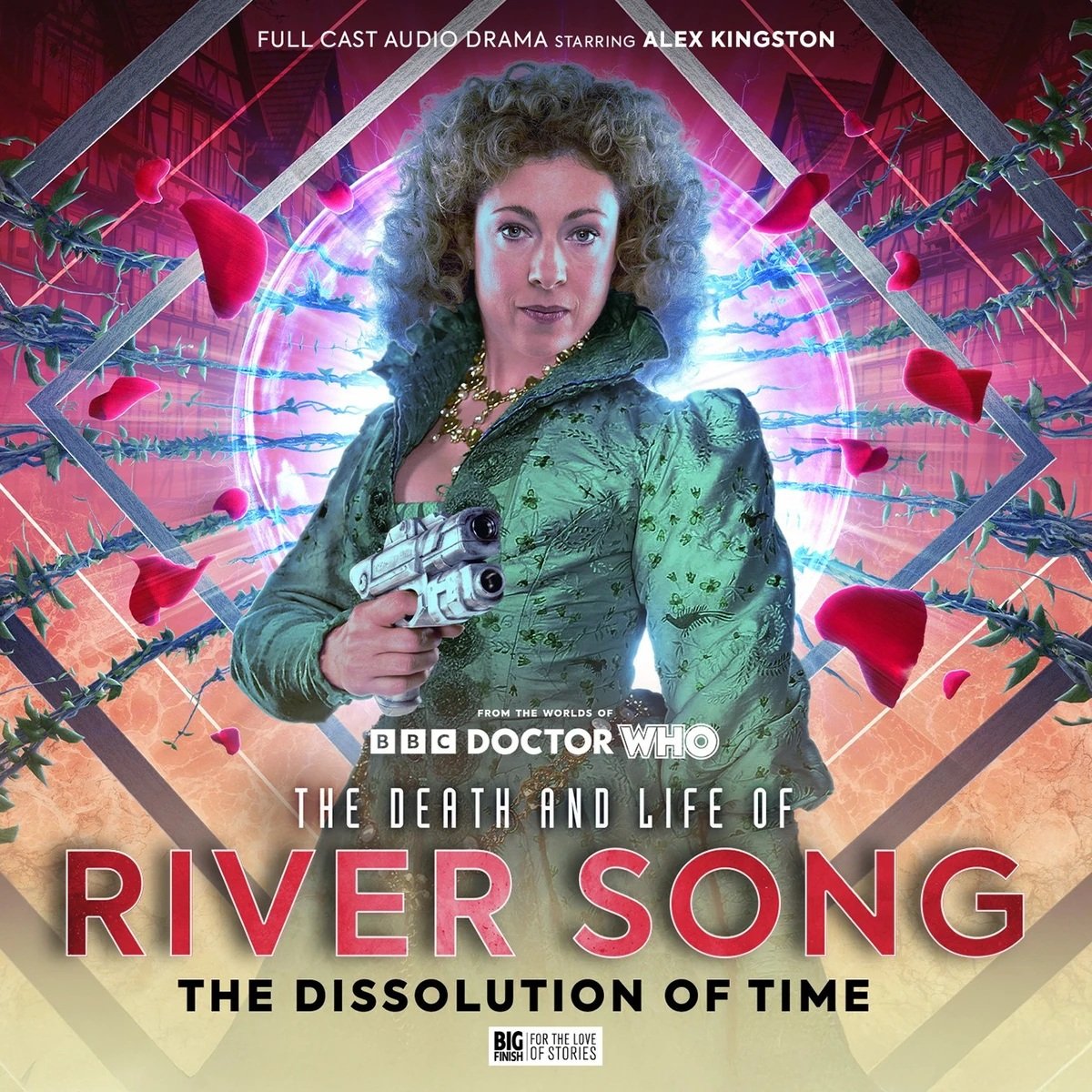
‘River Song has been imprisoned in the Stormcage, facing multiple life sentences for the Doctor’s assassination… or, at least, she was. Now, time is collapsing, and River is unexpectedly marooned in Tudor England, 1536 – with a mysterious alien companion, Dust.
Someone, or something, has broken history: the distortions centring on the court of King Henry VIII. River must find the culprit, and fix the damage, before it’s too late. But some players, for whom established history does not end happily, may have other ideas… ‘
I do love Alex Kingston — from Moll Flanders to E.R., to arriving on Doctor Who as the larger than life River Song. Do I love The Death and Life of River Song from Big Finish though? It’s been fifteen releases now, so she is a survivor! I keep buying the releases, I keep thinking the publisher will finally have an epiphany, decide where to take her, to have her find a life without the Doctor-obsession she exists under, and yet even after a recent series relaunch, nothing at all changes with this character or Alex Kingston’s approach to her.
Case in point: The Dissolution of Time.
The Armageddon Game
It’s a lovely opening to this release: we begin with the familiar sound of the TARDIS materialising, a chippy River Song exiting, asking the unseen Doctor not to leave it too long till ‘next time’ and River nonchalantly tottering back to her ‘room’ in the Stormcage facility… where she is being held after murdering the Doctor!
It’s a very good way of easing the listener into this release of four stories, and it is Alex Kingston who immediately arrests the listener’s attention — it reassures us straight away that this is going to be good!
The shame is that, after being delivered back to her ‘home’, it is amidst some temporal attack on Stormcage. The narrative immediately slips into a lot of technical babble and ‘talking heads’ exposition between River and Dust — Dust is a catlike humanoid at 7ft tall who appears to have pulled her out of the attack on Stormcage and into a safe bubble in time. It’s all quite laboured given the first four minutes of this opening story was so well done, and such a strong hook for the listener to be drawn in by. Dust appears to perhaps be from the 51st Century and is about as generic a character as it gets — very obviously inspired by the dog man seen in Jodie Whittaker’s series of Flux adventures, which doesn’t help in offsetting my growing lack of interest here.

It’s dull, this partnership. Achingly dull. The story is not being made clear, there is only these two pompous characters (mostly River) talking, and Dust is as boring as television static.
Time-shifting to the 16th Century and it is, again, all exposition from River, as she points out the lack of St Paul’s Cathedral and the dramatically disordered city skyline, then shifting seamlessly into an assessment of a Tudor wooden boss the two are stood by, which she deduces shows a ship that is the famous Mary Rose, and then witters on about her appreciation of Queen Elizabeth… Even Alex Kingston is struggling, and failing, to make this lumbering script sound remotely interesting, and we are only ten minutes in!
This lack of pacing is not good, as this set of stories are all written by the same person, Rochana Patel, and so what gets set here in the debut is what is surely going to be carried on for the next three to four hours of playtime. The flow does pick up gradually as we meet the Mary Rose’s captain and learn he is, in fact, Henry Tudor’s young and illegitimate son, the Duke of Richmond. This meeting will allow River access to Henry’s court, and there is a welcome sense of a historical play coming into force as we are on the day of Catherine of Aragon’s execution; River is having to be very cautious in navigating court politics and, in particular, the formidable King Henry VIII, played straight by the capable Harry Myers. This is no caricature of Henry VIII here, and it offers some hope of being partial historical drama, with therefore understandable stakes. But this tonal potential is never allowed to really solidify, as the direction of the script and delivery doesn’t lift itself away from the worst aspects of River’s characterisation, and the fact there is a camp 7ft cat-man-thing at her side that precludes actual serious drama from happening. It is a story that never takes that little leap of faith, and treats its historical environment seriously. Yet the setting of Henry VIII’s court is one of the most dramatic and dangerous settings in the whole of British history. The possibilities for historical drama and tragedy are enormous!
“River and Dust? Such poetic names.” – Henry VIII.
Anne Boleyn Must Die
“No one acts out of kindness — ever. Only self-interest.”
So says Anne Boleyn. As River and Dust uncover a secret link between the soon to be Queen and a shadowy alien plant-being what develops is a gradually arresting test of wits and will between River and Boleyn. Anne is the younger by far, but reveals herself as adept at navigating and playing the Royal Court, and in being able to read River and Dust’s true intentions like some shrewd intuitive gamesman. It’s fine characterisation.
History must take its course, and so the moral dilemma at hand is the knowledge of Anne’s fate, and what happens when she has been told of that destiny. How far will she go to protect herself, and how far will River find her own ethics being pushed as the stakes push her to make decisions on life and death, for the greater good?
Imprisoned in Stormcage after she supposedly killed the Doctor, River is not blind to the parallels between her own fate and that of Anne Boleyn. Both doomed, both on their own, both trying to look after their own futures. Charithra Chandran plays Anne Boleyn, and she is superb! Nearly all of the guest cast are very good, as they are serious drama actors playing with straight performances and therefore some authenticity with their characters and the historical setting, but Anne Boleyn is the central character here and Chandran doesn’t just hold her own against Alex Kingston; she shows herself as being the better actor…
“If you were to die, do you have any idea what would happen to the realm?” a concerned Boleyn implores Henry as he sets off on a jousting match, of which she knows well he has been wounded in before while participating. This is a small but important scene, in her fixation on her self-preservation. Anne is largely being blinded to any bigger picture. But with a child on the way and her having learned her head destined for the block in just weeks, fear is guiding her to take extreme actions, and the manipulations of the strange time-sensitive plant-being that visits her at key junctures are warping the flow of history unfolding.
A Good Woman Goes to War
Parallels between Anne Boleyn’s situation and River Song’s continue to be made in this third chapter.
Rochana Patel has done some decent research on Anne Boleyn, daughter Elizabeth, Jane Seymour, and Mary Queen of Scots — all of them are here, and name-checked, and yet apart from Thomas Cromwell, none are given much in the way of airtime within these first two chapters. It is a story set in one of the richest and most eventful times in British history, and yet it is all largely left hanging in the background here, hinted at but never broached. Instead, the focus is Anne Boleyn, her ruthlessness, her understandable desperation to stay alive; if it wasn’t for the excellent actress bringing her to vivid life, this whole release might fall completely flat. It plays with moral dilemmas that it cannot satisfactorily develop, and then close.
Henry VIII is dead, by Boleyn’s hand, as the mystery plant-being plays manipulative feints with her in order to feed on the disruption to natural events. Anne herself is proving no less adept and ruthless in using the people around her either. The plant, Anne, River, and even Dust, are all vying for their own aims and their own interests. So the question is: who, if anyone, will overcome their own selfishness and take personal charge for what needs to be done to set things right?
It all sounds rather interesting, but in fact while the concept of Henry dying before his time is a potentially gripping story device to ratchet up the dramatic tension, Rochana Patel instead slips off into light farce, as plot-device character Dust uses his technology to take on the appearance of Henry and it is all handled as if it were some light children’s television production. But then it’s back to semi-seriousness, as Cromwell quickly sees through the deception and recognises his king is indeed still dead. And elsewhere, Anne Boleyn has visited daughter Elizabeth only to have River catch up to her and again the tone shifts to light farce, thanks to Alex Kingston deciding this is not to be actual drama playing out, but her time to hog the stage for herself.
“Can’t say she likes me much — can’t say I blame her!” A line from River as she finds herself holding the infant Elizabeth. Which left me musing over whether Alex Kingston speaks it with awareness…
This storyline is now revealed as not a historical, and that’s one of its main problems. It is a story set in history, but history going wrong. And River and Dust have to set it back on the right path. Meaning the writer would have to be very skilled with developing character, in order for the listener to invest in Anne Boleyn’s plight, and feel something for her when events reach their conclusion. But this point is yet to be met, and everything that might make this storyline worthwhile therefore hangs on the final chapter here, and what, if any, decision Anne makes in order to set things right, save England, her husband, and indeed all history to come…
The Schism Bloom
“I’m here to tell you it doesn’t need to be that way!”
Were there “lawyers” in 16th Century England, would Thomas Cromwell ever have referred to the King’s law-makers in any such term?!
We are not in altered history anymore; the situation has shifted so that apparently we are now in an alternate timeline. And Henry’s illegitimate son, introduced in the first chapter, returns here to take a prominent role as he determines to take his father’s throne. Thomas Cromwell is then killed, four years before history actually records it, and the damage to time is accelerating as the chaos of a collapsing timeline feeds the plant creature.
On top of her slipping into using modern tics for scripting people living in the 16th Century, the writer also falls into characters using modern-day political mud-slinging and vernacular, further undermining the effort needed to believe this is the 16th Century, and that the court environment of Henry VIII is a very dangerous place to find yourself.
Anne finds herself being strong-armed by River into accepting an alliance with hated rival Mary, but while the two actresses are giving it their best efforts with some very dubious material, it is the lack of logic in the storytelling, and the lack of attention in developing these now-alternate characters, especially in this chaotic last chapter, that defeat any hope of this being a satisfying or touching conclusion for either story, or main characters. The history of King Henry VIII’s time in power is immensely eventful, but also very complex in its various players and its depth of intrigue. Rochana Patel has struggled in picking out the relevant points of interest and sticking to a straight or linear narrative. The story started its journey by creating a focus on Anne Boleyn’s fiery manoeuvring and desperate sense of self-preservation at all costs. To have it all then handed to the haughty and thick-headed River to resolve Anne’s very personal and completely understandable fears, and then deliver deeply unlikely lecturing to her and Mary, finishes off the listener’s last grains of interest in following any of it. By this point, it is a meaningless alternate universe, with multiple plot strands that are all shooting off in their own directions. Thankfully, the end is almost in sight…
Do I like River Song, from Big Finish? Well, err, it’s fairer I think to say that I want to like her. But then I want to like Bernice Summerfield as well, and despite me trying to give that character multiple chances to connect, that isn’t happening either.
As a storyline, The Dissolution of Time, would have benefitted from not having the expediency of Dust – the unreality of this character and the regular use of his problem-solving technology, combined with River’s invulnerability and unrelentingly superior air, works to remove what may otherwise have been a tense character-led storyline. Rochana Patel is not a terrible writer, but still falls beneath the more skilled plotting of the likes of Lizzie Hopely, Matt Fitton, and Katharine Armitage. This storyline demands some very tight plotting and strong character-work if you are going to make it last across a full boxset, which this storyline does not, unfortunately: the finale’ staggers on and on with at least three (misjudged) endings, and so Anne Boleyn’s tragedy, in the end, doesn’t feel like a tragedy at all.
It is not the worst I have been served with from Big Finish, but when I think of the fine historicals that the publisher has mounted in the past (in the superb David Bradley First Doctor range for example, or the more recent Fourth Doctor Last Queen of the Nile which pushed this Doctor into fresh areas for his character), the River Song series demonstrate Big Finish at its most lazy ‘pump-it-out’ worst. When you get the wonderfully done three volumes of Jenny – The Doctor’s Daughter from Big Finish, featuring a redundant character last seen on television in a one-off appearance in 2007, and then you have this River Song range still in production, and still showing absolutely no signs of bettering itself and heading off somewhere fresh and distinct with the lead character… I really have to ask whether Big Finish themselves like River Song.
There’s still strong sound design throughout this release. It still needs a better theme tune. But by the end, this was four-plus hours of near torment… I have not the stamina for a marathon-length four-hour River Song yarn on audio. Does anyone?!
The Death and Life of River Song: The Dissolution of Time is out now from Big Finish.