“During all The Avengers‘ time, when the most popular baddies were Soviet spies, my baddies were capitalists. No one noticed. For seven years, I wrote subversive Doctor Who serials. No one noticed…”
That was Malcolm Hulke, in private correspondence with Jean Tate, in 1975.
As an admission, it was provocative. Hence why he admitted it only in private conversation, as seen here. Even by today’s standards, though, it remains a provocative statement to read that Malcolm Hulke made. And if there is one connecting line between the environment of 1975, and here in 2025, it is that provocation can be… dangerous? Perhaps it was and is unwise to point some things out in full public view, and so Malcolm Hulke adopted some degree of subtlety as his writer’s cloak. A technique developed in his work whereby he did not signpost, did not label, but instead trusted his audience and readers’ intelligence to be able to pick up on the points of view on offer in his storytelling — i.e. how his characters and different factions sit in relation to one another, and how that is actually powering the drama within his writing output throughout the 1960s and ’70s. Some may like to use the word “political”, but Hulke’s was an approach to writing that was more about different points of view; some of his characters would be on one side of an extreme, and we would follow the reaction when these two extremes met on the screen, or the written page.
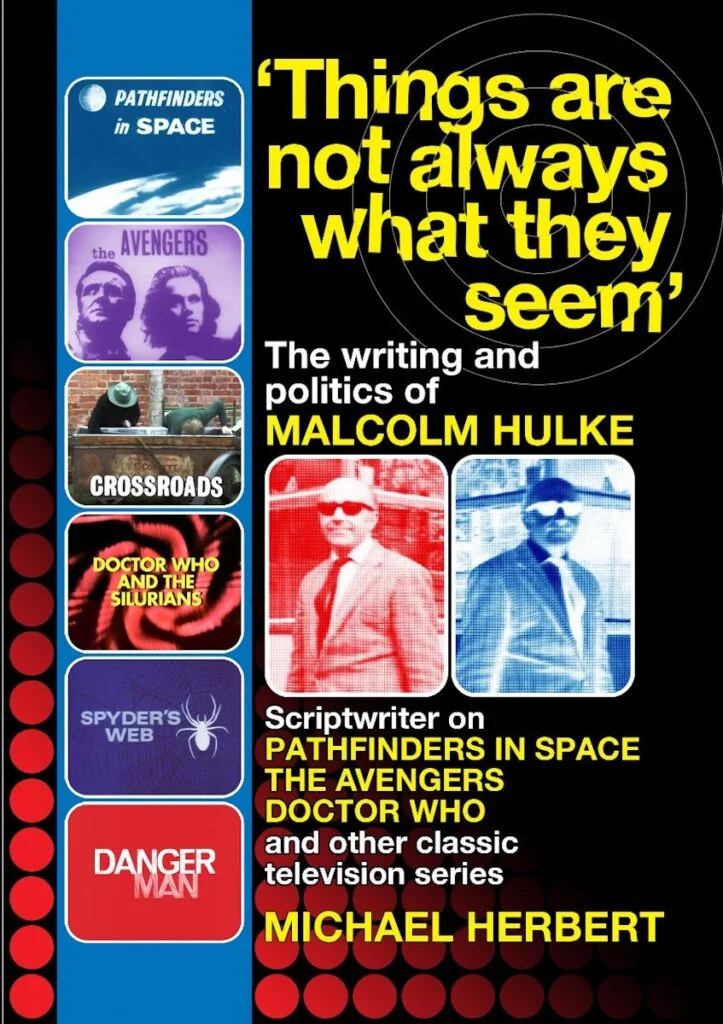
That’s a point of view well worth remembering when you go into Michael Herbert’s impressively researched, and incredibly illuminating look at the life and convictions of Malcolm Hulke, Things Are Not Always What They Seem — The Writings And Politics of Malcolm Hulke. and it is a further credit to Herbert in that he does not set out to ‘educate’ the reader here, but instead, much like Hulke himself, he presents his work and allows the reader to see what they will… and for me, it was the chapter of Hulke’s life dealing with his near lifelong membership to the Communist Party that really gave the best insight into why and how it was that he came to write the way he did by the 1970s.
It’s an important distinction here to always bear in mind that the past is a different place. The world that came out of the Second World War was hard; it was also conformist. It was the world where television and theatre creatives like Hulke were rubbing into (and against) the establishment. And while it is hard to say how greatly influenced Hulke was by the more libertarian societal shift that took place in the early 1960s, and best demonstrated within teen pop culture of the time, it is fair to say that his own outlook, from a very early age, was libertarian and open-minded anyway; it was clearly the reason he gravitated from living in the quiet of the Lake District, to the lively and mixed environment of London in the wake of the war.

Growing up in an unconventional household, with a mother who made ends meet by often skirting the law, Hulke never learned who his father actually was. It’s a point that haunted him for the rest of his life, and was quite possibly a reason why he could never quite settle down — even by the end of his life, he was single, and with no steady relationship. It’s indicative of an insulated and private struggle of which he clearly never managed to resolve within himself, and at least one of the ex-girlfriends Michael Herbert found confirms as much. Mac Hulke was never going to be a family man.
But while a personal life is by nature a private affair, it is Malcolm Hulke’s history and relationship with the British Communist Party of this post-war era that Michael Herbert has been able to research in an extraordinarily detailed way. While there is also a surprising level of research on his early childhood and (complex) formative years to be had here, it is the section dealing with Hulke’s entry into the party, and exposure to the developing internal feuds and double-standards within, that give some of the best insights into what perhaps made Malcolm Hulke the person he was professionally.
It is wrong to assume that the British branch of the Communist Party was a hardcore devotee of what came from the Soviet Union itself: Herbert points out the various fracture points that separated the two geographies — such as the effects of the Soviet incursion into Warsaw in 1968, and the earlier Korean war, both of which struck to the core of what British Communist members believed in; and it does seem apparent that, despite his unwavering loyalty to the party, and chairwoman Betty Reid’s ongoing strong hostility to him personally, Hulke wasn’t so much a party fundamentalist, but more a libertarian. It’s certainly the case, as Herbert notes, that he seemed to be always looking to be a ‘part’ of something — the Communist Party led him to an equally dedicated time in the related Unity Theatre, as writer then as its secretary. This, in turn, led to him founding The Writers Guild, which then led to his deeper interactions with the Trade Unions… but with ‘joining’ such groups came the internal and external conflicts and compromises he would naturally be immersed in. And from that continued exposure comes character building and an understanding of people. One could almost say that these internal group conflicts were a way of life for Mac.
As complicated as this chapter might be, you should follow all of this and come away from it with a far better true understanding of why and how his writing developed the way it did. And given that well over half of this book is devoted to looking at that work output and detailing it, that is all the better.
The true power (and joy) of this biography is that Herbert was, in the course of his researching of Mac Hulke’s friends, able to discover and gain access to a wealth of personal first-hand correspondence from the man himself. For such a well-respected and loved creator in the Doctor Who mythos, any actual knowledge or insight into the man himself has always been limited by the fact that he passed away in 1979. There were few interviews to be had, therefore, but along with a very insightful BBC World Service interview from 1963, Herbert’s access to these letters offers an incredible and informative direct line to Hulke himself. Whether it be writing lengthy dispatches from his time in Australia, writing to close friends, the Tates, or corresponding with business associates, you get to ‘speak’ with Malcolm Hulke. This gives you a real sense of both his outlook on life and his fierce sense of principles.
It’s not entirely clear where exactly these principles developed from; Hulke was a strong champion of writers’ and workers’ rights, and you do get a notion that there had to be a specific event early on in his life that ignited this passion, but Herbert isn’t able to pinpoint just what in particular it might have been.

And yet one running theme is that Hulke was loyal. He was loyal to his Communist Party membership; he was loyal to the friends he allowed into his circle; and he was loyal to fellow writers and workers. Where he does seem to have balked is when dealing with those who were potentially untrustworthy within the industry he worked in… which goes back to that sense that there must surely have been some early event in his working life that taught him to be suspicious of commissioners, editors, and their more distant executives hidden away in the background.
Certainly though, one contributing factor may be that even by the last years of his life, money was always short. The reasons why Hulke seemed to retire from television writing by 1976 have been a source of speculation for years now. But as one of Herbert’s discoveries seems to settle, it may have just been as simple a case of him realising, thanks to his successful Doctor Who and Crossroads novels, that prose was more rewarding. Both in terms of recognition and royalties. A career shift to writing solely novels and specialist non-fiction projects that interested him seemed to be beckoning, before fate intervened sadly. He was only 54 when he passed away in 1979.
This book is a biographical account I have long wanted to see made a reality. Malcolm Hulke was a figure from the 1960s and 1970s eras of Doctor Who who occupied a very similar pedestal to Robert Holmes, and it was interesting to learn that both began television writing at around the same time — 1958/59 — both submitted ideas to the Doctor Who production office throughout the ’60s, and both came to full prominence with the Barry Letts/Terrance Dicks era of the show. And it is fair to say that both writers owed a debt to the particular way in which Letts and Dicks would dutifully nurture and encourage their writers to do their best work on the series. But Dicks’ own testimony has made it clear that it was actually Mac himself who taught him that lesson — how to encourage and treat writers. I find that influence from Hulke, an influence which undoubtedly eased Robert Holmes’ own growth and increasing sense of confidence, to be an unspoken yet lasting, far-reaching legacy. (I didn’t even mention his Writing for Television books!)
Further to that though, it will be his Doctor Who work that ensures that Hulke himself will never be forgotten. The series goes on, and every year, a new generation of fans discovers what still makes him stand out from the rest…
The book is over 660 pages, and I have to say despite it being printed in full colour, it deserves a better format than what Lulu offers — ideally hardback. Michael Herbert’s dedication, going beyond the normal level of research, also deserves this to be given a hardback release. But if ever it does happen, I also must plead for the author to add an afterword or final chapter to round off the book; as it is, the book just stops cold. It is too abrupt. It needs a fitting end-chapter to make the journey coming this far as a reader fully satisfying. Perhaps an afterword from Jean Tate?
Even so, as it stands, this book is a very strong recommendation, and a huge credit to Michael Herbert.
“Since switching from TV to prose, my position as a writer seems to have improved enormously. Write a series enjoyed by 14 million and no one knows you. Write a book and you’re an established novelist. I now have 11 in the shops, two at the printers, commissions to write more, and endless short stories…”
– Malcolm Hulke, 1976.
Things Are Not Always What They Seem – The Writings And Politics of Malcolm Hulke is out now.