
Some seven years ago, I wrote a piece asking why all Doctor Who couldn’t be released in high definition. This was when the Blu-ray box sets were gaining traction and were clearly the next phase in the BBC wringing an extra bit of cash out of Classic Who fans, now that the DVDs had all but dried up.
I argued back then that the DVDs were sufficient as I believed that, in the future, the televisions themselves would be the medium that would deliver improved picture quality. Whereas there has been some truth to this – the current OLED televisions are magnificent – restoration (or in this case “improvement”) of Classic Who for Blu-ray has turned to Artificial Intelligence in an attempt to bring Classic Doctor Who picture quality up to high definition.
Since I wrote that original piece, AI has come on leaps and bounds; I didn’t even mention AI back in 2019, but now it has crept into much of everyday life. Even as I type this essay on a writing app, AI is guessing (correctly, more often than not) the next word I want to type or even what the end of my sentence is going to be.
YouTubers have been taking clips of Doctor Who for a while and applying AI to create an HD version of their chosen sequence and some of the results have been very good; it made sense that Doctor Who’s restoration could apply the same techniques to the forthcoming Blu-ray box set releases.
Unfortunately, the initial results of the first two ‘AI seasons’ were not well received. Season 13’s release, the first to have AI applied, had some obvious issues where some faces became unrecognisable, hands had missing fingers, and scenes could look ‘just wrong’. Season 21’s release seemed to have improved, but there were complaints of over-smoothing of the video and that characters could look a little plastic.
The whole AI situation throws up four issues…
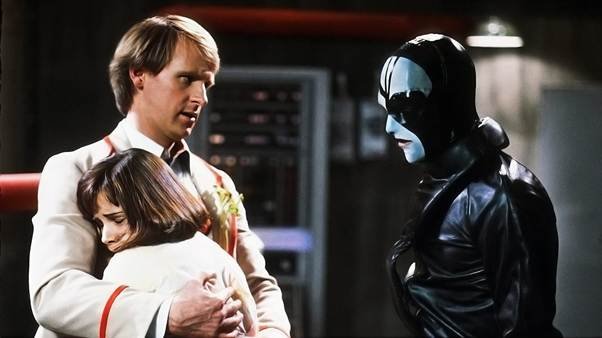
Issue one: Have the BBC decided to use AI before it was successfully developed enough? I would hazard a guess that they have. The speed of AI development could indicate that the current restoration team could have given at least another year before attempting to convert to high definition and avoid the problems that have occurred on the two recent Doctor Who Blu-ray releases.
Issue two: Here we have a situation where AI conversion is being attempted, but it’s after a significant number of Blu-ray season box-sets have already been released.
Let’s assume that the process has worked and is delivering standard definition Doctor Who in high definition at acceptable quality; what is going to happen to the seventeen box-sets already released where only a simple upscale (i.e. picture pixel count) has been applied?
Would the BBC be so bold as to apply AI to already released seasons, which were only a simple upscale, and release the sets again as special editions? Or will the range stay at part upscale, and part HD? Not ideal.
Purists could argue that the same situation occurred before Steve Roberts’ Restoration Team developed Vidfire – restoring episodes to how they would have looked on transmission – but, by and large, this was applied during the late VHS/early DVD years. Picture quality wasn’t a significant gain on the remaining VHS releases, and it caught most of the DVDs that needed it.
Issue three: The resistance to AI is understandable; especially when poor results are released. But there are also the issues around changing the source material. Will the AI version be significantly different from the original? Will it introduce strange artifacts? Or will things look just plain wrong? A lot of AI video still doesn’t look quite right and, in many cases, it is obvious that AI has had a hand in it (back to the first issue).
In my last piece, I mentioned that I’d watched an episode of The Prisoner where the HD version (re-scanned from the original film source material) had shown up production short-cuts such as set backdrops. VHS tapes or DVDs watched on our smaller CRT televisions were much more forgiving. As I said back in 2019:
“Cinema was made for big screens; pre-late 1990s television was not.”
This leads into a fourth issue: are we being a bit fussy?
I am reminded of when I was digitising a quite considerable VHS collection. This would have been around the 2000s and I would record a tape to my PC through various hardware and software filters and apply further “improvements” during the rendering process. Some of the results were good, but they ultimately remained “VHS” in essence.
Discussing my results on the VideoHelp.com forums, a distinguished contributor took me to task when he suggested that half of the effort I was making wasn’t necessary. Most of the processes I applied wouldn’t make any difference when I watched them back unless I was really looking out for them; faults visible on a screen grab wouldn’t necessarily appear on playback when it’s one frame out of 25 per second! Ultimately, the message was to do the basics, but keep it simple.
He had a point; cleaning up chroma noise (fuzzy colours during a VHS playback) was one thing, but applying smoothing or lighting changes were probably more detrimental than anything else (over restoration?), unless the source was really bad.
This is where the Restoration Team got it mostly right in the VHS/DVD days as, in many cases, the source material was in such bad shape. But back then the Restoration Team were bringing the quality back to what it should be, or as near as, rather than trying to make it better than it originally was.
My last statement on my previous essay – “Doctor Who can be HD, but not yet” – I believe still stands. AI will be the medium which will convert standard definition television into high-definition, certainly, but, judging by the way the Season 13 and 21’s releases were received, it’s still not quite there.