Haiiii! Good grief! It’s the one sentence reviews of the Pertwee stories, you ham fisted bun vendors!
It’s common for Who fans periodically to change their minds about which era of the programme they like best. I maintain – and other views are available – that the glory days of Doctor Who were the Pertwees and the first three seasons of Tom Baker, with the Sixties coming a close second. The Eighties were more of a mixed bag, ranging from the brilliant to the why-did-they-bothers; I’d probably say the same for nu-Who, though with more nuance (but as this is supposed to be an article on the Pertwee stories, I won’t elaborate on said nuances).
Anyway. I used marginally to prefer the Hinchcliffe/Holmes/Baker stories to the Pertwees but these days, I’ve changed my mind. I really, really like Jon Pertwee’s era. Interesting that, when I’m rewatching them and my 25 year old son wanders into the room, he always sits down to join me; he just says he likes the way Pertwee plays the Doctor – and he was born a quarter of a century after Pertwee relinquished the part. Pertwee’s legacy endures.
I could go on for days about the individual stories but our beloved and esteemed editor has limited us to a single sentence for each one. So, here, in brief, is my view of the series’ output from January 1970 to June 1974 – and yes, I saw all of them when they were first broadcast, and yes, they did give me nightmares. It is every British child’s inalienable birthright to be terrified by Doctor Who. I rejoiced in my terror.
Before I do so, however, would you care for some fascinating facts?
It’s notable that, while Pertwee marked the shift into colour, most of the contemporary audience didn’t notice. They watched the stories in black and white. A colour set cost £300 in 1970. If you adjust that for inflation, it comes out as an eye-watering £4000 in today’s money. Most people just couldn’t afford that, so when the Master insists on having a colour telly in his cell, it is a further demonstration of his unlimited greed. If people wanted colour, they usually rented their sets. Even then, the rental would set you back £5/5 a month. This is to use the old notation; it means five pounds and five shillings. Five guineas, in fact. Stick that into today’s prices, and it comes out as 80 quid a month. (Rather puts the Netflix subscription into perspective, doesn’t it?) Most people didn’t have £80 a month to chuck around, so 98% (sic) of all televisions were black and white in 1970.
Isn’t that interesting? (Who dares to say no?)
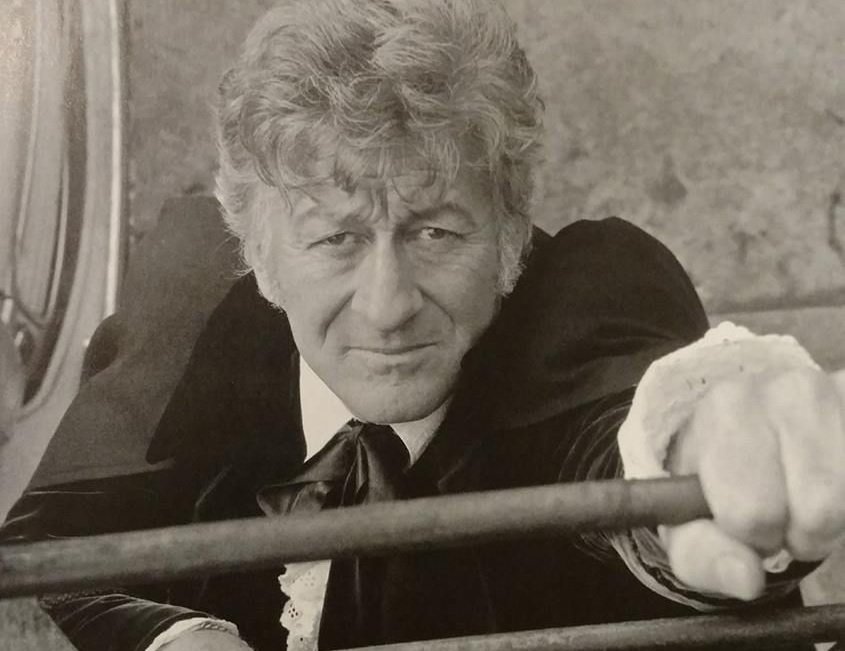
By the time of Planet of the Spiders, around 40% of sets were colour. Even so, most of the audience watched Pertwee in black and white, throughout his run.
We still had a black and white telly in 1974. Lots of people’s sets still used the old 405 line format, too, which was the videotape format for the Hartnells; BBC and ITV broadcast their output in both 405 as well as 625 lines well into the Eighties. So, not only did most people watch Pertwee in black and white, many saw him in rotten definition too.
(You can imagine my excitement when my brother Frank and I watched part five of Planet of the Daleks in colour at a friend’s house. What colour would the Daleks be? Pink and green? Orange and yellow? Red and silver? Nope. Black and grey.)
Enough rambling. Here, dear reader, are the single sentence reviews of all of the Third Doctor stories.
Spearhead from Space
A stunning debut for the new cast and the new format; Channing, a chilling study in public school villainy, remains one of the greatest of all Doctor Who baddies.
Doctor Who and the Silurians
Strong cast, outstanding script (a subtle parable on racism), putting the new Doctor at loggerheads with Courtney’s uncharacteristically pragmatic, hard, and uncompromising Brigadier.
The Ambassadors of Death
It looks good but it’s a stretch at seven episodes; the tortured multiple rewrites of David Whitaker’s screenplay are sadly evident in the finished product.
Inferno
Inferno is another belter: the Nazis evidently won the war and Britain becomes a Hitlerian dystopia.
Terror of the Autons
Rewrite of Spearhead from Space with over-enthusiastic use of CSO, introducing Delgado’s definitive Master.
The Mind of Evil
Nasty and very, very frightening.
The Claws of Axos
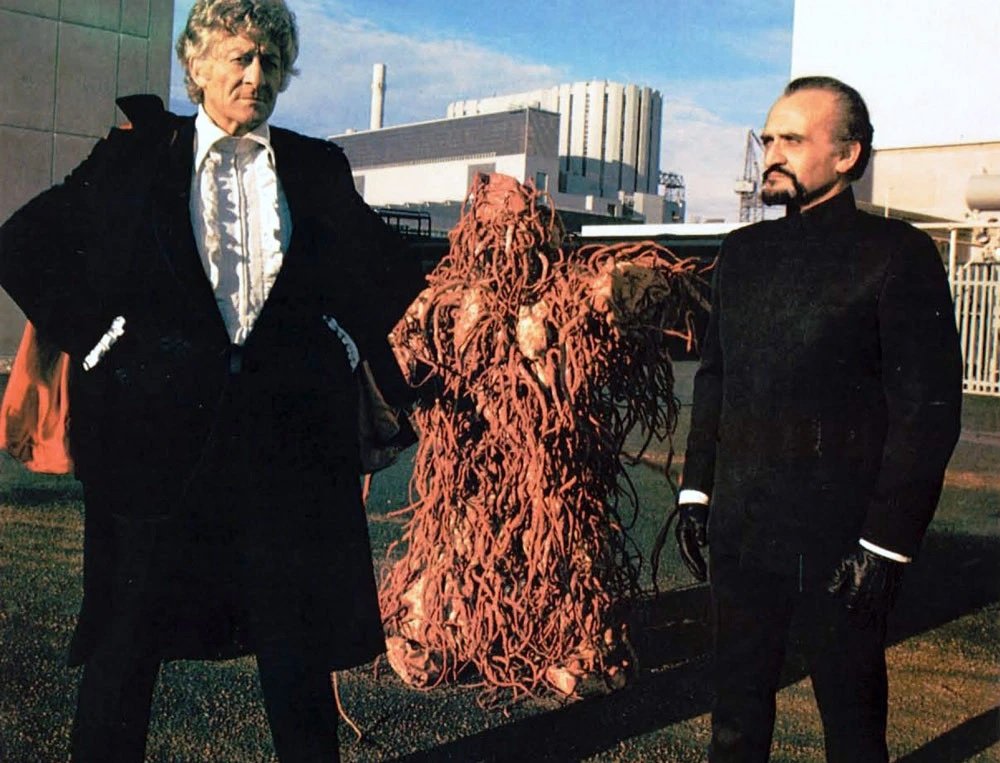
Seventies psychedelia: weird and kerrrr-azy, daddio!
Colony in Space
Another excellent Malcolm Hulke script, exploring the then-obsession with over-population; Hulke expands on the subtle religious themes in his novelisation.
The Dæmons
Shamelessly ripped off from Quatermass and the Pit but it’s beautifully done, with a strong script from Letts and Sloman, and the Master as the local vicar is a delight.
Day of the Daleks
A brilliant screenplay but Paul Bernard’s leaden direction spoils it a little; the Daleks are curiously static and their voices aren’t great: had Bernard ever bothered to watch a Sixties Dalek story?
The Curse of Peladon
Imaginative and convincing world-building from Brian Hayles, as Peladon has to decide whether to join the European Community – sorry, I mean the Galactic Federation.
The Sea Devils
Good visuals and lovely design for the Sea Devils (who I refuse to call Homo Aqua, Homo Reptilia, or Homo Fishface), but it’s essentially a rewrite of Doctor Who and the Silurians and it ain’t as good.
The Mutants
Baker/ Martin stories are always a bit hit and miss; this one’s a miss.
The Time Monster
As with its predecessor, this is that rarest of things: a Pertwee turkey (though when I was little, I remember being frightened by Kronos’ big shiny face and by the giant space budgie).
The Three Doctors

Huge fun and lovely to have Pat and Bill back, though it looks a bit dated now.
Carnival of Monsters
Fantastic monsters, witty script, lovely performances from the guest cast – what’s not to like?
Frontier in Space
The combination of Delgado and the Daleks thrilled me as a child; a rare attempt by Doctor Who at space opera.
Planet of the Daleks
Standard Terry Nation Dalek runaround, but David Maloney, one of Who’s finest directors, makes a brilliant job of it.
The Green Death
Outstanding: one of the best Doctor Who stories ever made, and an object lesson on how to tell a morality tale — keep the message as subtext, and concentrate on the story.
The Time Warrior
Sarah, the Sontarans, and the name of the Time Lords’ homeworld (pronounced differently here from the inflection pioneered by Lalla Ward) all make their debut; Kevin Lindsay is compelling as the prototype Sontaran, played here as a brutal thug rather than for laughs.
Invasion of the Dinosaurs
Forget the rubber monsters and just enjoy the script – Hulke’s last for the programme.
Death to the Daleks
Basically a Hartnell Dalek story with a different cast, but Michael Bryant’s direction makes it very stylish.
The Monster of Peladon
Not as good as its prequel but it’s still pretty good, and Alpha Centauri is glorious.
Planet of the Spiders
You can quibble about some bits of it (I enjoyed the chase when I was an eight-year-old, so there!), but I still think it’s outstanding; even today, it easily makes my top ten favourite Doctor Whos.
NEXT TIME: All teeth and curls, and something of a legend!