
With the latest details regarding Doctor Who’s new multimedia series, Circuit Breaker, it’s clear that the incumbent incarnation of the show’s main character right now is Jo Martin as the Fugitive Doctor.
Given she’s at the centre of the show’s future (bar the little-mentioned Cbeebies show in development), there has been little content actually featuring Martin in the main role to date. She has her own range of audio dramas at Big Finish, but her first, and so far only, series featured just six episodes and the Fugitive Doctor has only been worked into two other stories by the production company.
The second boxset in its Fugitive Doctor Adventures implicitly examined who the Fugitive Doctor is and explicitly examines who Cosmogon (played by Alice Krige) is. Cosmogon is the Division agent who spends her time chasing this Doctor in the audio medium and, when succeeding in catching her, then treating her fellow Time Lord as her prisoner.
That starting point in the Dead or Alive boxset follows on from the first boxset, Most Wanted, which, across three episodes, made up the first half of this series. Boxset two, also containing three episodes, therefore brings it to an end.
While that seems short for a run that does have an arc, while five 21st Century Doctors have ‘full length’ series with their Big Finish ranges, what Dead or Alive succeeds in doing is progressing as far from its starting point as possible by the end of its third episode.
The boxset’s first episode, Flying Solo, is a strong historical and explores colonialisation, empires, and the fact that Britain fought World War II with personnel from across the world. Doing this type of story with a black incarnation of the Doctor does make a difference.
Talented RAF pilot Mohinder Singh Johal is the main character, and has to combat prejudice and tribalism within his life at home and abroad in addition to fighting the Nazis. He is introduced at the very start, being told off for a squabble in a pub after a soldier had mocked his turban. The differences between himself and his superiors, between the army and the air force, and between political ideologies, is quickly and expertly threaded into a scene that is comedic too.
It’s interrupted by a switch to the Fugitive Doctor in her TARDIS, being chased by Cosmogon. This is a recurring feature of the boxset given it’s an ongoing chase, and unfortunately Jo Martin’s worst dialogue comes in her first minute in the story, due to being a companion-less incarnation. She enters the episode by talking to herself, calling herself Doctor six times in two sentences, and it’s only once she starts conversing with Cosmogon that the performance sounds more realistic. Thankfully, it’s an upward trajectory for Martin’s performance thereon across the three episodes.

The leaking of chronon energy from the Doctor’s TARDIS puts it above the English Channel in summer 1941 and casts Mohinder into a leakage cloud in his Spitfire. The two vessels are basically connected through the rest of the story, taking them to different times and locations linked to Mohinder’s ancestral past. Rather intriguingly, since Winston Churchill is Prime Minister, it means the “Blue Box protocol” is in effect and the RAF is told not to intervene with the sight of a TARDIS presumably in said shape.
It is quite literally ‘the bits of history they tellingly left out at school’, both for students in the British Empire 90 years ago and in Britain today, and for anyone unfamiliar with how India politically changed over the centuries, it’s a great educational listen. None of it is lectured, but is part of the story itself since Mohinder realises the positive impact that could be had by changing key moments in history.
The sound design is a particularly strong mark, given Mohinder experiences most of the episode from his cockpit, and it is instead the Doctor and Cosmogon who interact directly with other characters more often. It casts the latter as a sly and manipulative sort, intent on catching the Doctor no matter what, which is a strong starting point to develop from. It’s nice to hear the Doctor and Cosmogon easily intimidate and cement themselves against the male one-off characters in the story, bar the inspired Mohinder who, as the episode title suggests, is ‘Flying Solo’ with his own fate. He even pushes hard against this Doctor’s desire for non-intervention in the places she visits and says she has “become a weapon for someone who wants to see you in chains”. All of the best dialogue goes to Raj Ghatak, who plays Mohinder, in what truly is his story.
As for the characterisation of the Fugitive Doctor, she’s very dry, no-nonsense, and actually a bit flat. Straight to the point, no flirting or messing around, and when she does crack a joke, it often doesn’t land, so she returns to her usual manner. On screen, that proved captivating in part due to the contrast to Jodie Whittaker’s performance as the Thirteenth Doctor. On audio, it’s intriguing rather than standout.
This incarnation feels old and battle-tired (including dodgy knees), without knowing why, and had her mind wiped so is learning more about herself and the work she previously did as knowledge returns. She is, of course, a fugitive, cleverer than her captors and travelling to truly run away rather than other incarnations’ runs towards adventure.
In the behind-the-scenes material, script editor Robert Valentine explains how this story is representative of what Big Finish wants to do with the Fugitive Doctor; Jo Martin says much the same and particularly regarding the Doctor visiting real atrocities that are in the pages of history but not often read.
After being able to escape the 1940s, the Fugitive Doctor flies away with Cosmogon in pursuit and they end up in episode two: The Junkyard Loop.
This is possibly the most surprising of this incarnation’s appearances on audio as it leans heavily on the fact that the Fugitive Doctor once did have a companion. And since she used to be an agent of Division, it begs the question of what kind of work required a companion and what kind of companionship it was.
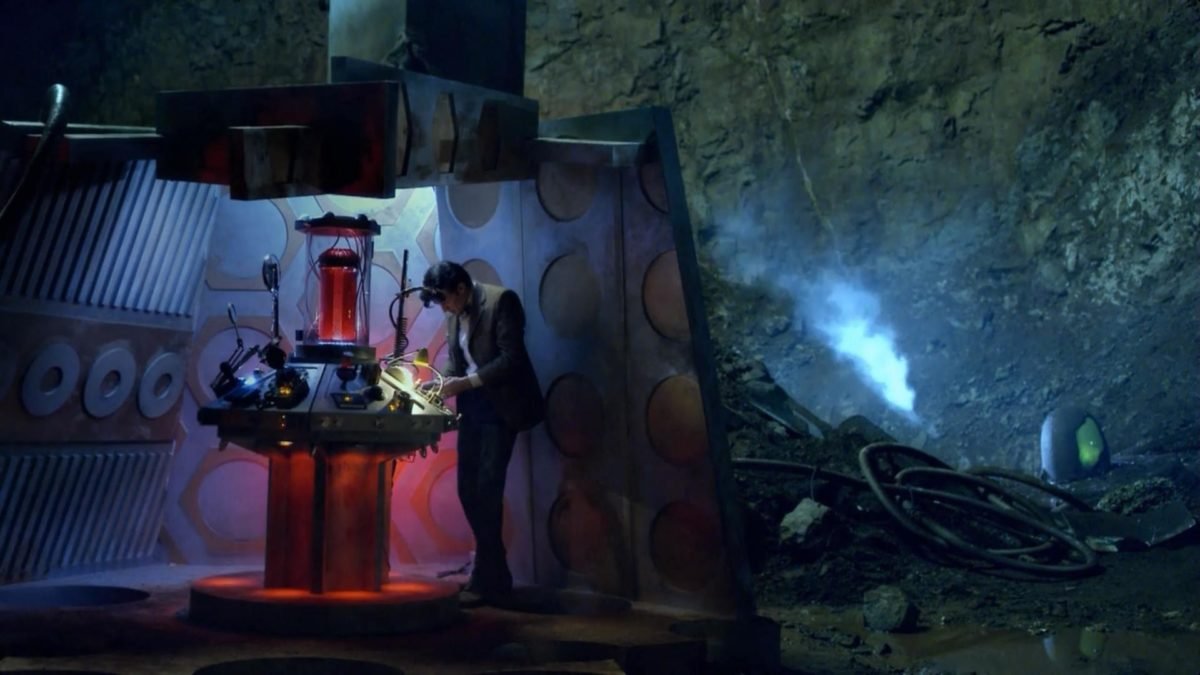
The introduction of this past companion (not that the audience or the Doctor knows that this is who they are yet) makes for a good pre-titles scene, and once she lands on a junkyard planet, she is almost immediately attacked. The inspiration from An Unearthly Child and The Doctor’s Wife is clear, and it makes it more Doctor Who-y. That’s certainly not a bad thing, but it ties this Doctor to the rest of the show’s lore and type of storytelling it had avoided until this point.
The science-fiction films of the early 1990s seems to most closely match the vibe of The Junkyard Loop, and rather distracting is Charlotte Palmer’s performance as ex-companion Sodalis. Her vocal register seems to change multiple times, which appears to be a change in how she was directed according to the behind-the-scenes interviews, since her actual acting is strong and she brings the character to life well. It’s her inputs that also flesh out the Fugitive Doctor, with a knowledge of what she was like before her memory was wiped by the Time Lords, and it’s fitting that this story comes on a planet which has bits of broken time machines everywhere. The parasitic threat on the planet’s surface isn’t used consistently, but adds a layer of ‘what’s actually happening here?’
Unfortunately, Alexander Vlahos then turns up as the stompy commander Zentorius to complete the job Cosmogon has failed to do, and it’s just a character who talks in big strokes of brashness while everyone else is getting intimate to some degree.
The Doctor’s bad knees come into play again (a bad back is partly what’s stopping more filmed Doctor Who with this incarnation), and both Martin and Krige get to shine before Zentorius goes all Spy Master and sounds utterly insane.
At least the listeners get a strong twist out of it, and it feels well timed for an advert break as explored in this review of the preceding boxset.
While an unconventional incarnation in some ways, the Fugitive Doctor is closest to the First Doctor in characterisation but with a moral compass that interjects her need for self-preservation in a notable way. She doesn’t set out to be heroic — she is, after all, on the run — but does get distracted when she sees a way to help out, even with a non-intervention mindset. Leading by example matters to her, and this is explored with her ex-companion who has been on pure survival mode for many years. The Junkyard Loop can be summed up as a tale of morals, companionship, and a bit of Aliens.
Zentorius’ actions impact Cosmogon more than anyone else, but then there is another twist at the end which leaves a key character mark on the Doctor and sets up the final episode, Hereafter.
Cosmo, as she is otherwise known, is not cynical and the Doctor is not naïve, which is basically the thread that runs through the series finale.
Hereafter comes from the reliable hands of Tim Foley, who already has experience of writing for the Fugitive Doctor, and he opts for a much slower pace of storytelling with the instructions he was given from the script editor.

It’s primarily an exploration of Cosmo’s motivations for working on behalf of Division, looking at the relationship with her anti-authority father and how she tried to cement and protect herself by embedding into the very authoritative system of Gallifreyan society.
Howard Carter’s sound design was added to the recording while the actors were delivering their lines, and you can tell it was appreciated by cast and crew both in the behind-the-scenes material and in the performances given.
While Hereafter begins with the premise of Cosmo chasing the Doctor again, it beautifully walks its way (literally) to a very different place. For a period of time, the Doctor is handcuffed, so all she can use really is her words, and that’s still enough to rattle Cosmo. The scene transitions are so clean, and it’s often what goes unsaid that allows the listener (but not necessarily the Doctor) to read more into Cosmo and her fragility.
The choice of setting works to its strengths structurally, since it is a pace-setter, and there are enough details for efficient world-building, but the focus remains on the core characters throughout, which includes Abbie Andrews as local girl Herma.
Without spoiling the adventure they go on, there is a creature from the dark times they must face and it is used rather differently to their return in another Big Finish release with links to this era. The stakes do get high, and conceptually, there is some great stuff, executed well, but the way the main villain faces off with the Doctor suffers a similar issue to the preceding story because the character with the biggest presence takes attention away from the quiet moments where the best drama is taking place.
The sound design and musical cues are brilliant, and such strong production elements are key to pulling off some of the concepts in Hereafter, and the final scenes set up what’s next for the Doctor, Cosmo, and Herma. Krige describes her role as a piece of music in its evolution across the series, and she isn’t wrong.
It’s a lovely ending, setting up what feels like would have been an arc to a second series or at least a longer first one. Alas, it was not to be, and now we have Circuit Breaker to look forward to.
“Not the end of the chase, but after this, it can never be the same again.”
The Fugitive Doctor Adventures: Dead or Alive is available now from Big Finish.