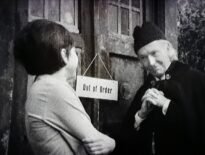
Peter Capaldi stated during a recent interview that, in Doctor Who, he thought that regeneration in general had become diminished. It used to be a noteworthy event. Something quite special.
During the classic series, there were only five regenerations shown over the course of 26 seasons. The William Hartnell to Patrick Troughton change was more of a shaky experiment, and not even referred to as regeneration, but “renewal”. But it basically still was a regeneration. With Troughton’s swansong, we didn’t even see it, although we know it eventually happened. This time, it was mentioned only as changing his appearance, and they skipped it. And no, the silly, tacked-on regen scene in the butchered War Games edit may be part Russell T Davies’ head canon, but that’s all it is: more misguided fan fiction, better ignored, like so many recent developments.
It was with Jon Pertwee that the word “regeneration” finally came in, and we saw his, then Tom Baker’s, Peter Davison’s, and finally Colin Baker’s into Sylvester McCoy (well, there was a wig present). Five regenerations shown in 26 years.
The Wilderness years stretched out over 16 years and all we had to show for it was one so-so TV Movie, one regeneration, and one new Doctor in Paul McGann.
Then came the revival, 21st Century Who, where, at the end of his one and only series, Christopher Eccleston burst into a raging torrent of regeneration energy, becoming David Tennant. I think it’s safe to say that, up until this point, regeneration was still a pretty big deal. Even more so for new fans who had no idea what was happening there. It was a bold and enlightening statement about what happens to this character called the Doctor.
Then, things slowly started to change, with showrunner Russell T Davies deciding to play with regeneration energy a bit. Do something a bit different, specifically with how the energy is used. He kicked it off with Tennant regenerating his severed hand, a bit like a lizard. This just started the trend of different, clever uses of regeneration energy. At the end of Series 4, Tennant actually shoves the energy into that aforementioned hand (it having been kept in a jar by Captain Jack Harkness… for some reason).
Then, the energy bonded with Donna and formed a brand new meta-crisis Doctor. And by the end of the 2009 specials, after whining a bit, Tennant literally exploded with even more powerful regeneration energy that partially destroys his TARDIS. This seems a bit unproductive, having your life-renewing energy destroy your mobile space home, but Davies has always liked spectacle. Some might even say at the expense of more important things. But I digress.

Thus began a litany of scenes using regeneration or regeneration energy more and more each season. Here’s the (I hope) entire list since the revival:
- Eccleston regenerates into Tennant (The Parting of the Ways)
- Tennant regrows his hand after one is cut off (The Christmas Invasion)
- Prof. Yana into Master (Utopia)
- Tennant into his discarded hand (Journey’s End)
- Donna forms meta-crisis Tennant (also Journey’s End)
- Tennant into Matt Smith (The End of Time)
- Teselecta on the beach (The Impossible Astronaut, revisited primarily in The Wedding of River Song)
- Young Melody in an alley (Day of the Moon)
- Mel into River Song (Let’s Kill Hitler)
- River saving Smith (Let’s Kill Hitler)
- Smith healing River (The Angels Take Manhattan)
- McGann into Hurt (The Night of the Doctor)
- Hurt to Eccleston (The Day of the Doctor)
- Smith destroying the Dalek army (The Time of the Doctor)
- Smith into Peter Capaldi (The Time of the Doctor)
- Capaldi helping/tricking Davros (The Witch’s Familiar)
- Capaldi tricking Bill Potts (The Lie of the Land)
- Capaldi shoots the General, he regenerates (Hell Bent)
- Capaldi fights against it in cold open (World Enough and Time)
- Capaldi fighting back against it (The Doctor Falls)
- Bradley’s First Doctor/Hartnell into Patrick Troughton (Twice Upon a Time)
- Capaldi into Jodie Whitaker (Twice Upon a Time)
- Minimum six kids experimented on, and forced to regenerate by Tecteun (The Timeless Children)
- CyberLords regenerating (The Power of the Doctor)
- Whitaker into the Master (The Power of the Doctor)
- The Master back into Whitaker (The Power of the Doctor)
- Whitaker into Tennant (The Power of the Doctor)
- Tennant bigeneration with Ncuti Gatwa (The Giggle)
- Flood bigeneration with Rani (The Interstellar Song Contest)
- Gatwa into Billie Piper (The Reality War)
That’s a whopping 35 times in 15 revival seasons, as opposed to five times in the first 26 seasons.

That’s leaving out the occasional whisper breath of energy post-regeneration. And it’s very possible that I’ve missed some bits, but you get the picture. Regeneration and its energy have both become so run-of-the-mill, there’s little to no real excitement left. This is not to say all the times it’s applied have been bad. Not at all. Using it to heal was a nice touch. Bigeneration, and all the logistical problems: that brings up though, or maybe not.
Referring back to the sheer destructive quality of regeneration energy… Smith being able to use it to destroy the Dalek fleet came in handy when he was on his way out, but Tennant destroying his own TARDIS was a bit silly. We must assume the Doctor has no control over its intensity, which could be quite problematic.
Another factor is the Time Lord’s current turnover rate. On one hand, no actor manages to stay more than three seasons anymore. Tennant, Smith, and Capaldi all could have had fourth seasons — all of them, but the Beeb went cheap and either stretched out seasons, replaced them with a few specials, or just had a gap year to waste time/save money. Whittaker lasted only three short seasons in five years, because that’s how then-showrunner Chris Chibnall constructed his contract, so more wasted time there. There never has been a real “three-year rule”; just a corporation that likes to use that excuse to save money. The Disney plan, in Davies’ mind anyway, was supposed to go at least four seasons, but we saw how that turned out.
The other massive development to trivialise regeneration was, of course, the Timeless Child. An idea developed possibly during a fever dream in the five-year-old brain of Chibnall after jumping to conclusions while watching The Brain of Morbius. The Timeless Child not only divided fandom; it made regeneration utterly meaningless. This new version of the Doctor can never truly die now. At the very least, the character is nearly impossible to destroy.
The development meant that the Doctor is now more of an immortal god who’s never really in danger of dying, thus sucking out a lot of the danger and suspense in certain situations. At least for the Doctor. I suppose the companions are still legit cannon fodder.
So yes, Mr Capaldi is correct. Regeneration is now so common, it means very little, and that’s unfortunate. Let’s hope that when the show does come back, they stay away from a lot of that type of baggage, like non-stop regenerations and the revolving door.